 Do fundo do mar... Sea bottom

Monday, August 30, 2004
"Empress of Ireland"
______________________________________________________________________________________
After being struck by a Norwegian freighter on May 29, 1914,
the passenger liner Empress of Ireland sank in the St. Lawrence River,
near Rimouski, killing 1,012 people.
MIRO CERNETIG
Rimouski, Que.—Right about now, Rob Rondeau is crossing the prairie, rattling westward through the wheat fields in a red van stuffed with a valuable collection of Canada's heritage: Wreckage from the Empress of Ireland, the Canadian Pacific passenger liner that sunk to the bottom of the St. Lawrence River 90 years ago, killing 1,012 people.
He, and some others, are doing what the federal and Quebec governments won't. They're buying up historically valuable artifacts treasure-hunters have scavenged off Canada's worst-ever shipwreck for most of the last 30 years. Rondeau's aim is to keep the ship's remains from being bought up, piece by piece, by private collectors, who most likely would keep them in their homes or ship them off to the United States and Europe, where they would probably be lost to Canada's museums forever.
"This is our Titanic and I don't want to see Canada lose it," says the 40-year-old commercial diver, standing on a dock in Rimouski, leading to the wind-whipped waters of the St. Lawrence River. It's more than 45 kilometres wide here, a big and treacherous stretch of water that has swallowed dozens of vessels over the years.
"We've already lost a lot of history from this wreck," laments Rondeau, who retired from full-time commercial diving to concentrate on documenting and preserving shipwrecks. "There's stuff from the Empress of Ireland that's disappeared into basements up and down this coast and been hidden in warehouses all over the world. Somebody's got to do something to save what we still can, while we still can. This is a forgotten ship, a forgotten part of our history."
A powerfully built man, Rondeau's got the thick, calloused fingers deep-sea divers develop from 20 years of lugging around heavy oxygen tanks and working wrenches far beneath the ocean, keeping oil rigs afloat and undersea pipelines flowing. But he's also a trained marine archaeologist and displays a delicate touch as he holds a perfectly preserved porcelain plate, from the Empress of Ireland's first-class dining room, which he is packing in bubble wrap for the trip to Alberta, destined for a museum exhibit.
He deposits it into his van, now filling up with other treasures from the Empress' last voyage, which he's bought from local Quebec divers who have "worked" the rusting wreck. There's the brass radio phone on which the crew likely sent out its calls for help; he's paid $1,000 for a wine bottle, purchased the finger bowls, candle holders and a lasagna dish from the last meal in the wood panelled first-class dining room. There's even a brass bugle, from the ship's dance band, which unlike the Titanic's, didn't have time to strike up as the ship went down.
"It's a long drive to get these out West," says Rondeau, thumping shut his 15-year-old van's door, ready to start his dawn-to-dusk trek to Alberta. "It takes me 4 1/2 days from Rimouski to Alberta. That's about $800 in gas each way. I sleep in the van at truck stops. So I never actually let the artifacts out of my sight. And I've got my shotgun in the back. They'll be safe."
On May 29, 1914, people were understandably more worried about lost lives than the lost treasures left on the Empress of Ireland.
Shortly before 2 a.m., having steamed past Rimouski on a six-day voyage bound for Liverpool, the 548-foot-long Empress found itself facing down a Norwegian freighter, the Storstad, coming upriver laden with a cargo of coal. After the sinking of the Titanic in 1912, caution prevailed aboard ocean liners like the Empress, which had been outfitted with extra lifeboats. Captain Henry George Kendall anticipated a routine passing in the night.
Then, one of the St. Lawrence's thick and unpredictable "phantom fogs" descended on the river. Minutes passed, with each ship blindly feeling its way through the mist, sounding their foghorns. It wasn't enough.
Without today's radar or ship-to-ship communications, the snub-nosed prow of the coal freighter suddenly emerged from the mist. There was no time for the Empress to veer out of the way as the Storstad sliced through its side. It was so clean and quick a cut through the Empress's steel hull, some survivors reported feeling only a nudge and chose to remain in their bunks.
But a gaping hole had been punched into the ocean liner. The cold, black water of the St. Lawrence flooded in at more than 200,000 litres per second. The ship rolled to its side, becoming a death trap for those below. Within 14 minutes, at 2:09 a.m., the Empress sank, killing all but 465 of its 1,477 passengers.
When divers went down a few months later, to recover bodies and salvage the millions in gold and silver in the ship's safe, they were horrified to see the heads of people sticking out of the portholes. To escape the rising black water, passengers had tried to wedge their bodies through the narrow, brass portholes, the last part of the ship offering passage to the surface before she sank 37 metres to the bottom of the St. Lawrence.
News of the disaster flashed around Canada and the world. But too soon, it seemed to drift out of most people's minds.
The Titanic, sunk by an iceberg on its maiden voyage, had been a bigger tragedy and settled in the public mind of what could go wrong at sea. The Canadian Pacific, which made a fortune on its reputation of offering safe passage across the Atlantic and Pacific oceans, did its best to downplay the sinking. And the world was on the brink of war, offering new tragedies for Canadians to ponder.
"I only started to get involved in this when I was watching Peter Mansbridge, on the CBC," says Marion Kelch, a retired schoolteacher from Czar, Alta., who is leading the fight to save the artifacts. "There was this report about somebody selling off the biggest collection of Empress artifacts to someone in the United States. And I just thought, `This is wrong. How can we allow this priceless history to leave Canada?'"
Kelch struck up the Empress of Ireland Artifacts Committee, beginning a grassroots campaign that soon attracted people from across the country. "This was an immigration ship," she explains, "so there are people all over Canada, especially the West, who have descendants who sailed on her to Canada. It's a ship, and a story, that touches many families."
Indeed, the Empress tragedy is still remembered each year by the Salvation Army, which lost as many as 200 members of its Toronto band who were on their way to Britain.
"This is part of the fabric of our land," says Karl Larson, who works in the Army's heritage archives. "It's important that they remember this and important that we protect this history for the future. I think these artifacts should be in the Museum of Civilization."
Kelch quickly found out that the collection destined for the U.S. belonged to Philippe Beaudry, one of a small group of elite Quebec divers who started diving the Empress wreck decades ago, long before the 1999 decision by the Quebec government to outlaw treasure hunting on the wreck. It was a time before "archaeological sensitivity," when divers would emerge from the river, with 60-year-old bottles of champagne from the Empress' wine cellar, some of which they would crack open and guzzle in celebration.
Beaudry, amongst the best of the era's divers, managed to amass what is considered the most impressive Empress collection — more than 500 artifacts, including the prize of every major shipwreck: The brass bell.
A few years ago, Beaudry says, he felt the pinch of retirement looming. It was time to collect on his bounty and those years of diving. He decided he would sell his collection, now resting in a storage depot outside of Montreal, to a U.S. collector for $1.5 million. The bell alone would be appraised at a cool $1 million.
After years of the wreck being pillaged with little protest, the prospective sale ignited a firestorm. Ottawa initially blocked it, requiring that Beaudry apply for an export permit and give Canadian museums the first chance to buy his collection.
To encourage that, the federal government said it would kick in $750,000 to purchase the collection, providing that the Musée de la Mer, a museum near Rimouski with a small collection of Empress of Ireland artifacts, would raise the other half.
"We couldn't get the money from the Quebec government," said Annemarie Bourassa, the museum's assistant director. "It's strange. The Quebec government was willing to pay for Maurice Richard (collectibles) that were being sold to the United States. But they didn't help us with this."
That meant Beaudry was free to sell to the U.S. But by then, to the delight of Kelch, the sale had fallen through.
Today, Beaudry is trying to sell the collection off piece by piece to people in Canada, and he chuckles at the irony that Kelch and her committee are now his biggest customer. So far, Kelch has managed to raise $25,000 to buy a few dozen pieces that she plans to put on a "dinner on the Empress" display that she will take on a western tour that will end at the Vancouver Maritime Museum.
"I'm doing this all out of my own pocket," says the 63-year-old Kelch, who hopes to set up a public foundation. "I'm hoping to raise awareness and maybe embarrass the government into doing something."
Beaudry isn't optimistic that will work.
"The best thing I could do is put these artifacts back under a couple of thousand feet of water," he grumbles. "Believe me, the other divers around Rimouski have sold off thousands of artifacts to the United States. But because I have the best collection, it's been nothing but trouble for me. I risked my life putting this together and now I can't find a museum in Canada that wants to buy it."
The Empress of Ireland wreck, which has claimed the lives of at least six divers, can be a dangerous obsession, as Jean-Pierre Bouillon well knows.
On his first dive, he got tangled in the steel cables that still hang from the wreck, an underwater spider web hidden by the total blackness at the river bottom. He barely freed himself before his air ran out. On his last dive, in 1991, he was hit by the bends, the deadly build-up of nitrogen caused by surfacing too quickly. He was rushed to a decompression chamber, saving his life, but his legs are now partially paralyzed.
Leaning on a cane as he stands on the porch of his house, he can see the white buoy almost seven kilometres away that marks where the Empress went down. Boullion admits that over the years he was one of the divers who took the most out of the Empress. He unearthed bottles of 1907 champagne, still chilled by the St.
Lawrence. He banged out dozens of the ship's heavy, brass portholes, selling them to collectors, "but only to people who respected them, understood they were holy things."
Today, however, he's happy to see that the ship is protected. Things were getting out of hand.
"There were divers who wanted to come and blast the wreck, to get at things inside it," says Bouillon, who now runs a charter service for divers. "That would have destroyed the wreck. Now it's against the law to take things away."
But people still do, he concedes. This week, divers discovered a skull lodged inside a lifeboat has gone missing. His fear is that somebody has stolen it, as a gruesome souvenir.
"That's the dark side of diving," says Rondeau, who is meeting with Bouillon about buying some of his artifacts. "There are people who collect skulls. A guy in Florida offered me $5,000 if I got him one. It's pretty awful."
After his years of ripping things out of the Empress, Bouillon has now become something of a cultural nationalist himself. He wants to sell part of his own collection to Kelch's committee, saying "it would be good to let other Canadians see these things. It might bring them out here, to Rimouski, to see where it happened."
Opening up his basement door, Bouillon takes Rondeau into a cellar full of bottles and portholes from the Empress. He sells one blue-green bottle to Rondeau for $150, considered a bargain. A little later, Bouillon has a friend bring over another brass porthole that causes Rondeau's eyes to light up.
"It's perfect for our exhibit," he gushes.
But there's a price: $7,000 (U.S.).
"That's not bad," says Rondeau, already planning another trip to load up his van with history. "I'll be back in Rimouski next month. Maybe then we'll be able to pick this porthole up, too."
See article here.
Side scan sonar here.

©1997 KEN MARSCHALL, DETAIL FROM LOST LINERS,
MADISON PRESS BOOK
After being struck by a Norwegian freighter on May 29, 1914,
the passenger liner Empress of Ireland sank in the St. Lawrence River,
near Rimouski, killing 1,012 people.
MIRO CERNETIG
Rimouski, Que.—Right about now, Rob Rondeau is crossing the prairie, rattling westward through the wheat fields in a red van stuffed with a valuable collection of Canada's heritage: Wreckage from the Empress of Ireland, the Canadian Pacific passenger liner that sunk to the bottom of the St. Lawrence River 90 years ago, killing 1,012 people.
He, and some others, are doing what the federal and Quebec governments won't. They're buying up historically valuable artifacts treasure-hunters have scavenged off Canada's worst-ever shipwreck for most of the last 30 years. Rondeau's aim is to keep the ship's remains from being bought up, piece by piece, by private collectors, who most likely would keep them in their homes or ship them off to the United States and Europe, where they would probably be lost to Canada's museums forever.
"This is our Titanic and I don't want to see Canada lose it," says the 40-year-old commercial diver, standing on a dock in Rimouski, leading to the wind-whipped waters of the St. Lawrence River. It's more than 45 kilometres wide here, a big and treacherous stretch of water that has swallowed dozens of vessels over the years.
"We've already lost a lot of history from this wreck," laments Rondeau, who retired from full-time commercial diving to concentrate on documenting and preserving shipwrecks. "There's stuff from the Empress of Ireland that's disappeared into basements up and down this coast and been hidden in warehouses all over the world. Somebody's got to do something to save what we still can, while we still can. This is a forgotten ship, a forgotten part of our history."
A powerfully built man, Rondeau's got the thick, calloused fingers deep-sea divers develop from 20 years of lugging around heavy oxygen tanks and working wrenches far beneath the ocean, keeping oil rigs afloat and undersea pipelines flowing. But he's also a trained marine archaeologist and displays a delicate touch as he holds a perfectly preserved porcelain plate, from the Empress of Ireland's first-class dining room, which he is packing in bubble wrap for the trip to Alberta, destined for a museum exhibit.
He deposits it into his van, now filling up with other treasures from the Empress' last voyage, which he's bought from local Quebec divers who have "worked" the rusting wreck. There's the brass radio phone on which the crew likely sent out its calls for help; he's paid $1,000 for a wine bottle, purchased the finger bowls, candle holders and a lasagna dish from the last meal in the wood panelled first-class dining room. There's even a brass bugle, from the ship's dance band, which unlike the Titanic's, didn't have time to strike up as the ship went down.
"It's a long drive to get these out West," says Rondeau, thumping shut his 15-year-old van's door, ready to start his dawn-to-dusk trek to Alberta. "It takes me 4 1/2 days from Rimouski to Alberta. That's about $800 in gas each way. I sleep in the van at truck stops. So I never actually let the artifacts out of my sight. And I've got my shotgun in the back. They'll be safe."
On May 29, 1914, people were understandably more worried about lost lives than the lost treasures left on the Empress of Ireland.
Shortly before 2 a.m., having steamed past Rimouski on a six-day voyage bound for Liverpool, the 548-foot-long Empress found itself facing down a Norwegian freighter, the Storstad, coming upriver laden with a cargo of coal. After the sinking of the Titanic in 1912, caution prevailed aboard ocean liners like the Empress, which had been outfitted with extra lifeboats. Captain Henry George Kendall anticipated a routine passing in the night.
Then, one of the St. Lawrence's thick and unpredictable "phantom fogs" descended on the river. Minutes passed, with each ship blindly feeling its way through the mist, sounding their foghorns. It wasn't enough.
Without today's radar or ship-to-ship communications, the snub-nosed prow of the coal freighter suddenly emerged from the mist. There was no time for the Empress to veer out of the way as the Storstad sliced through its side. It was so clean and quick a cut through the Empress's steel hull, some survivors reported feeling only a nudge and chose to remain in their bunks.
But a gaping hole had been punched into the ocean liner. The cold, black water of the St. Lawrence flooded in at more than 200,000 litres per second. The ship rolled to its side, becoming a death trap for those below. Within 14 minutes, at 2:09 a.m., the Empress sank, killing all but 465 of its 1,477 passengers.
When divers went down a few months later, to recover bodies and salvage the millions in gold and silver in the ship's safe, they were horrified to see the heads of people sticking out of the portholes. To escape the rising black water, passengers had tried to wedge their bodies through the narrow, brass portholes, the last part of the ship offering passage to the surface before she sank 37 metres to the bottom of the St. Lawrence.
News of the disaster flashed around Canada and the world. But too soon, it seemed to drift out of most people's minds.
The Titanic, sunk by an iceberg on its maiden voyage, had been a bigger tragedy and settled in the public mind of what could go wrong at sea. The Canadian Pacific, which made a fortune on its reputation of offering safe passage across the Atlantic and Pacific oceans, did its best to downplay the sinking. And the world was on the brink of war, offering new tragedies for Canadians to ponder.
"I only started to get involved in this when I was watching Peter Mansbridge, on the CBC," says Marion Kelch, a retired schoolteacher from Czar, Alta., who is leading the fight to save the artifacts. "There was this report about somebody selling off the biggest collection of Empress artifacts to someone in the United States. And I just thought, `This is wrong. How can we allow this priceless history to leave Canada?'"
Kelch struck up the Empress of Ireland Artifacts Committee, beginning a grassroots campaign that soon attracted people from across the country. "This was an immigration ship," she explains, "so there are people all over Canada, especially the West, who have descendants who sailed on her to Canada. It's a ship, and a story, that touches many families."
Indeed, the Empress tragedy is still remembered each year by the Salvation Army, which lost as many as 200 members of its Toronto band who were on their way to Britain.
"This is part of the fabric of our land," says Karl Larson, who works in the Army's heritage archives. "It's important that they remember this and important that we protect this history for the future. I think these artifacts should be in the Museum of Civilization."
Kelch quickly found out that the collection destined for the U.S. belonged to Philippe Beaudry, one of a small group of elite Quebec divers who started diving the Empress wreck decades ago, long before the 1999 decision by the Quebec government to outlaw treasure hunting on the wreck. It was a time before "archaeological sensitivity," when divers would emerge from the river, with 60-year-old bottles of champagne from the Empress' wine cellar, some of which they would crack open and guzzle in celebration.
Beaudry, amongst the best of the era's divers, managed to amass what is considered the most impressive Empress collection — more than 500 artifacts, including the prize of every major shipwreck: The brass bell.
A few years ago, Beaudry says, he felt the pinch of retirement looming. It was time to collect on his bounty and those years of diving. He decided he would sell his collection, now resting in a storage depot outside of Montreal, to a U.S. collector for $1.5 million. The bell alone would be appraised at a cool $1 million.
After years of the wreck being pillaged with little protest, the prospective sale ignited a firestorm. Ottawa initially blocked it, requiring that Beaudry apply for an export permit and give Canadian museums the first chance to buy his collection.
To encourage that, the federal government said it would kick in $750,000 to purchase the collection, providing that the Musée de la Mer, a museum near Rimouski with a small collection of Empress of Ireland artifacts, would raise the other half.
"We couldn't get the money from the Quebec government," said Annemarie Bourassa, the museum's assistant director. "It's strange. The Quebec government was willing to pay for Maurice Richard (collectibles) that were being sold to the United States. But they didn't help us with this."
That meant Beaudry was free to sell to the U.S. But by then, to the delight of Kelch, the sale had fallen through.
Today, Beaudry is trying to sell the collection off piece by piece to people in Canada, and he chuckles at the irony that Kelch and her committee are now his biggest customer. So far, Kelch has managed to raise $25,000 to buy a few dozen pieces that she plans to put on a "dinner on the Empress" display that she will take on a western tour that will end at the Vancouver Maritime Museum.
"I'm doing this all out of my own pocket," says the 63-year-old Kelch, who hopes to set up a public foundation. "I'm hoping to raise awareness and maybe embarrass the government into doing something."
Beaudry isn't optimistic that will work.
"The best thing I could do is put these artifacts back under a couple of thousand feet of water," he grumbles. "Believe me, the other divers around Rimouski have sold off thousands of artifacts to the United States. But because I have the best collection, it's been nothing but trouble for me. I risked my life putting this together and now I can't find a museum in Canada that wants to buy it."
The Empress of Ireland wreck, which has claimed the lives of at least six divers, can be a dangerous obsession, as Jean-Pierre Bouillon well knows.
On his first dive, he got tangled in the steel cables that still hang from the wreck, an underwater spider web hidden by the total blackness at the river bottom. He barely freed himself before his air ran out. On his last dive, in 1991, he was hit by the bends, the deadly build-up of nitrogen caused by surfacing too quickly. He was rushed to a decompression chamber, saving his life, but his legs are now partially paralyzed.
Leaning on a cane as he stands on the porch of his house, he can see the white buoy almost seven kilometres away that marks where the Empress went down. Boullion admits that over the years he was one of the divers who took the most out of the Empress. He unearthed bottles of 1907 champagne, still chilled by the St.
Lawrence. He banged out dozens of the ship's heavy, brass portholes, selling them to collectors, "but only to people who respected them, understood they were holy things."
Today, however, he's happy to see that the ship is protected. Things were getting out of hand.
"There were divers who wanted to come and blast the wreck, to get at things inside it," says Bouillon, who now runs a charter service for divers. "That would have destroyed the wreck. Now it's against the law to take things away."
But people still do, he concedes. This week, divers discovered a skull lodged inside a lifeboat has gone missing. His fear is that somebody has stolen it, as a gruesome souvenir.
"That's the dark side of diving," says Rondeau, who is meeting with Bouillon about buying some of his artifacts. "There are people who collect skulls. A guy in Florida offered me $5,000 if I got him one. It's pretty awful."
After his years of ripping things out of the Empress, Bouillon has now become something of a cultural nationalist himself. He wants to sell part of his own collection to Kelch's committee, saying "it would be good to let other Canadians see these things. It might bring them out here, to Rimouski, to see where it happened."
Opening up his basement door, Bouillon takes Rondeau into a cellar full of bottles and portholes from the Empress. He sells one blue-green bottle to Rondeau for $150, considered a bargain. A little later, Bouillon has a friend bring over another brass porthole that causes Rondeau's eyes to light up.
"It's perfect for our exhibit," he gushes.
But there's a price: $7,000 (U.S.).
"That's not bad," says Rondeau, already planning another trip to load up his van with history. "I'll be back in Rimouski next month. Maybe then we'll be able to pick this porthole up, too."
See article here.
Side scan sonar here.
©1997 KEN MARSCHALL, DETAIL FROM LOST LINERS,
MADISON PRESS BOOK


Doomsday wreck in Thames could blow - The "Richard Montgomery"
______________________________________________________________________________________
Mick Hamer
NewScientist.com news service
Unstable fuses could cause unsalvaged World War II bombs aboard an abandoned shipwreck in the river Thames, UK, to blow, reveal investigations by New Scientist.
For 60 years the people of Sheerness in Kent have been living next door to a 1400-tonne time bomb. A lethal mixture of unstable second world war bombs is in the rusting wreck of the Richard Montgomery, a US cargo ship that lies half-submerged on a sandbank in the Thames, only two kilometres from the Kentish town.
If the wreck explodes it will be one of the biggest non-nuclear explosions ever. The cargo contains a mixture of fused and unfused bombs that were destined to support the Allied push in France following the D-Day landings.
For the first time a New Scientist investigation has established that UK government explosives experts believe that some of the fuses are unstable. Even a small shock could cause one of them to detonate, setting off part or all of the rest of the cargo.
Deadly cargo
The investigation has uncovered official estimates of the devastation that the explosion would cause, including predictions of a three kilometre high column of water, mud, metal and munitions sent into the air by the blast.
Five years ago the government asked independent consultants to carry out a risk assessment of the wreck. The consultants said that the safest course of action would be to remove the wreck's deadly cargo.
In 2001 the government held a meeting in Southampton to discuss what should be done about the wreck. But three years later this risk assessment remains unpublished and the Richard Montgomery remains on its sandbank, slowly rusting.
Full exclusive details are published in New Scientist print edition, 21 August.
Article.
Related article here and here (sonar images).

Mick Hamer
NewScientist.com news service
Unstable fuses could cause unsalvaged World War II bombs aboard an abandoned shipwreck in the river Thames, UK, to blow, reveal investigations by New Scientist.
For 60 years the people of Sheerness in Kent have been living next door to a 1400-tonne time bomb. A lethal mixture of unstable second world war bombs is in the rusting wreck of the Richard Montgomery, a US cargo ship that lies half-submerged on a sandbank in the Thames, only two kilometres from the Kentish town.
If the wreck explodes it will be one of the biggest non-nuclear explosions ever. The cargo contains a mixture of fused and unfused bombs that were destined to support the Allied push in France following the D-Day landings.
For the first time a New Scientist investigation has established that UK government explosives experts believe that some of the fuses are unstable. Even a small shock could cause one of them to detonate, setting off part or all of the rest of the cargo.
Deadly cargo
The investigation has uncovered official estimates of the devastation that the explosion would cause, including predictions of a three kilometre high column of water, mud, metal and munitions sent into the air by the blast.
Five years ago the government asked independent consultants to carry out a risk assessment of the wreck. The consultants said that the safest course of action would be to remove the wreck's deadly cargo.
In 2001 the government held a meeting in Southampton to discuss what should be done about the wreck. But three years later this risk assessment remains unpublished and the Richard Montgomery remains on its sandbank, slowly rusting.
Full exclusive details are published in New Scientist print edition, 21 August.
Article.
Related article here and here (sonar images).
WXTide32 - a free Windows tide and current prediction program
______________________________________________________________________________________
Web site:
Visit the WXTide32 web site
Author:
Mike Hopper
WXTide32 is a FREE 32-bit Windows (9x/NT4/2k/ME/XP) program for predicting tides from 1970 to 2038.
The included database has tide data for around 8,500 locations worldwide and tidal current data for about 100 locations in North America.
Any number of user (custom) stations can be configured. Predictions can be displayed graphically or in any of several text formats including daily tide lists and month tide calendars.
The program is self-contained and has context sensitive help and extensive options to customize the content, display and presentation of data. Program source code in "C" is included.
Version 4.0 adds a new User Station Manager, nearest station command line option, and an updated database with U.K. Ireland and Scotland stations.
Link:
http://simtel.net/pub/pd/57988.html - also downloadable here

Web site:
Visit the WXTide32 web site
Author:
Mike Hopper
WXTide32 is a FREE 32-bit Windows (9x/NT4/2k/ME/XP) program for predicting tides from 1970 to 2038.
The included database has tide data for around 8,500 locations worldwide and tidal current data for about 100 locations in North America.
Any number of user (custom) stations can be configured. Predictions can be displayed graphically or in any of several text formats including daily tide lists and month tide calendars.
The program is self-contained and has context sensitive help and extensive options to customize the content, display and presentation of data. Program source code in "C" is included.
Version 4.0 adds a new User Station Manager, nearest station command line option, and an updated database with U.K. Ireland and Scotland stations.
Link:
http://simtel.net/pub/pd/57988.html - also downloadable here
Plant Pollen Pinpoints Shipwreck Origins
______________________________________________________________________________________

A Pollen Grain
By Rossella Lorenzi, Discovery News
Pollen analysis could provide ancient shipwrecks with rather reliable birth certificates, according to French research.
The study focused on pollen grains trapped in the sticky resins used to seal the joints of ship's boards and sometimes even to cover the entire hulls.
"Local pollen would become incorporated into the ship as it is being built. This can provide important clues in order to deduce the shipyard's geographical origins," Serge Muller of the University of Montpellier-2 in France told Discovery News.
According to his study, pollen analysis can show key information more reliably than timber analysis. Since the wood was often imported and may predate the ship's construction, beams have proven largely useless in pinpointing where a wreck was originally built.
Muller used his identification technique to trace the origins of three ancient wrecks located in the French Golfe du Lion: the Baie-de-l'Amitié, the Cap-Be'ar III and the Port-la-Nautique.
Baie-de-l'Amitié is a 2,000-year-old wreck that now lies 150 meters (492 feet) from the beach near Cap d'Agde in a rocky hollow at a depth of 3 meters (10 feet). Of the three wrecks, its origins turned out to be different than thought.
"The occurrence of Platanus pollen in the three resin samples of the Baie-de-l'Amitié wreck, in relation to the wood pieces, strongly suggests a shipyard localized east of southern Italy, which represents the western boundary of Platanus orientalis range," Muller writes in the current issue of the Journal of Archaeological Science.
Muller also found pollen grains from Haplophyllum, a species which does not exist in France. The presence of this weed, seven species of which live in Europe, among which six grow in the eastern Mediterranean, "may be considered as supplementary evidence in favor of the eastern Mediterranean origin of the Baie-de-l'Amitié wreck," concluded Muller.
"Palynology (the study of plant pollens) offers innumerable opportunities to archaeologists, and has been widely used to trace the origins and history of various items. But as far as I know, this is the first time that pollen analysis has been applied to pinpoint geographical areas for ancient shipyards," Marta Mariotti of Florence University's department of vegetable biology told Discovery News.
Mariotti has recently analyzed the clay sediments from archaeological excavations in the ancient port of Pisa. The study showed that most likely the ships embedded in the clay were built just around Pisa.
Though pollen and resin analysis can offer reliable clues to trace shipwrecks' roots, there is always a risk of contamination, especially if the resin has been imported, according to Mariotti.
Muller's method will be used soon by archaeologists from the Faculté de St-Jérôme, Marseille, on other Mediterranean antique shipwrecks.
Robert Hohlfelder, an archaeologist at the University of Colorado, Boulder, also hopes to use the technique. The archaeologist is looking for the remains of the Persian fleet that sank off Greece in 492 B.C. More than 1,000 ships, which were supposed to invade Greece, are thought to lie 100 meters (328 feet) beneath the sea.
"If we find any ships with resin as caulking, I would be delighted to see what results could be obtained by Muller's techniques. Any new scientific techniques that expand our ability to better understand archaeological data are always most welcome," Hohlfelder told Discovery News.
Link:
http://dsc.discovery.com/news/briefs/20040202/pollen.html
http://www.histarmar.com.ar/HYAMNEWS/HyamNews2004/HY14-04%20Napoles-Polen-proyecto.htm - In Spanish
Bibliography:
Muller, S. D. Palynological study of antique shipwrecks from the western Mediterranean Sea, France. Journal of Archaeological Science, 31, 343 - 349, doi:10.1016/j.jas.2003.09.005 (2004).
A Pollen Grain
By Rossella Lorenzi, Discovery News
Pollen analysis could provide ancient shipwrecks with rather reliable birth certificates, according to French research.
The study focused on pollen grains trapped in the sticky resins used to seal the joints of ship's boards and sometimes even to cover the entire hulls.
"Local pollen would become incorporated into the ship as it is being built. This can provide important clues in order to deduce the shipyard's geographical origins," Serge Muller of the University of Montpellier-2 in France told Discovery News.
According to his study, pollen analysis can show key information more reliably than timber analysis. Since the wood was often imported and may predate the ship's construction, beams have proven largely useless in pinpointing where a wreck was originally built.
Muller used his identification technique to trace the origins of three ancient wrecks located in the French Golfe du Lion: the Baie-de-l'Amitié, the Cap-Be'ar III and the Port-la-Nautique.
Baie-de-l'Amitié is a 2,000-year-old wreck that now lies 150 meters (492 feet) from the beach near Cap d'Agde in a rocky hollow at a depth of 3 meters (10 feet). Of the three wrecks, its origins turned out to be different than thought.
"The occurrence of Platanus pollen in the three resin samples of the Baie-de-l'Amitié wreck, in relation to the wood pieces, strongly suggests a shipyard localized east of southern Italy, which represents the western boundary of Platanus orientalis range," Muller writes in the current issue of the Journal of Archaeological Science.
Muller also found pollen grains from Haplophyllum, a species which does not exist in France. The presence of this weed, seven species of which live in Europe, among which six grow in the eastern Mediterranean, "may be considered as supplementary evidence in favor of the eastern Mediterranean origin of the Baie-de-l'Amitié wreck," concluded Muller.
"Palynology (the study of plant pollens) offers innumerable opportunities to archaeologists, and has been widely used to trace the origins and history of various items. But as far as I know, this is the first time that pollen analysis has been applied to pinpoint geographical areas for ancient shipyards," Marta Mariotti of Florence University's department of vegetable biology told Discovery News.
Mariotti has recently analyzed the clay sediments from archaeological excavations in the ancient port of Pisa. The study showed that most likely the ships embedded in the clay were built just around Pisa.
Though pollen and resin analysis can offer reliable clues to trace shipwrecks' roots, there is always a risk of contamination, especially if the resin has been imported, according to Mariotti.
Muller's method will be used soon by archaeologists from the Faculté de St-Jérôme, Marseille, on other Mediterranean antique shipwrecks.
Robert Hohlfelder, an archaeologist at the University of Colorado, Boulder, also hopes to use the technique. The archaeologist is looking for the remains of the Persian fleet that sank off Greece in 492 B.C. More than 1,000 ships, which were supposed to invade Greece, are thought to lie 100 meters (328 feet) beneath the sea.
"If we find any ships with resin as caulking, I would be delighted to see what results could be obtained by Muller's techniques. Any new scientific techniques that expand our ability to better understand archaeological data are always most welcome," Hohlfelder told Discovery News.
Link:
http://dsc.discovery.com/news/briefs/20040202/pollen.html
http://www.histarmar.com.ar/HYAMNEWS/HyamNews2004/HY14-04%20Napoles-Polen-proyecto.htm - In Spanish
Bibliography:
Muller, S. D. Palynological study of antique shipwrecks from the western Mediterranean Sea, France. Journal of Archaeological Science, 31, 343 - 349, doi:10.1016/j.jas.2003.09.005 (2004).
Update - Searching for "Guerrero" - New article
______________________________________________________________________________________
Divers search for slave ship 'Guerrero' off Key Largo Florida
Powered by CDNN - CYBER DIVER News Networkby
JENNIFER BABSON
KEY LARGO, Florida (29 August 2004) -- It was a passage like thousands of others made in the shadow of an untamed island chain off Cuba -- 561 Africans shackled below, the Spanish ship that claimed them gliding under cover of darkness toward a colony still fueled by the slave trade.
On the night of Dec. 19, 1827, however, an otherwise routine haul of human cargo on the Spanish-flagged Guerrero turned into a shipwreck that archaeologists and others are literally trying to piece together nearly 200 years later...
Continues here.
Divers search for slave ship 'Guerrero' off Key Largo Florida
Powered by CDNN - CYBER DIVER News Networkby
JENNIFER BABSON
KEY LARGO, Florida (29 August 2004) -- It was a passage like thousands of others made in the shadow of an untamed island chain off Cuba -- 561 Africans shackled below, the Spanish ship that claimed them gliding under cover of darkness toward a colony still fueled by the slave trade.
On the night of Dec. 19, 1827, however, an otherwise routine haul of human cargo on the Spanish-flagged Guerrero turned into a shipwreck that archaeologists and others are literally trying to piece together nearly 200 years later...
Continues here.
China excavating ancient warships serving reclamation of Taiwan
______________________________________________________________________________________
Chinese archaeologists are excavating sunken warships used by Zheng Chenggong and his followers to reclaim Taiwan from Dutch occupiers more than three centuries ago.
The ruins of Zheng's fleet were found near Dongshan Island in east China's Fujian Province in 2000. But as long as ten years before, local people had found bowls, plates and other porcelain wares with the seals of Zheng Chenggong.
Local fishermen said they can see rusty cannons at ebb tide.
The excavation began on June 6 and is scheduled to finish by the end of September. It may last longer, though, if the sunken ships are found to be still intact, said Chen Liqun, a cultural official in Dongshan County.
Chen said that archaeologists have yet to determine how many ships are under water.
More than 20 underwater archaeologists from the National Museumin Beijing are working in Dongshan. They have discovered broken china pieces, cannonballs, grenades, iron blocks and muddy sand mixed with gun powder.
Archaeologist Lin Guo said that the ruins are located in a geologically complex area. Tides and typhoon also add to the difficulty in excavation.
Lin said that what they have found can help prove that Dongshan served as an important military training base for Zheng's troops.
Zheng Chenggong was born in 1624, the year Dutch invaders occupied Taiwan. His troops drove the invaders off the island in 1662. Zheng died on the island in the same year.
See article here.
Related articles here and here. And the story of Zheng Chenggong.

Zheng Chenggong.
Chinese archaeologists are excavating sunken warships used by Zheng Chenggong and his followers to reclaim Taiwan from Dutch occupiers more than three centuries ago.
The ruins of Zheng's fleet were found near Dongshan Island in east China's Fujian Province in 2000. But as long as ten years before, local people had found bowls, plates and other porcelain wares with the seals of Zheng Chenggong.
Local fishermen said they can see rusty cannons at ebb tide.
The excavation began on June 6 and is scheduled to finish by the end of September. It may last longer, though, if the sunken ships are found to be still intact, said Chen Liqun, a cultural official in Dongshan County.
Chen said that archaeologists have yet to determine how many ships are under water.
More than 20 underwater archaeologists from the National Museumin Beijing are working in Dongshan. They have discovered broken china pieces, cannonballs, grenades, iron blocks and muddy sand mixed with gun powder.
Archaeologist Lin Guo said that the ruins are located in a geologically complex area. Tides and typhoon also add to the difficulty in excavation.
Lin said that what they have found can help prove that Dongshan served as an important military training base for Zheng's troops.
Zheng Chenggong was born in 1624, the year Dutch invaders occupied Taiwan. His troops drove the invaders off the island in 1662. Zheng died on the island in the same year.
See article here.
Related articles here and here. And the story of Zheng Chenggong.
Zheng Chenggong.
Sunday, August 29, 2004
Tracking down Kad'yak - News update
______________________________________________________________________________________
by Diana Michelle Fox
An in-depth examination of a newly identified shipwreck in Alaska
On July 15, 2004, a mystery was finally put to rest when East Carolina University archaeologists identified the remains of a shipwreck that has been below Alaskan waters for 144 years. The identification of Kad'yak--the culmination of years of document compilation, translation from Russian, and proposal writing--was a triumph for those who worked on the discovery and recording of the vessel's remains. The find of Kad'yak is important scientifically, and it is so significant historically that it has already joined the National Register of Historic Places.
The 132-foot Russian American Company ship Kad'yak, a German-made vessel, was once a mighty three-masted freighter. In 1860, the ship was headed toward San Francisco from Woody Island in Kodiak, Alaska (Kodiak and Kad'yak come from the Alutiq word for island).
It was carrying more than 350 tons of ice to San Francisco so that the gold miners could enjoy cold beverages.
The ship never completed its journey, which would have taken two to three months. Along the way, it struck a rock and filled with water.
The ship's crew survived, but the vessel was lost. The ice kept it afloat for three days, and the ship's "corpse" drifted six miles until it eventually sank to the bottom of Monk's Lagoon on Spruce Island.
The loss of this vessel spawned a fascinating local myth, especially among those of the Russian Orthodox faith. Illarion Archimandritof, the captain of Kad'yak, had promised the governor of Russian America that he would pay homage to Saint Herman. The saint was the most important Russian Orthodox missionary who had converted the Native Alaskans.
Captain Archimandritof never kept his promise to go to Herman's chapel on the shore of Spruce Island. When Kad'yak sank, it was right in front of the chapel.
To feed the mythological tradition even further, the mainmast's top and a yardarm remained above the surface, forming the shape of a cross.
Even today, many locals, especially those of the village of Ouzinkie, where the chapel was located, see the sinking as an act of retribution by Father Herman, who had died in 1836.
Whether or not one believes that these coincidences were the results of divine intervention, we do indeed know that the wreck of Kad'yak is a physical reality and is near the spot of its demise as revealed in this legend.
The modern story of Kad'yak and the events leading to its discovery and identification begins in the late 1970s, when Mike Yarborough, now an archaeological consultant in Anchorage, found references to it in archives while researching a shipwreck in Cold Bay.
He and several others began to investigate the story and keep a file on the subject, eventually eliciting the help of Katherine Arndt of the University of Alaska, Fairbanks, to translate Russian documents into English.
For years, Yarborough's leads on the Kad'yak remained undeveloped, until a fortuitous meeting between Yarborough's wife and Bradley Stevens through their shared folk music hobby.
Upon learning about the wreck, Stevens, an Alaska-based marine biologist for the National Oceanic and Atmospheric Administration, took a great interest in the story, eventually gathering a volunteer team of divers who discovered the wreck in July of 2003. Only a year later a team of professional underwater archaeologists were brought in from East Carolina University who were able to identify the wreck for certain as the Kad'yak, thanks to an amazing find--a brass object that was possibly the hub of the ship's wheel.
It was inscribed with the ship's name in Cyrillic, telling archaeologists that the site they had found was indeed the Kad'yak.
The remains of the ship are located 80 feet below the surface of the water and scattered across a few hundred yards. Most noteworthy, however, is its preservation.
Before this summer's work on Kad'yak, which was primarily a survey rather than an excavation, many archaeologists thought that a wooden vessel would not be able to survive well in the rough Alaskan waters.
However, upon finding the remains of the ship, it seems that the cold water and anaerobic conditions have helped to keep the ship from deteriorating.
Since the work on the ship was a survey, few artifacts were removed. Archaeologists recovered just a few brass items, which are easier to conserve than iron objects. On the bottom, however, they identified three anchors, a ballast pile, deck braces, two cannons, and copper sheathing that once covered the ship's wood.
The artifacts that were removed are now being conserved in the lab facility of Alaska's department of archaeology being conserved.
Dave McMahan, state archaeologist at the Alaskan Department of Natural Resources, hopes to work with the local museums of Kodiak Island to develop exhibits with artifacts from Kad'yak.
Continued work on the site will depend on funding, and grant proposals are being submitted. This summer, the project was funded by the National Oceanic and Atmospheric Administration and the National Science Foundation.
For now, McMahan is working to ensure the integrity of the shipwreck site. Recreational diving is currently restricted in the area, and the East Carolina University archaeologists have a special permit to be able to work on the site. Alaska's State Department is also relying upon the people of Ouzinkie, the nearest village on the site, to notify authorities if they see anything suspicious.
No matter what the future of the wreck holds, Kad'yak's identification brought a local myth alive and solved a long-standing mystery. The Kad'yak project has been the first official maritime work in Alaska, and all involved hope that it will continue next year, paving the way for further underwater archaeological work in our 49th state and teaching us more about the history of Russian Alaska and the Russian American Company.
Diana Michelle Fox, a classics major at the University of Chicago, is an intern with ARCHAEOLOGY.
See article here. And the search for the Kad'yak here.
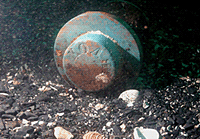
The identifying artifact of the Kad'yak wreck
(Courtesy Tane Casserley, NOAA)
by Diana Michelle Fox
An in-depth examination of a newly identified shipwreck in Alaska
On July 15, 2004, a mystery was finally put to rest when East Carolina University archaeologists identified the remains of a shipwreck that has been below Alaskan waters for 144 years. The identification of Kad'yak--the culmination of years of document compilation, translation from Russian, and proposal writing--was a triumph for those who worked on the discovery and recording of the vessel's remains. The find of Kad'yak is important scientifically, and it is so significant historically that it has already joined the National Register of Historic Places.
The 132-foot Russian American Company ship Kad'yak, a German-made vessel, was once a mighty three-masted freighter. In 1860, the ship was headed toward San Francisco from Woody Island in Kodiak, Alaska (Kodiak and Kad'yak come from the Alutiq word for island).
It was carrying more than 350 tons of ice to San Francisco so that the gold miners could enjoy cold beverages.
The ship never completed its journey, which would have taken two to three months. Along the way, it struck a rock and filled with water.
The ship's crew survived, but the vessel was lost. The ice kept it afloat for three days, and the ship's "corpse" drifted six miles until it eventually sank to the bottom of Monk's Lagoon on Spruce Island.
The loss of this vessel spawned a fascinating local myth, especially among those of the Russian Orthodox faith. Illarion Archimandritof, the captain of Kad'yak, had promised the governor of Russian America that he would pay homage to Saint Herman. The saint was the most important Russian Orthodox missionary who had converted the Native Alaskans.
Captain Archimandritof never kept his promise to go to Herman's chapel on the shore of Spruce Island. When Kad'yak sank, it was right in front of the chapel.
To feed the mythological tradition even further, the mainmast's top and a yardarm remained above the surface, forming the shape of a cross.
Even today, many locals, especially those of the village of Ouzinkie, where the chapel was located, see the sinking as an act of retribution by Father Herman, who had died in 1836.
Whether or not one believes that these coincidences were the results of divine intervention, we do indeed know that the wreck of Kad'yak is a physical reality and is near the spot of its demise as revealed in this legend.
The modern story of Kad'yak and the events leading to its discovery and identification begins in the late 1970s, when Mike Yarborough, now an archaeological consultant in Anchorage, found references to it in archives while researching a shipwreck in Cold Bay.
He and several others began to investigate the story and keep a file on the subject, eventually eliciting the help of Katherine Arndt of the University of Alaska, Fairbanks, to translate Russian documents into English.
For years, Yarborough's leads on the Kad'yak remained undeveloped, until a fortuitous meeting between Yarborough's wife and Bradley Stevens through their shared folk music hobby.
Upon learning about the wreck, Stevens, an Alaska-based marine biologist for the National Oceanic and Atmospheric Administration, took a great interest in the story, eventually gathering a volunteer team of divers who discovered the wreck in July of 2003. Only a year later a team of professional underwater archaeologists were brought in from East Carolina University who were able to identify the wreck for certain as the Kad'yak, thanks to an amazing find--a brass object that was possibly the hub of the ship's wheel.
It was inscribed with the ship's name in Cyrillic, telling archaeologists that the site they had found was indeed the Kad'yak.
The remains of the ship are located 80 feet below the surface of the water and scattered across a few hundred yards. Most noteworthy, however, is its preservation.
Before this summer's work on Kad'yak, which was primarily a survey rather than an excavation, many archaeologists thought that a wooden vessel would not be able to survive well in the rough Alaskan waters.
However, upon finding the remains of the ship, it seems that the cold water and anaerobic conditions have helped to keep the ship from deteriorating.
Since the work on the ship was a survey, few artifacts were removed. Archaeologists recovered just a few brass items, which are easier to conserve than iron objects. On the bottom, however, they identified three anchors, a ballast pile, deck braces, two cannons, and copper sheathing that once covered the ship's wood.
The artifacts that were removed are now being conserved in the lab facility of Alaska's department of archaeology being conserved.
Dave McMahan, state archaeologist at the Alaskan Department of Natural Resources, hopes to work with the local museums of Kodiak Island to develop exhibits with artifacts from Kad'yak.
Continued work on the site will depend on funding, and grant proposals are being submitted. This summer, the project was funded by the National Oceanic and Atmospheric Administration and the National Science Foundation.
For now, McMahan is working to ensure the integrity of the shipwreck site. Recreational diving is currently restricted in the area, and the East Carolina University archaeologists have a special permit to be able to work on the site. Alaska's State Department is also relying upon the people of Ouzinkie, the nearest village on the site, to notify authorities if they see anything suspicious.
No matter what the future of the wreck holds, Kad'yak's identification brought a local myth alive and solved a long-standing mystery. The Kad'yak project has been the first official maritime work in Alaska, and all involved hope that it will continue next year, paving the way for further underwater archaeological work in our 49th state and teaching us more about the history of Russian Alaska and the Russian American Company.
Diana Michelle Fox, a classics major at the University of Chicago, is an intern with ARCHAEOLOGY.
See article here. And the search for the Kad'yak here.
The identifying artifact of the Kad'yak wreck
(Courtesy Tane Casserley, NOAA)
Saturday, August 28, 2004
"Titanic" Artifacts Sail into Shanghai
______________________________________________________________________________________
The Epoch Times
Translated from the Chinese Edition
Visitors to Shanghai's International Media Center will have the chance to see artifacts from the ship Titanic over the next two months. Shanghai is the first Asian stop for the Titanic Experience and Priceless Artifact Exhibition, which has been touring the world since 1994.
The exhibition has gone from Chicago to Los Angeles, and from Paris to London, attracting more than 14 million visitors. Parts of the Titanic have been reproduced and more than 300 items found beneath the doomed luxury liner will be on display.
Among the objects featured in the exhibition are ship ruins such as the anchor, rudder and compass. There are also personal belongings and letters of passengers. Survivor statements and some photographs taken on board the ship, a twisted cabin window, the frame of a deck chair, flat-bottomed pans used for cooking, cash, jewellery, and glassware with the mark of the “White Star Line” are also on display. Although these objects are either stained with rust or broken into pieces, they are considered priceless treasures.
Security is paramount for Titanic Experience organizers. The exhibition’s halls and cabinets all have impressive monitor systems. The cabinets consist of touch-sensitive plexiglass shells fitted with alarm devices that automatically alert police and emit a very loud alarm.
On April 15, 1912, the Titanic sank after striking an iceberg. The grand luxury cruise ship was carrying 1,316 passengers and 891 crew members. Nearly 1,500 people died as a result of the shipwreck that is considered one of the 10 greatest calamities of the 20th century. In 1985, the remains of Titanic were found in the northern Atlantic Ocean two-and-a-half miles below sea level.
See article here.

The Titanic Experience and Priceless Artifact
Exhibition landed in Shanghai on the first leg of its
Asian journey. Photo: Getty Images
The Epoch Times
Translated from the Chinese Edition
Visitors to Shanghai's International Media Center will have the chance to see artifacts from the ship Titanic over the next two months. Shanghai is the first Asian stop for the Titanic Experience and Priceless Artifact Exhibition, which has been touring the world since 1994.
The exhibition has gone from Chicago to Los Angeles, and from Paris to London, attracting more than 14 million visitors. Parts of the Titanic have been reproduced and more than 300 items found beneath the doomed luxury liner will be on display.
Among the objects featured in the exhibition are ship ruins such as the anchor, rudder and compass. There are also personal belongings and letters of passengers. Survivor statements and some photographs taken on board the ship, a twisted cabin window, the frame of a deck chair, flat-bottomed pans used for cooking, cash, jewellery, and glassware with the mark of the “White Star Line” are also on display. Although these objects are either stained with rust or broken into pieces, they are considered priceless treasures.
Security is paramount for Titanic Experience organizers. The exhibition’s halls and cabinets all have impressive monitor systems. The cabinets consist of touch-sensitive plexiglass shells fitted with alarm devices that automatically alert police and emit a very loud alarm.
On April 15, 1912, the Titanic sank after striking an iceberg. The grand luxury cruise ship was carrying 1,316 passengers and 891 crew members. Nearly 1,500 people died as a result of the shipwreck that is considered one of the 10 greatest calamities of the 20th century. In 1985, the remains of Titanic were found in the northern Atlantic Ocean two-and-a-half miles below sea level.
See article here.
The Titanic Experience and Priceless Artifact
Exhibition landed in Shanghai on the first leg of its
Asian journey. Photo: Getty Images
Treasure hunters in Asia
______________________________________________________________________________________
By Arul John
Swede and his crew comb the waters of Malaysia and Indonesia for buried history
He has been attacked by pirates and his ship had to be escorted by navy frigates.
Move over Indiana Jones because Mr Sten Sjostrand is a modern-day treasure hunter who has had his fair share of close calls.
Like how his ship once hit a rock and he had to bail out just before it sank.
All in a day's work for the modest Swede who used to work here as an oil rigger.
Mr Sjostrand's fascination with treasures of the waters of Malaysia and Indonesia started when he bought an antique Chinese bowl. He dreamt of the day when he would buy his own ship and scour the seas.
It took him more than 20 years but there's no looking back.
Today the 60-year-old Swede makes a living out of his treasures.
It involves good old detective work.
He told The New Paper: 'In fact, the recovery is the easy part and often takes only about two days. But locating the shipwreck and the research can take months.'
And that means going through piles of tattered documents and books for leads.
He claimed his firm, Nanhai Marine Archaeology Sendirian Berhad, is unusual.
'We are not a salvage firm,' he said. 'Salvage firms search for cargo for profit, but we are motivated by our love for historical accuracy.
'So we like to think of ourselves as a recovery and excavation firm.'
Nanhai means South China Sea in Mandarin. It is also the name of a place in China's Guangzhou province where one of his first wrecks came from.
Mr Sjostrand left Sweden after graduating in engineering and naval architecture and moved to design offshore oil rigs in then booming South-east Asia.
He bought an antique Chinese bowl in Singapore as a souvenir in the '70s.
That inspired him to do research and he set up Nanhai after he retired in 1992.
He and his three associates have taken part in salvaging 10 shipwrecks.
They have recovered pottery and ceramics from the 10th to 19th centuries.
Nanhai operates out of its building near Johor's Endau-Rompin national park, or from its lone research ship, which he said was as long as a fishing trawler and cost 'a few thousand ringgit'.
Mr Sjostrand's Thai wife also travels with him. The couple have no children, but Mr Sjostrand has two grown-up children in Scandinavia from an earlier marriage.
He said: 'My wife usually helps with the cooking, while the rest of us do the diving, excavation and research.'
He prefers to deal with a select group of collectors and museums, usually through the Internet or at hotels.
'I do not like auctions because they are usually held overseas among the wrong crowd. South-east Asian treasures should be sold or appreciated in the region.'
Most of the items sold for between $250 and $2,000 but one 630-year-old ceramic piece fetched RM48,000 ($21,600)
Mr Sjostrand said: 'We live off the proceeds of the sales and are comfortable. We often live on the boat and do not have salaries.'
Article.

By Arul John
Swede and his crew comb the waters of Malaysia and Indonesia for buried history
He has been attacked by pirates and his ship had to be escorted by navy frigates.
Move over Indiana Jones because Mr Sten Sjostrand is a modern-day treasure hunter who has had his fair share of close calls.
Like how his ship once hit a rock and he had to bail out just before it sank.
All in a day's work for the modest Swede who used to work here as an oil rigger.
Mr Sjostrand's fascination with treasures of the waters of Malaysia and Indonesia started when he bought an antique Chinese bowl. He dreamt of the day when he would buy his own ship and scour the seas.
It took him more than 20 years but there's no looking back.
Today the 60-year-old Swede makes a living out of his treasures.
It involves good old detective work.
He told The New Paper: 'In fact, the recovery is the easy part and often takes only about two days. But locating the shipwreck and the research can take months.'
And that means going through piles of tattered documents and books for leads.
He claimed his firm, Nanhai Marine Archaeology Sendirian Berhad, is unusual.
'We are not a salvage firm,' he said. 'Salvage firms search for cargo for profit, but we are motivated by our love for historical accuracy.
'So we like to think of ourselves as a recovery and excavation firm.'
Nanhai means South China Sea in Mandarin. It is also the name of a place in China's Guangzhou province where one of his first wrecks came from.
Mr Sjostrand left Sweden after graduating in engineering and naval architecture and moved to design offshore oil rigs in then booming South-east Asia.
He bought an antique Chinese bowl in Singapore as a souvenir in the '70s.
That inspired him to do research and he set up Nanhai after he retired in 1992.
He and his three associates have taken part in salvaging 10 shipwrecks.
They have recovered pottery and ceramics from the 10th to 19th centuries.
Nanhai operates out of its building near Johor's Endau-Rompin national park, or from its lone research ship, which he said was as long as a fishing trawler and cost 'a few thousand ringgit'.
Mr Sjostrand's Thai wife also travels with him. The couple have no children, but Mr Sjostrand has two grown-up children in Scandinavia from an earlier marriage.
He said: 'My wife usually helps with the cooking, while the rest of us do the diving, excavation and research.'
He prefers to deal with a select group of collectors and museums, usually through the Internet or at hotels.
'I do not like auctions because they are usually held overseas among the wrong crowd. South-east Asian treasures should be sold or appreciated in the region.'
Most of the items sold for between $250 and $2,000 but one 630-year-old ceramic piece fetched RM48,000 ($21,600)
Mr Sjostrand said: 'We live off the proceeds of the sales and are comfortable. We often live on the boat and do not have salaries.'
Article.
Friday, August 27, 2004
New Zealand - WW II shipwreck "Niagara"
______________________________________________________________________________________
Powered by CDNN - CYBER DIVER News Network
WHANGAREI, New Zealand (Aug 2004) -- Secrets of the World War II wreck Niagara are being revealed by advances in diving and computer technology and the work of a Northland dive expert.
Keith Gordon, of Tutukaka, has the exclusive salvage contract for the Niagara, a cargo ship which sank after hitting a German mine near the Hen and Chicken Islands south of Whangarei in 1940.
When it sank 120m to the seabed, it was carrying 8.5 tonnes of gold.
Most of the 590 gold bars were recovered - 555 in 1941 and 30 in 1952 - but five bars worth about $1.4 million are still believed to be in the wreck or on the seabed nearby.
The depth of the wreck meant only the most experienced and hardiest scuba divers could visit it but new technology is making it more accessible.
Mr Gordon said remotely operated vehicles could dive to the wreck with video cameras and lights, allowing people on the surface to examine it in detail.
And improved scuba diving technology enabled more people to dive to the wreck.
"When we first started looking at the Niagara in 1988, not a lot of scuba divers could go to that depth," said Mr Gordon.
"Going down 120 metres was almost unheard of in those days, especially for sport divers."
New technology enables divers to go deeper by breathing a mix of oxygen, nitrogen and helium.
But this new technology is not cheap - divers to the Niagara have to spend about $30,000 for their equipment.
"But like any new technology, it's just a matter of time before it's more affordable," Mr Gordon said.
He has salvaged some items from the Niagara, including cups, pipes and a porthole, and says the ship still holds a wealth of items - possibly including the five missing gold bars.
The gold is still owned by the British Treasury, which would claim any recovered by Mr Gordon.
He said the wreck, which is lying on its port side, was starting to deteriorate and was in serious risk of collapsing in the next 10 years or so.
Powered by CDNN - CYBER DIVER News Network
WHANGAREI, New Zealand (Aug 2004) -- Secrets of the World War II wreck Niagara are being revealed by advances in diving and computer technology and the work of a Northland dive expert.
Keith Gordon, of Tutukaka, has the exclusive salvage contract for the Niagara, a cargo ship which sank after hitting a German mine near the Hen and Chicken Islands south of Whangarei in 1940.
When it sank 120m to the seabed, it was carrying 8.5 tonnes of gold.
Most of the 590 gold bars were recovered - 555 in 1941 and 30 in 1952 - but five bars worth about $1.4 million are still believed to be in the wreck or on the seabed nearby.
The depth of the wreck meant only the most experienced and hardiest scuba divers could visit it but new technology is making it more accessible.
Mr Gordon said remotely operated vehicles could dive to the wreck with video cameras and lights, allowing people on the surface to examine it in detail.
And improved scuba diving technology enabled more people to dive to the wreck.
"When we first started looking at the Niagara in 1988, not a lot of scuba divers could go to that depth," said Mr Gordon.
"Going down 120 metres was almost unheard of in those days, especially for sport divers."
New technology enables divers to go deeper by breathing a mix of oxygen, nitrogen and helium.
But this new technology is not cheap - divers to the Niagara have to spend about $30,000 for their equipment.
"But like any new technology, it's just a matter of time before it's more affordable," Mr Gordon said.
He has salvaged some items from the Niagara, including cups, pipes and a porthole, and says the ship still holds a wealth of items - possibly including the five missing gold bars.
The gold is still owned by the British Treasury, which would claim any recovered by Mr Gordon.
He said the wreck, which is lying on its port side, was starting to deteriorate and was in serious risk of collapsing in the next 10 years or so.
Legal Battle Rages over 18th Century Shipwreck "Vrouw Maria"
____________________________________________________________________________________
The bitter dispute over an eighteenth century shipwreck has moved to the Turku Court of Appeal, with divers and the state arguing over who owns the wreck.
The two-masted wooden merchant ship Vrouw Maria sank off Turku in October 1771, carrying a load of art belonging to Czarina Catherine the Great.
The scuba divers who found the wreck are appealing a ruling by the Turku Maritime Court in June. That court rejected a previous appeal by the divers and their company against the state and the Maritime Museum of Finland, who have claimed ownership of the ship.
Citing the Protection of Antiquities Act, the court ruled that it is state property and that the treasure hunters do not have rights to it.
The court also declared that the divers no longer have any right to carry out salvage on the shipwreck, which they found in June, 1999 at a depth of 40 metres. The court of appeal is expected to rule on the case next spring.
The 26-metre Vrouw Maria was en route from Amsterdam to St Petersburg when it was caught in a fierce storm in Finland's south-western archipelago. Only a few paintings from its priceless cargo were rescued before the ship went down.
__________
See the Vrouw Maria complete story and artistic draws here.
See photos here.
Shipwreck Central online magazine

Photo: Jukka Nurminen
The bitter dispute over an eighteenth century shipwreck has moved to the Turku Court of Appeal, with divers and the state arguing over who owns the wreck.
The two-masted wooden merchant ship Vrouw Maria sank off Turku in October 1771, carrying a load of art belonging to Czarina Catherine the Great.
The scuba divers who found the wreck are appealing a ruling by the Turku Maritime Court in June. That court rejected a previous appeal by the divers and their company against the state and the Maritime Museum of Finland, who have claimed ownership of the ship.
Citing the Protection of Antiquities Act, the court ruled that it is state property and that the treasure hunters do not have rights to it.
The court also declared that the divers no longer have any right to carry out salvage on the shipwreck, which they found in June, 1999 at a depth of 40 metres. The court of appeal is expected to rule on the case next spring.
The 26-metre Vrouw Maria was en route from Amsterdam to St Petersburg when it was caught in a fierce storm in Finland's south-western archipelago. Only a few paintings from its priceless cargo were rescued before the ship went down.
__________
See the Vrouw Maria complete story and artistic draws here.
See photos here.
Shipwreck Central online magazine
Photo: Jukka Nurminen
Salvaging in the "Douglass Beach Wreck" — the remains of a 1715 Spanish galleon
______________________________________________________________________________________
By Shawna Gallagher Vega staff writer
August 23, 2004
FORT PIERCE — It was a cloudy, dull day at Riverside Marina, but the glimmer of gold coins and exotic jewels kept John Brandon's boat Endeavor shining as a summer storm approached.
Brandon, a large gold medallion hanging from his neck, showed off his latest acquisition from undersea treasure hunting — $100,000 worth of coins and jewelry he and his crew found off the coast of Fort Pierce.
But it's more than a lucky catch borne of a wishful hobby for Brandon and his men. It's the result of a hard day's work.
"It's the only thing I've ever done, to go out and find treasure," Brandon said.
Brandon, a 35-year veteran of historical shipwreck salvage missions, has had plenty of luck. He's found a $43,000 gold bar, $6,000 gold coins, gold cufflinks and a 14.5 carat emerald ring in his searches.
Fellow divers Ryan Iacona of Port St. Lucie and Tim McGuire of Fort Pierce helped Brandon find the $100,000 treasure Aug. 4. They came upon what is known as the "Douglass Beach Wreck" — the remains of a 1715 Spanish galleon that sank near Frederick Douglass Memorial Beach.
Among the loot they found were 300-year-old gold and silver coins and a 22-Karat gold ring worth almost $15,000. On Aug. 6, the findings were brought to the Mel Fisher Center in Sebastian, where it will go through various inspections and archaeological research.
The historical value of the findings will be assessed at the Fisher Center. "In about a year, Florida will take 20 percent, then we get 80 percent," Brandon said.
_________
Look for information here, and here.
By Shawna Gallagher Vega staff writer
August 23, 2004
FORT PIERCE — It was a cloudy, dull day at Riverside Marina, but the glimmer of gold coins and exotic jewels kept John Brandon's boat Endeavor shining as a summer storm approached.
Brandon, a large gold medallion hanging from his neck, showed off his latest acquisition from undersea treasure hunting — $100,000 worth of coins and jewelry he and his crew found off the coast of Fort Pierce.
But it's more than a lucky catch borne of a wishful hobby for Brandon and his men. It's the result of a hard day's work.
"It's the only thing I've ever done, to go out and find treasure," Brandon said.
Brandon, a 35-year veteran of historical shipwreck salvage missions, has had plenty of luck. He's found a $43,000 gold bar, $6,000 gold coins, gold cufflinks and a 14.5 carat emerald ring in his searches.
Fellow divers Ryan Iacona of Port St. Lucie and Tim McGuire of Fort Pierce helped Brandon find the $100,000 treasure Aug. 4. They came upon what is known as the "Douglass Beach Wreck" — the remains of a 1715 Spanish galleon that sank near Frederick Douglass Memorial Beach.
Among the loot they found were 300-year-old gold and silver coins and a 22-Karat gold ring worth almost $15,000. On Aug. 6, the findings were brought to the Mel Fisher Center in Sebastian, where it will go through various inspections and archaeological research.
The historical value of the findings will be assessed at the Fisher Center. "In about a year, Florida will take 20 percent, then we get 80 percent," Brandon said.
_________
Look for information here, and here.
Thursday, August 26, 2004
Artifacts From Limau Manis River On Exhibit
____________________________________________________________________________________
By Laila Rahman
Bandar Seri Begawan - The Brunei Museum at Kota Batu yesterday launched an exhibition and a book on the artifacts unearthed at the Limau Manis River archaeological site.
The guest of honour at the function was Pehin Dato Seri Paduka (Dr.) Haji Awang Hussain, the Minister of Culture, Youth and Sports.
Also present at the ceremony were the Director of Museums and foreign ambassadors and high commissioners.
The ceremony began with the welcoming remarks by Pengiran Dr. Karim bin Pengiran Haji Osman, the Curator of Archaeology cum the chairperson of the exhibition committee.
In his speech, he explained that the `Secrets from the River' showcase was one of the exhibitions initiated by the Brunei Museum to attract visitors.
The Limau Manis River archaeological site is situated at Kampong Limau Manis in Mukim Pengkalan Batu in the Brunei-Muara District.
It was discovered when a local company was carrying out a project to expand and deepen the river. The Archaeology Department was informed on the discovery on Oct 19, 2002 by the local residents.
Excavating work at the site commenced on Oct 21, 2002. Till now, it has unearthed 52,637 artifacts, comprising mostly of Chinaware dating back to the 10th to 13th centuries, which coincided with the Sung and Yuan Dynasties of China.
He added that the result of their analysis showed that the artifacts are more than 1,000 years old. This finding is not only important to the nation but also to the research work on the archaeological site.
The exhibition aims to create greater public awareness on the importance to preserve and maintain the country's heritage.
The highlight of yesterday's ceremony was the launching of the book entitled 'Limau Manis River - Archaeology Site of the 10th till 13th Centuries' by the minister.
The book can be purchased at the museum in Kota Batu.
At the end of the ceremony the guest of honour toured the exhibition to get a closer look at the artifacts on display. -- Courtesy of Borneo Bulletin
By Laila Rahman
Bandar Seri Begawan - The Brunei Museum at Kota Batu yesterday launched an exhibition and a book on the artifacts unearthed at the Limau Manis River archaeological site.
The guest of honour at the function was Pehin Dato Seri Paduka (Dr.) Haji Awang Hussain, the Minister of Culture, Youth and Sports.
Also present at the ceremony were the Director of Museums and foreign ambassadors and high commissioners.
The ceremony began with the welcoming remarks by Pengiran Dr. Karim bin Pengiran Haji Osman, the Curator of Archaeology cum the chairperson of the exhibition committee.
In his speech, he explained that the `Secrets from the River' showcase was one of the exhibitions initiated by the Brunei Museum to attract visitors.
The Limau Manis River archaeological site is situated at Kampong Limau Manis in Mukim Pengkalan Batu in the Brunei-Muara District.
It was discovered when a local company was carrying out a project to expand and deepen the river. The Archaeology Department was informed on the discovery on Oct 19, 2002 by the local residents.
Excavating work at the site commenced on Oct 21, 2002. Till now, it has unearthed 52,637 artifacts, comprising mostly of Chinaware dating back to the 10th to 13th centuries, which coincided with the Sung and Yuan Dynasties of China.
He added that the result of their analysis showed that the artifacts are more than 1,000 years old. This finding is not only important to the nation but also to the research work on the archaeological site.
The exhibition aims to create greater public awareness on the importance to preserve and maintain the country's heritage.
The highlight of yesterday's ceremony was the launching of the book entitled 'Limau Manis River - Archaeology Site of the 10th till 13th Centuries' by the minister.
The book can be purchased at the museum in Kota Batu.
At the end of the ceremony the guest of honour toured the exhibition to get a closer look at the artifacts on display. -- Courtesy of Borneo Bulletin
Robots reach ancient Russian shipwreck
______________________________________________________________________________________
Moscow - Russian divers, with a little help from a state-of-the-art robot, have reached the wreck of a famous icebreaker that has lain untouched for 70 years at the bottom of Russia's far-northern Chukotsky Sea, RIA Novosti news agency said on Monday.
The scientific ship Akademik Lavrentyev left the Arctic port of Anadyr, on Russia's Chukotsky peninsula, last week to reach the spot where the Chelyuskin icebreaker sank in 1934 after becoming trapped in ice.
According to Yevgueny Kupavykh, who heads the scientific expedition, the shipwreck lies 50m under the sea, 250km from Cape Severny and 230km from Cape Uelen, RIA Novosti said.
Kupavykh said that the expedition's divers were trained to work in extreme conditions as the temperature of the water around the wreck hovered the freezing point.A state-of-the-art robot operated by remote control and equipped with video cameras and scanners was also used to explore the wreck of the Cheliuskin.
According to Kupavykh, more information will be available after the expedition's return to Anadyr, planned for Tuesday.The icebreaker Chelyuskin left the port of Murmansk in July 1933 to explore Russia's far northern waters. But it soon became trapped in an icefield in the Chukotsky Sea and drifted with the ice for seven month before finally sinking in February 1934.
About 100 passengers, including a two-year-old child, managed to flee the sinking ship and spent three months in a tent built on the ice before being rescued in a spectacular airlift. No one died in the incident. - Sapa-AFP
See article.
____________________
The Loss of Ice-breaker Chelyuskin
The North-East Pssage was important. Along the Siberian coast there were trappers, weather stations and others who needed supplies - food, clothing, machines and medicines. Now, the ice-breaker Chelyuskin was planned to go along the northern coast, and the work was to be finished before the winter. On July 16 1933, the expedition left under Otto Schmidt's command and with Krenkel as Chief Radio Operator. On board were engineers, carpenters and others who should replace people on the Wrangel Island.
The ship advanced slower and slower, and finally it was stuck in the pack-ice. It was clear that everybody had to leave the ice-breaker. Cases and boxes containing rice, canned food, sugar, lemons, onions, blankets, fur coats etc were brought out of the ship. Suddenly the ship was hit by a heavy blow, and then by another one. The forebody was already under the ice. Otto Yulyevich Schmidt gave the ship's log and the scientific observations to the captain and went to Krenkel to have a distress message sent. Krenkel transmitted it, dismantled his radio equipment and carried it onto the ice.
Suddenly the ship rised, stood for a moment almost vertically. A big smoke cloud came out of the funnel. And then, there was nothing left than dark water.
This happened in February 1934. 104 men and women had to encamp on the ice. In the radio tent lived Otto Schmidt, Ernst Krenkel and three others.
"On February 24, we rebuilt the radio tent. We made a table of rough boards and put it in the rear, with accumulators under it and receiver and transmitter on the top of it. The table was my sacred place. I became very angry if someone tried to put a tea mug or a tin-can there. In the tent we also had a small kerosene heater and a lamp. At 0530, Ivanov lighted the heater and melted ice for the tea. I got up a few minutes to six and exchanged weather reports with the mainland at 0600."
Small aircraft could bring a few persons to the mainland each time, provided that the weather was favourable both at Cape Vankarem and the camp on the ice at the same time. The book does not tell the distance, but other sources say that the distance to Cape Wellen was 230 kms. Women and children (there was a two year old child among them!) were evacuated first. 30 men volunteered to be among the last ten, so it was decided that the last 50 should be considered as being "the last ten".
The rescue operation would have been impossible without the radio communication. Lacking modern navigational aid it was still very difficult. Krenkel had to maintain the equipment carefully. In the night the "indoor" temperature was below 0° C, and when the heater was lit, dew appeared in the cold radio gear."I had to take the equipment apart, polish the contacts and let the components dry near the heater. When working with that noone was allowed to talk to me, I cursed and muttered to myself. Schmidt was silent, knowing that the rescue operation depended on the radio equipment."
The night between April 8 and 9 there was a heavy ice-pressure, and the antenna mast was saved in the last moment. The day after, the weather was extraordinary favourable, three aircraft could operate, and one of them could make three round-trip flights. On April 12 (after 7 weeks on the ice) only six men were still to be rescued, and among them was Ernst Krenkel, of course. The following is not printed in the book, but Krenkel has told it to me. He, Schmidt and some others were waiting for the last aircraft. As usual, they had to light a fire so that the pilots could see the smoke. But no firewood was left, so they had to set their fur-coats afire - hoping that they would not be left on the ice another night. However, Krenkel sometimes seemed to apply the Swedish proverb "Small lies adorn your speech". So we will never know for sure.
This story here.
North pole voyages.

USSR stamp from 1935 - Aeral Rescue of Ice - breaker
Chelyuskin Crew and Scientific Expedition


Expedition to rescue the crew of the Icebreaker, 'Chelyuskins', 1934.
Moscow - Russian divers, with a little help from a state-of-the-art robot, have reached the wreck of a famous icebreaker that has lain untouched for 70 years at the bottom of Russia's far-northern Chukotsky Sea, RIA Novosti news agency said on Monday.
The scientific ship Akademik Lavrentyev left the Arctic port of Anadyr, on Russia's Chukotsky peninsula, last week to reach the spot where the Chelyuskin icebreaker sank in 1934 after becoming trapped in ice.
According to Yevgueny Kupavykh, who heads the scientific expedition, the shipwreck lies 50m under the sea, 250km from Cape Severny and 230km from Cape Uelen, RIA Novosti said.
Kupavykh said that the expedition's divers were trained to work in extreme conditions as the temperature of the water around the wreck hovered the freezing point.A state-of-the-art robot operated by remote control and equipped with video cameras and scanners was also used to explore the wreck of the Cheliuskin.
According to Kupavykh, more information will be available after the expedition's return to Anadyr, planned for Tuesday.The icebreaker Chelyuskin left the port of Murmansk in July 1933 to explore Russia's far northern waters. But it soon became trapped in an icefield in the Chukotsky Sea and drifted with the ice for seven month before finally sinking in February 1934.
About 100 passengers, including a two-year-old child, managed to flee the sinking ship and spent three months in a tent built on the ice before being rescued in a spectacular airlift. No one died in the incident. - Sapa-AFP
See article.
____________________
The Loss of Ice-breaker Chelyuskin
The North-East Pssage was important. Along the Siberian coast there were trappers, weather stations and others who needed supplies - food, clothing, machines and medicines. Now, the ice-breaker Chelyuskin was planned to go along the northern coast, and the work was to be finished before the winter. On July 16 1933, the expedition left under Otto Schmidt's command and with Krenkel as Chief Radio Operator. On board were engineers, carpenters and others who should replace people on the Wrangel Island.
The ship advanced slower and slower, and finally it was stuck in the pack-ice. It was clear that everybody had to leave the ice-breaker. Cases and boxes containing rice, canned food, sugar, lemons, onions, blankets, fur coats etc were brought out of the ship. Suddenly the ship was hit by a heavy blow, and then by another one. The forebody was already under the ice. Otto Yulyevich Schmidt gave the ship's log and the scientific observations to the captain and went to Krenkel to have a distress message sent. Krenkel transmitted it, dismantled his radio equipment and carried it onto the ice.
Suddenly the ship rised, stood for a moment almost vertically. A big smoke cloud came out of the funnel. And then, there was nothing left than dark water.
This happened in February 1934. 104 men and women had to encamp on the ice. In the radio tent lived Otto Schmidt, Ernst Krenkel and three others.
"On February 24, we rebuilt the radio tent. We made a table of rough boards and put it in the rear, with accumulators under it and receiver and transmitter on the top of it. The table was my sacred place. I became very angry if someone tried to put a tea mug or a tin-can there. In the tent we also had a small kerosene heater and a lamp. At 0530, Ivanov lighted the heater and melted ice for the tea. I got up a few minutes to six and exchanged weather reports with the mainland at 0600."
Small aircraft could bring a few persons to the mainland each time, provided that the weather was favourable both at Cape Vankarem and the camp on the ice at the same time. The book does not tell the distance, but other sources say that the distance to Cape Wellen was 230 kms. Women and children (there was a two year old child among them!) were evacuated first. 30 men volunteered to be among the last ten, so it was decided that the last 50 should be considered as being "the last ten".
The rescue operation would have been impossible without the radio communication. Lacking modern navigational aid it was still very difficult. Krenkel had to maintain the equipment carefully. In the night the "indoor" temperature was below 0° C, and when the heater was lit, dew appeared in the cold radio gear."I had to take the equipment apart, polish the contacts and let the components dry near the heater. When working with that noone was allowed to talk to me, I cursed and muttered to myself. Schmidt was silent, knowing that the rescue operation depended on the radio equipment."
The night between April 8 and 9 there was a heavy ice-pressure, and the antenna mast was saved in the last moment. The day after, the weather was extraordinary favourable, three aircraft could operate, and one of them could make three round-trip flights. On April 12 (after 7 weeks on the ice) only six men were still to be rescued, and among them was Ernst Krenkel, of course. The following is not printed in the book, but Krenkel has told it to me. He, Schmidt and some others were waiting for the last aircraft. As usual, they had to light a fire so that the pilots could see the smoke. But no firewood was left, so they had to set their fur-coats afire - hoping that they would not be left on the ice another night. However, Krenkel sometimes seemed to apply the Swedish proverb "Small lies adorn your speech". So we will never know for sure.
This story here.
North pole voyages.
USSR stamp from 1935 - Aeral Rescue of Ice - breaker
Chelyuskin Crew and Scientific Expedition
Expedition to rescue the crew of the Icebreaker, 'Chelyuskins', 1934.
Wednesday, August 25, 2004
Rift leaves hundreds of planes in world's bodies of water
______________________________________________________________________________________
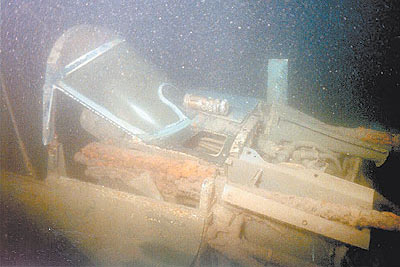
An SBD Dauntless rests 150 feet below the surface of Lake Michigan.
This front view shows the cockpit with its bomb sight and twin .50-caliber machine guns.
PHOTOS FROM THE A&T RECOVERY AND CREW
By JACK DORSEY, The Virginian-Pilot © August 23, 2004
Today, they have Oceana, Fentress and the decks of a dozen aircraft carriers.
But 60 years ago, in the heat of World War II, young Navy pilots learning the art of carrier takeoffs and landings had it a little rougher.
With German submarines patrolling the East Coast and the Japanese threatening the West Coast, the Navy took its carrier-landing training inland to Lake Michigan. Flying off the shore of Chicago, nearly 18,000 pilots – including former President George H.W. Bush – honed their skills on “lake carriers.”
They practiced on two converted side-wheel paddle steamers – coal-fueled former excursion ships with their tops cut off. Much smaller than the Navy’s biggest carriers, the makeshift flat-tops were a considerable challenge for fledgling aviators.
Eight pilots died in the training; hundreds of others survived accidents that left an estimated 200 planes at the bottom of Lake Michigan. That graveyard of planes is a treasure trove of Naval aviation history: Grumman F-4F Wildcat fighters, Douglas SBD Dauntless dive bombers, F-4U1 Corsairs and F-6F3 Hellcats.
The aluminum carcasses at the bottom of Lake Michigan – and other wrecks across the world – are also at the heart of a clash between two Navy agencies with different ideas on how best to preserve the wrecks.
Officials with the National Museum of Naval Aviation in Pensacola, Fla., want to retrieve the planes and put them on display.
But archaeologists with the Naval Historical Center in Washington, which claims ownership of all Navy aircraft and ship wrecks, believe the treasures may be better left alone.
Proponents of retrieval say waiting could result in the eventual corrosion of the wrecks, especially those in salt water graves.
“The Navy Historical Center and its underwater archaeology people are the obstacle to the salvage of Navy aircraft, not only from Lake Michigan, but everywhere else in the world,” said Ed Ellis, the Naval Aviation Museum Foundation’s secretary and a retired Navy captain and lawyer. But Robert S. Neyland, head of the underwater archaeology branch of the Navy Historical Center, defends leaving the wrecks undisturbed.
“Those that are left are very good resources for the future,” he said. “That resource should be used in good stewardship. Think how much more important it will be to recover one in 100 years from now, or 150 years from now, once this generation has died.”
For now, the two sides are at a stalemate – no U.S. Navy planes have been raised since 1996.
The Navy used more than 100 carriers in World War II; today’s Navy has just 12 of the floating airfields.
During the war, the “real” carriers were needed for combat, mostly in the Pacific. So for training purposes, the Navy cobbled together the two lake carriers.
The excursion ships, renamed Wolverine and Sable, were fitted with 550-foot flight decks just 27 feet above the water. The real carriers had decks that were almost 900 feet long and 80 feet off the water.
Normally, planes have to take off from carriers headed into a stiff wind, often generated by a fast-moving carrier. But the lake carriers barely were able to make 20 knots, and when they couldn’t do that, training stopped until the wind increased.
The ships left almost daily from Navy Pier in downtown Chicago. The main complaint from the locals was that when they left the pier, soot from their smoke stacks soiled laundry drying on lines. So the ships were ordered to leave port before dawn, before the clothes were hung.
Operating from nearby Glenview Naval Air Station, the pilot trainees would visit the carriers only briefly. They needed just eight successful takeoffs and landings and often qualified in two or three days; today’s pilots need a minimum of 48 “touch-and-goes” to be qualified.
The Lake Michigan wrecks are just a fraction of what is out there: the Navy has identified about 12,000 World War II crash sites on land or in the water. Museums have retrieved some for restoration and display, including 31 from Lake Michigan before the Navy Historical Center put the clamps on raising planes.
Many of the planes raised from Lake Michigan were in near-pristine condition because of the cold, fresh water. Some had fuel in their tanks, propellers that spin, inflated tires and 12-volt batteries still able to accept a charge.
A few were even restored to air-worthy status. A Grumman F-4F3 Wildcat discovered in Lake Michigan in 1992 is the only one still flying out of 2,000 produced.
Another group also favors raising the wrecks: salvage companies that can recover the planes. “The turf battle between the agencies is relatively new,” said Peter E. Hess, an admiralty lawyer from Wilmington, Del., and an avid wreck diver for 20 years. “But the battle between the private-sector salvor wishing to recover the wrecks and the bureaucrats wishing to stand guard over them has been going on since the advent of scuba diving.”
Taras C. Lyssenko of A&T Recovery in Chicago has retrieved three dozen aircraft from Lake Michigan, including the prized F-4F3 Wildcat that is back in the air. He has no love for the Navy Historical Center.
“NHC has been the most harmful agency to the preservation of naval history,” Lyssenko said. “They have stopped the recovery of airplanes which are being ripped apart by zebra mussels and salt water in the ocean.”
Some of Lyssenko’s discoveries are on display at museums in Long Island, N.Y.; aboard the carrier Yorktown, in Charleston, S.C.; aboard the carrier Lexington in Corpus Christie, Texas; in San Diego, Palm Springs, Calif., and Seattle; at O’Hare and Midway airports in Chicago; and at the Navy museum in Pensacola, Fla.
Robert Rasmussen, director of the Pensacola museum for the past 17 years, declines to criticize the NHC and says that the 30 aircraft the museum has recovered from Lake Michigan “have given us tremendous resources.”
Four of the museum’s planes were in combat before being returned to the United States and used for training on Lake Michigan. One was a veteran of the Battle of Midway.
“We are working on a project now to recover two from the lake,” Rasmussen said. “One is a F-4U1 Corsair and the other is a F-6F3 Hellcat. The Corsair is very rare. It was used by the Marine Corps during the greater part of the war in the Pacific.”
Rasmussen did say that “there is urgency to get them up.”
In some cases, the Lake Michigan planes are the only examples left in the world of some models . “Before we got the combat veterans out of Lake Michigan, we had zero combat veterans of World War II,” Rasmussen said.
Lyssenko, a former Army Ranger who has operated his salvage business out of Lake Michigan since the early 1980s, says he has mapped the location of at least 80 aircraft wrecks, but won’t reveal the locations to the Navy without a fee.
In June, Navy Historical Center archaeologists attempted to locate the lake wrecks . A team of seven Navy divers from Fort Story in Virginia Beach – Explosive Ordnance Disposal Mobile Unit 10 – towed two of their boats to Lake Michigan to search for the wrecks. But the poor weather inhibited the search , and the divers were only able to verify two sites.
Hess, the admiralty lawyer, successfully has battled state and federal governments to open shipwrecks, such as the Monitor, to the diving public. He maintains that the public has a right to the underwater aviation wrecks.
“You don’t protect the site by leaving it underwater,” he said. “You protect it by recovering it and restoring it.”
He noted that Neyland headed the recovery efforts of the confederate submarine H.L. Hunley, which sank in 1864 off South Carolina’s coast and was raised in 2000.
“Why raise a submarine and not an airplane?” he said .
Neyland, who joined NHC in 1994 , says he is concerned that some planes are further damaged in the process of being raised, and that often there is no clear plan to preserve their originality. “If somebody has a good use for the aircraft and can learn something from them, and if they have a good plan for the display, I don’t think we have any real objection,” Neyland said. “I don’t know where Pensacola plans to display the two aircraft from Lake Michigan.”
Neyland also said that some planes have been raised, then used by museums as currency, a transaction authorized by the Secretary of the Navy.
“In the past we did have some concern here about aircraft being traded out of the Navy to pay for other services by the museum and the foundation,” he said. “We questioned whether that was being a good use of the aircraft as a resource.”
Through the Pensacola museum, Lyssenko said he had permits to retrieve two planes, but that those permits expired in 2001 and have not been renewed by the Navy Historical Center.
Lyssenko said the center placed so many additional demands on the projects, including increasingly detailed archaeological reports, that it increased the recovery cost by $80,000 per plane. That increase is passed on to the foundation, or museum, and eventually the Navy, which funds both organizations .
Generally, the cost of salvage, depending on water depth, has been between $150,000 and $170,000 a plane, according to Ellis, secretary of the Pensacola museum.
Ellis said that the Navy Historical Center also has added red tape to the salvage process.
“They have taken the position that every aircraft crash site must have an archaeological survey and a fully documented record of the salvage,” he said.
Reach Jack Dorsey at 446-2284 or jack.dorsey@pilotonline.com.
The article here.

This photo link.
An SBD Dauntless rests 150 feet below the surface of Lake Michigan.
This front view shows the cockpit with its bomb sight and twin .50-caliber machine guns.
PHOTOS FROM THE A&T RECOVERY AND CREW
By JACK DORSEY, The Virginian-Pilot © August 23, 2004
Today, they have Oceana, Fentress and the decks of a dozen aircraft carriers.
But 60 years ago, in the heat of World War II, young Navy pilots learning the art of carrier takeoffs and landings had it a little rougher.
With German submarines patrolling the East Coast and the Japanese threatening the West Coast, the Navy took its carrier-landing training inland to Lake Michigan. Flying off the shore of Chicago, nearly 18,000 pilots – including former President George H.W. Bush – honed their skills on “lake carriers.”
They practiced on two converted side-wheel paddle steamers – coal-fueled former excursion ships with their tops cut off. Much smaller than the Navy’s biggest carriers, the makeshift flat-tops were a considerable challenge for fledgling aviators.
Eight pilots died in the training; hundreds of others survived accidents that left an estimated 200 planes at the bottom of Lake Michigan. That graveyard of planes is a treasure trove of Naval aviation history: Grumman F-4F Wildcat fighters, Douglas SBD Dauntless dive bombers, F-4U1 Corsairs and F-6F3 Hellcats.
The aluminum carcasses at the bottom of Lake Michigan – and other wrecks across the world – are also at the heart of a clash between two Navy agencies with different ideas on how best to preserve the wrecks.
Officials with the National Museum of Naval Aviation in Pensacola, Fla., want to retrieve the planes and put them on display.
But archaeologists with the Naval Historical Center in Washington, which claims ownership of all Navy aircraft and ship wrecks, believe the treasures may be better left alone.
Proponents of retrieval say waiting could result in the eventual corrosion of the wrecks, especially those in salt water graves.
“The Navy Historical Center and its underwater archaeology people are the obstacle to the salvage of Navy aircraft, not only from Lake Michigan, but everywhere else in the world,” said Ed Ellis, the Naval Aviation Museum Foundation’s secretary and a retired Navy captain and lawyer. But Robert S. Neyland, head of the underwater archaeology branch of the Navy Historical Center, defends leaving the wrecks undisturbed.
“Those that are left are very good resources for the future,” he said. “That resource should be used in good stewardship. Think how much more important it will be to recover one in 100 years from now, or 150 years from now, once this generation has died.”
For now, the two sides are at a stalemate – no U.S. Navy planes have been raised since 1996.
The Navy used more than 100 carriers in World War II; today’s Navy has just 12 of the floating airfields.
During the war, the “real” carriers were needed for combat, mostly in the Pacific. So for training purposes, the Navy cobbled together the two lake carriers.
The excursion ships, renamed Wolverine and Sable, were fitted with 550-foot flight decks just 27 feet above the water. The real carriers had decks that were almost 900 feet long and 80 feet off the water.
Normally, planes have to take off from carriers headed into a stiff wind, often generated by a fast-moving carrier. But the lake carriers barely were able to make 20 knots, and when they couldn’t do that, training stopped until the wind increased.
The ships left almost daily from Navy Pier in downtown Chicago. The main complaint from the locals was that when they left the pier, soot from their smoke stacks soiled laundry drying on lines. So the ships were ordered to leave port before dawn, before the clothes were hung.
Operating from nearby Glenview Naval Air Station, the pilot trainees would visit the carriers only briefly. They needed just eight successful takeoffs and landings and often qualified in two or three days; today’s pilots need a minimum of 48 “touch-and-goes” to be qualified.
The Lake Michigan wrecks are just a fraction of what is out there: the Navy has identified about 12,000 World War II crash sites on land or in the water. Museums have retrieved some for restoration and display, including 31 from Lake Michigan before the Navy Historical Center put the clamps on raising planes.
Many of the planes raised from Lake Michigan were in near-pristine condition because of the cold, fresh water. Some had fuel in their tanks, propellers that spin, inflated tires and 12-volt batteries still able to accept a charge.
A few were even restored to air-worthy status. A Grumman F-4F3 Wildcat discovered in Lake Michigan in 1992 is the only one still flying out of 2,000 produced.
Another group also favors raising the wrecks: salvage companies that can recover the planes. “The turf battle between the agencies is relatively new,” said Peter E. Hess, an admiralty lawyer from Wilmington, Del., and an avid wreck diver for 20 years. “But the battle between the private-sector salvor wishing to recover the wrecks and the bureaucrats wishing to stand guard over them has been going on since the advent of scuba diving.”
Taras C. Lyssenko of A&T Recovery in Chicago has retrieved three dozen aircraft from Lake Michigan, including the prized F-4F3 Wildcat that is back in the air. He has no love for the Navy Historical Center.
“NHC has been the most harmful agency to the preservation of naval history,” Lyssenko said. “They have stopped the recovery of airplanes which are being ripped apart by zebra mussels and salt water in the ocean.”
Some of Lyssenko’s discoveries are on display at museums in Long Island, N.Y.; aboard the carrier Yorktown, in Charleston, S.C.; aboard the carrier Lexington in Corpus Christie, Texas; in San Diego, Palm Springs, Calif., and Seattle; at O’Hare and Midway airports in Chicago; and at the Navy museum in Pensacola, Fla.
Robert Rasmussen, director of the Pensacola museum for the past 17 years, declines to criticize the NHC and says that the 30 aircraft the museum has recovered from Lake Michigan “have given us tremendous resources.”
Four of the museum’s planes were in combat before being returned to the United States and used for training on Lake Michigan. One was a veteran of the Battle of Midway.
“We are working on a project now to recover two from the lake,” Rasmussen said. “One is a F-4U1 Corsair and the other is a F-6F3 Hellcat. The Corsair is very rare. It was used by the Marine Corps during the greater part of the war in the Pacific.”
Rasmussen did say that “there is urgency to get them up.”
In some cases, the Lake Michigan planes are the only examples left in the world of some models . “Before we got the combat veterans out of Lake Michigan, we had zero combat veterans of World War II,” Rasmussen said.
Lyssenko, a former Army Ranger who has operated his salvage business out of Lake Michigan since the early 1980s, says he has mapped the location of at least 80 aircraft wrecks, but won’t reveal the locations to the Navy without a fee.
In June, Navy Historical Center archaeologists attempted to locate the lake wrecks . A team of seven Navy divers from Fort Story in Virginia Beach – Explosive Ordnance Disposal Mobile Unit 10 – towed two of their boats to Lake Michigan to search for the wrecks. But the poor weather inhibited the search , and the divers were only able to verify two sites.
Hess, the admiralty lawyer, successfully has battled state and federal governments to open shipwrecks, such as the Monitor, to the diving public. He maintains that the public has a right to the underwater aviation wrecks.
“You don’t protect the site by leaving it underwater,” he said. “You protect it by recovering it and restoring it.”
He noted that Neyland headed the recovery efforts of the confederate submarine H.L. Hunley, which sank in 1864 off South Carolina’s coast and was raised in 2000.
“Why raise a submarine and not an airplane?” he said .
Neyland, who joined NHC in 1994 , says he is concerned that some planes are further damaged in the process of being raised, and that often there is no clear plan to preserve their originality. “If somebody has a good use for the aircraft and can learn something from them, and if they have a good plan for the display, I don’t think we have any real objection,” Neyland said. “I don’t know where Pensacola plans to display the two aircraft from Lake Michigan.”
Neyland also said that some planes have been raised, then used by museums as currency, a transaction authorized by the Secretary of the Navy.
“In the past we did have some concern here about aircraft being traded out of the Navy to pay for other services by the museum and the foundation,” he said. “We questioned whether that was being a good use of the aircraft as a resource.”
Through the Pensacola museum, Lyssenko said he had permits to retrieve two planes, but that those permits expired in 2001 and have not been renewed by the Navy Historical Center.
Lyssenko said the center placed so many additional demands on the projects, including increasingly detailed archaeological reports, that it increased the recovery cost by $80,000 per plane. That increase is passed on to the foundation, or museum, and eventually the Navy, which funds both organizations .
Generally, the cost of salvage, depending on water depth, has been between $150,000 and $170,000 a plane, according to Ellis, secretary of the Pensacola museum.
Ellis said that the Navy Historical Center also has added red tape to the salvage process.
“They have taken the position that every aircraft crash site must have an archaeological survey and a fully documented record of the salvage,” he said.
Reach Jack Dorsey at 446-2284 or jack.dorsey@pilotonline.com.
The article here.
This photo link.
Tuesday, August 24, 2004
Wreck may be Cromwell's flagship
______________________________________________________________________________________
From AFP
August 23, 2004
THE wreck of a 17th-century ship found preserved in a sandbar in southern Ireland five years ago could well be the navy flagship of England ruler Oliver Cromwell, according to a Irish government archaeologist.Connie Kelleher of the environment ministry's underwater archaeology unit said the historical and archaeological value of the find in the Waterford Harbour estuary "cannot be overestimated".
It was found in 1999 after a dredger cut through part of it when working to keep a commercial shipping channel open through the estuary and is the first shipwreck from the period to be discovered in Irish waters.
Kelleher said the prime candidate for the find is the "Great Lewis", a 410-tonne frigate which sank in 1645 with 200 soldiers aboard.
Scans of the sandbar by Kelleher's team show the wooden structure of the vessel embedded almost intact in the sand.
A line of cannons are exposed above the seabed about 8m under the surface. They have been dated to between 1636 and 1670 and were made in an English foundry, according to research published by the magazine Archaeology Ireland.
"Very little is known of ship typology from this period," Kelleher told the magazine Archaeology Ireland.
"The possibility that it could have been directly involved in a period of our history that has left such an immense mark adds even more importance to the wreck, as does the realisation that we could, in fact, be looking at a war grave," she added.
The wreck has been declared a national monument and the site is protected by an exclusion zone. Diving can take place only with a government licence.
Cromwell was Lord Protector and leader of the English republican commonwealth between 1653-58 after the execution of King Charles I.
The militant Protestant or "puritan" leader who died in 1658 is notorious in Ireland for the brutal suppression of the Catholic country by his parliamentary army.
In the 1640s civil war broke out in Ireland and Britain. The Great Lewis arrived in Waterford Harbour with three others ships to relieve the parliamentary forces in Duncannon Fort.
Irish Catholic Confederate forces loyal to the royalist cause had laid siege to the fort, the night before the Great Lewis-led flotilla arrived at Duncannon.
On arrival, the Irish forces began to bombard the anchored ships.
While three cut their cables and escaped, the Great Lewis was caught by the tide and was pounded by mortar fire that smashed its masts.
The ship drifted out of range but was so badly damaged it sank two days later with the loss of most of the crew.
______
Related News, here, here and here.

Photo Description: Statue of Oliver Cromwell
in St. Ives, England.
From AFP
August 23, 2004
THE wreck of a 17th-century ship found preserved in a sandbar in southern Ireland five years ago could well be the navy flagship of England ruler Oliver Cromwell, according to a Irish government archaeologist.Connie Kelleher of the environment ministry's underwater archaeology unit said the historical and archaeological value of the find in the Waterford Harbour estuary "cannot be overestimated".
It was found in 1999 after a dredger cut through part of it when working to keep a commercial shipping channel open through the estuary and is the first shipwreck from the period to be discovered in Irish waters.
Kelleher said the prime candidate for the find is the "Great Lewis", a 410-tonne frigate which sank in 1645 with 200 soldiers aboard.
Scans of the sandbar by Kelleher's team show the wooden structure of the vessel embedded almost intact in the sand.
A line of cannons are exposed above the seabed about 8m under the surface. They have been dated to between 1636 and 1670 and were made in an English foundry, according to research published by the magazine Archaeology Ireland.
"Very little is known of ship typology from this period," Kelleher told the magazine Archaeology Ireland.
"The possibility that it could have been directly involved in a period of our history that has left such an immense mark adds even more importance to the wreck, as does the realisation that we could, in fact, be looking at a war grave," she added.
The wreck has been declared a national monument and the site is protected by an exclusion zone. Diving can take place only with a government licence.
Cromwell was Lord Protector and leader of the English republican commonwealth between 1653-58 after the execution of King Charles I.
The militant Protestant or "puritan" leader who died in 1658 is notorious in Ireland for the brutal suppression of the Catholic country by his parliamentary army.
In the 1640s civil war broke out in Ireland and Britain. The Great Lewis arrived in Waterford Harbour with three others ships to relieve the parliamentary forces in Duncannon Fort.
Irish Catholic Confederate forces loyal to the royalist cause had laid siege to the fort, the night before the Great Lewis-led flotilla arrived at Duncannon.
On arrival, the Irish forces began to bombard the anchored ships.
While three cut their cables and escaped, the Great Lewis was caught by the tide and was pounded by mortar fire that smashed its masts.
The ship drifted out of range but was so badly damaged it sank two days later with the loss of most of the crew.
______
Related News, here, here and here.
Photo Description: Statue of Oliver Cromwell
in St. Ives, England.
A Stony Brook field team sifts through the Hudson River in search of submerged prehistoric artifacts
______________________________________________________________________________________
THE ASSOCIATED PRESS
August 23, 2004
CROTON-on-HUDSON, N.Y. - It was tough digging, according to archaeology students Erin Head and Matt Napolitano.
Cold seeped through wet suits. Dislodged river muck swirled through the water. Visibility was only a few inches.
"Some days you can't see your hand in front of your face," said Head, waist-deep in a Hudson River bay. So it goes in the world of underwater archaeology.
Diggers this summer at Croton Point Park donned wet suits and scuba gear as they dug up discoveries beyond the reach of landlocked archaeologists.
Daria Merwin and a team of students found buckets of submerged stone artifacts where the Croton River flows into the Hudson, about 30 miles north of New York City.
"I know it's stone tools, but it's stone tools people haven't seen in a few thousand years," said Merwin, an adjunct professor at Stony Brook University.
Creeping sea levels over thousands of years are believed to have submerged settlements that stood by the water's edge.
The dig site today is a peninsular park by a commuter train station and the suburban bustle of Westchester County. But thousands of years ago, it was a wild area with easy access to sturgeon, berries, oysters and fresh water - a great spot for hunters and gatherers, according to Merwin. She was enticed to the site by a local's man discovery of washed-up artifacts.
Merwin, whose underwater work has included shipwrecks in the Hudson, recently devoted the first half of a six-week summer course in underwater archaeology to the Croton site.
The work is typical archaeology - sites are meticulously mapped into grids and methodically dug out. Pairs of divers follow a tape line about 150 feet out, then dig exploratory holes every 15 feet as they work back to shore. They use the same type of scoops found in hotel ice machines. Metal screens are used to sift the silt. Results are logged on clipboards, though divers write on waterproof Mylar instead of paper.
Low tide allows the divers to use snorkels.More than 100 stone artifacts have been bagged and tagged in the three weeks. Many artifacts are "cores," heavy stones from which spear points or other tools were made. Some artifacts are "flakes," leftover chippings from tool-making.
Working under hazy skies, Napolitano and Head found a good example of the latter - a finger-sized gray rock with ragged edges on either side."Holy cow, that's a big flake!" Merwin said as she waded out to examine her discovery.
That find was trumped later in the day by another pair of students who found an arrowhead - the first fully formed tool found at the site. Based on the design, Merwin believes the arrowhead is roughly 2,000 years old.
Copyright © 2004, Newsday, Inc.
THE ASSOCIATED PRESS
August 23, 2004
CROTON-on-HUDSON, N.Y. - It was tough digging, according to archaeology students Erin Head and Matt Napolitano.
Cold seeped through wet suits. Dislodged river muck swirled through the water. Visibility was only a few inches.
"Some days you can't see your hand in front of your face," said Head, waist-deep in a Hudson River bay. So it goes in the world of underwater archaeology.
Diggers this summer at Croton Point Park donned wet suits and scuba gear as they dug up discoveries beyond the reach of landlocked archaeologists.
Daria Merwin and a team of students found buckets of submerged stone artifacts where the Croton River flows into the Hudson, about 30 miles north of New York City.
"I know it's stone tools, but it's stone tools people haven't seen in a few thousand years," said Merwin, an adjunct professor at Stony Brook University.
Creeping sea levels over thousands of years are believed to have submerged settlements that stood by the water's edge.
The dig site today is a peninsular park by a commuter train station and the suburban bustle of Westchester County. But thousands of years ago, it was a wild area with easy access to sturgeon, berries, oysters and fresh water - a great spot for hunters and gatherers, according to Merwin. She was enticed to the site by a local's man discovery of washed-up artifacts.
Merwin, whose underwater work has included shipwrecks in the Hudson, recently devoted the first half of a six-week summer course in underwater archaeology to the Croton site.
The work is typical archaeology - sites are meticulously mapped into grids and methodically dug out. Pairs of divers follow a tape line about 150 feet out, then dig exploratory holes every 15 feet as they work back to shore. They use the same type of scoops found in hotel ice machines. Metal screens are used to sift the silt. Results are logged on clipboards, though divers write on waterproof Mylar instead of paper.
Low tide allows the divers to use snorkels.More than 100 stone artifacts have been bagged and tagged in the three weeks. Many artifacts are "cores," heavy stones from which spear points or other tools were made. Some artifacts are "flakes," leftover chippings from tool-making.
Working under hazy skies, Napolitano and Head found a good example of the latter - a finger-sized gray rock with ragged edges on either side."Holy cow, that's a big flake!" Merwin said as she waded out to examine her discovery.
That find was trumped later in the day by another pair of students who found an arrowhead - the first fully formed tool found at the site. Based on the design, Merwin believes the arrowhead is roughly 2,000 years old.
Copyright © 2004, Newsday, Inc.
Monday, August 23, 2004
U.S. Navy’s Civil War vessel, the "Alligator", believed to be older than the Confederacy’s "Hunley"
______________________________________________________________________________________
Posted on Sat, Aug. 21, 2004
Union sub wreckage sought off N.C. coastU.S.
Navy’s Civil War vessel, the Alligator, believed to be older than the Confederacy’s HunleyBy
MICHAEL KILIAN Chicago Tribune
WASHINGTON — Undersea explorers will plunge into the waters off Cape Hatteras and into the depths of long-forgotten history Sunday in hopes of finding the 141-year-old wreckage of the U.S. Navy’s first submarine.
Named the Alligator because of its green color and the leglike oars that initially propelled it, the vessel was launched in 1862. It failed in its assigned missions against Confederate targets in Virginia’s Hampton Roads area and sank off North Carolina’s Outer Banks while under tow in a fierce storm in 1863.
Discovery of the Alligator would undercut the claim of various Confederate historical groups that the Confederate navy’s H.L. Hunley was the first working submarine. Built in 1863 in Mobile, Ala., the 25-foot Hunley sank the Union warship USS Housatonic the following year.
The Hunley wreckage was discovered off Charleston harbor in 1995 and was raised in 2000.
The expedition to discover the Alligator, a joint enterprise of the National Oceanic and Atmospheric Administration and the Navy’s Office of Naval Research, will spend 10 days working a shallow underwater area east of Ocracoke Island, where unidentified sunken objects have recently been discovered.
If this effort fails to find the vessel, future searches ultimately could take the team to deep water on the brink of the Atlantic Shelf.
QUEST THROUGH HISTORY
For decades, historians had identified the USS Holland, an 1897 precursor to the submarines used in World War I, as the Navy’s first submarine. But in recent years, Civil War historians have come across evidence of the existence of the Alligator, prompting the Navy to become extremely interested in locating the 47-foot vessel.
“I had never heard of the Alligator,” said Rear Adm. Jay Cohen, chief of naval research. “I had never read about or seen a reference to it — nothing.”
It was only last year that exploration project manager Catherine Marzin found letters and scale drawings of the sub in an obscure archive in France.
The Alligator was designed by French inventor Brutus de Villeroi, whose papers were in the French archive. It was originally developed for the Union Navy as a counter to the first Confederate ironclad, the CSS Virginia, also called the Merrimack. In the end, it was the Monitor that thwarted the Virginia.
The Alligator was nevertheless launched May 1, 1862, at Philadelphia, where its strange appearance so frightened residents that the vessel was initially confiscated by the Philadelphia police.
Taking possession of it, the Union Navy sent the craft down to the lower Chesapeake Bay area, where it was ordered to destroy a key Confederate bridge over the Appomattox River and remove debris from the James River that was blocking the water route to Richmond.
But the rivers proved too shallow for the Alligator to maneuver, and the submarine had to be withdrawn to the Washington Navy Yard.
President Abraham Lincoln himself took part in the subsequent sea trial observations.
Far ahead of its time, the Alligator was equipped with an air-purification system and a water-tight air lock for divers. The submarine carried a crew of 17 to 22, depending on its mission.
FATEFUL STORM SEALED SUB’S FATE
The Alligator was assigned to take part in Union Navy operations against the port of Charleston. But taken under tow by the Union warship USS Sumpter in April 1863, it met its doom when the Sumpter encountered a ferocious storm off Hatteras.
The sub was a drag on the other vessel and threatened to sink them both.
“There were two towlines, and one broke,” said Marzin. “The Sumpter had no choice but to cut the other line and set the submarine adrift.”
No crew members were aboard the sub at the time.
NOAA and Navy experts have been using computer technology and weather models to try to determine the position of the vessels when the Alligator was cut loose, and to figure out how far it might have traveled before sinking. The expedition team is using a research vessel along with side-seeing sonar and magnetometers.
“No decision has been made about recovering the Alligator,” said Marzin, noting that Titanic discoverer Robert Ballard and other undersea archaeologists have strong feelings against disturbing underwater wrecks.
For the Navy, simply locating the submarine may be enough.
“If we can find the Alligator, we can find anything,” said Cohen.
News article. Another one.
The saga of the submarine.
Alligator Project.
To follow the search for the Allligator, go to http://sanctuaries.noaa.gov/alligator/hunt2004/
For historic information on the Alligator, go to http://sanctuaries.noaa.gov/alligator
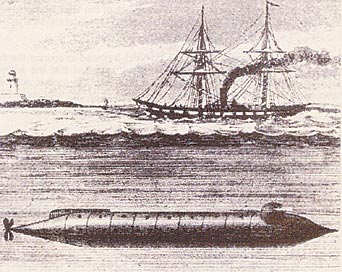
A woodcut shows the Navy’s first submarine, the Alligator.
The sub was set adrift in 1863 and never found.
COURTESY PHOTO
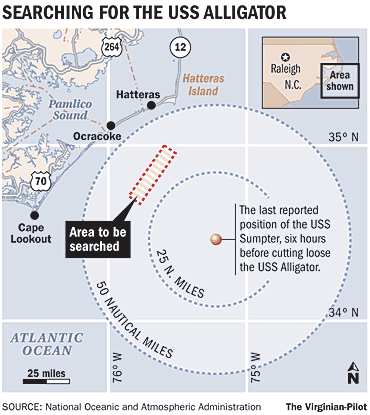
Posted on Sat, Aug. 21, 2004
Union sub wreckage sought off N.C. coastU.S.
Navy’s Civil War vessel, the Alligator, believed to be older than the Confederacy’s HunleyBy
MICHAEL KILIAN Chicago Tribune
WASHINGTON — Undersea explorers will plunge into the waters off Cape Hatteras and into the depths of long-forgotten history Sunday in hopes of finding the 141-year-old wreckage of the U.S. Navy’s first submarine.
Named the Alligator because of its green color and the leglike oars that initially propelled it, the vessel was launched in 1862. It failed in its assigned missions against Confederate targets in Virginia’s Hampton Roads area and sank off North Carolina’s Outer Banks while under tow in a fierce storm in 1863.
Discovery of the Alligator would undercut the claim of various Confederate historical groups that the Confederate navy’s H.L. Hunley was the first working submarine. Built in 1863 in Mobile, Ala., the 25-foot Hunley sank the Union warship USS Housatonic the following year.
The Hunley wreckage was discovered off Charleston harbor in 1995 and was raised in 2000.
The expedition to discover the Alligator, a joint enterprise of the National Oceanic and Atmospheric Administration and the Navy’s Office of Naval Research, will spend 10 days working a shallow underwater area east of Ocracoke Island, where unidentified sunken objects have recently been discovered.
If this effort fails to find the vessel, future searches ultimately could take the team to deep water on the brink of the Atlantic Shelf.
QUEST THROUGH HISTORY
For decades, historians had identified the USS Holland, an 1897 precursor to the submarines used in World War I, as the Navy’s first submarine. But in recent years, Civil War historians have come across evidence of the existence of the Alligator, prompting the Navy to become extremely interested in locating the 47-foot vessel.
“I had never heard of the Alligator,” said Rear Adm. Jay Cohen, chief of naval research. “I had never read about or seen a reference to it — nothing.”
It was only last year that exploration project manager Catherine Marzin found letters and scale drawings of the sub in an obscure archive in France.
The Alligator was designed by French inventor Brutus de Villeroi, whose papers were in the French archive. It was originally developed for the Union Navy as a counter to the first Confederate ironclad, the CSS Virginia, also called the Merrimack. In the end, it was the Monitor that thwarted the Virginia.
The Alligator was nevertheless launched May 1, 1862, at Philadelphia, where its strange appearance so frightened residents that the vessel was initially confiscated by the Philadelphia police.
Taking possession of it, the Union Navy sent the craft down to the lower Chesapeake Bay area, where it was ordered to destroy a key Confederate bridge over the Appomattox River and remove debris from the James River that was blocking the water route to Richmond.
But the rivers proved too shallow for the Alligator to maneuver, and the submarine had to be withdrawn to the Washington Navy Yard.
President Abraham Lincoln himself took part in the subsequent sea trial observations.
Far ahead of its time, the Alligator was equipped with an air-purification system and a water-tight air lock for divers. The submarine carried a crew of 17 to 22, depending on its mission.
FATEFUL STORM SEALED SUB’S FATE
The Alligator was assigned to take part in Union Navy operations against the port of Charleston. But taken under tow by the Union warship USS Sumpter in April 1863, it met its doom when the Sumpter encountered a ferocious storm off Hatteras.
The sub was a drag on the other vessel and threatened to sink them both.
“There were two towlines, and one broke,” said Marzin. “The Sumpter had no choice but to cut the other line and set the submarine adrift.”
No crew members were aboard the sub at the time.
NOAA and Navy experts have been using computer technology and weather models to try to determine the position of the vessels when the Alligator was cut loose, and to figure out how far it might have traveled before sinking. The expedition team is using a research vessel along with side-seeing sonar and magnetometers.
“No decision has been made about recovering the Alligator,” said Marzin, noting that Titanic discoverer Robert Ballard and other undersea archaeologists have strong feelings against disturbing underwater wrecks.
For the Navy, simply locating the submarine may be enough.
“If we can find the Alligator, we can find anything,” said Cohen.
News article. Another one.
The saga of the submarine.
Alligator Project.
To follow the search for the Allligator, go to http://sanctuaries.noaa.gov/alligator/hunt2004/
For historic information on the Alligator, go to http://sanctuaries.noaa.gov/alligator
A woodcut shows the Navy’s first submarine, the Alligator.
The sub was set adrift in 1863 and never found.
COURTESY PHOTO
Expedition Aims to Find Lost Slave Ship "Trouvadore"
______________________________________________________________________________________
Sat Aug 21, 7:34 AM ET
By IAN JAMES, Associated Press Writer
SAN JUAN, Puerto Rico - Archaeologists are set to begin an expedition this month in hopes of finding a Spanish ship that wrecked along the jagged reefs off the Turks and Caicos Islands in 1841 carrying a cargo of African slaves.
The story of the Trouvadore is unusual because all 193 slaves made it to shore, and all but one survived to see their freedom granted by a British government that had just outlawed slavery. Most settled in the arid, low-lying islands and began new lives working its salt ponds and raising families.
The shipwreck holds particular significance for the British territory of 25,000 people because researchers believe virtually all native islanders have ties by blood or marriage to the survivors.
Their story was nearly forgotten, reflected only in vague tales passed down over generations, until archaeologists in the past decade pieced together details from records in Britain, Cuba, Jamaica, Bahamas and the United States.
The two-week expedition is to begin Aug. 28, with searchers using swimmers dragged on tow boards behind a dive boat to scan 3 square miles of shallow, clear waters seldom visited by divers.
"We are very confident we're going to find it simply because all the paperwork points to one location," said Nigel Sadler, an English archaeologist and director of the Turks and Caicos National Museum.
All accounts say the Spanish brigantine sank off Breezy Point on uninhabited East Caicos island, a treacherous coastline littered with shipwrecks.
The chartered search boat, T&C Explorer, is to leave Grand Turk with a 13-member team including filmmakers from Windward Media of Kemah, Texas, making a documentary for U.S. public television. The expedition is funded with $80,000 given by resorts, developers, the islands' hotel and tourism association, tourism board and private donors.
A first hint of the ship's existence came in 1993 when Grethe Seim, late founder of the National Museum, and American archaeologist Donald Keith were looking through records of artifacts at the Smithsonian Institution (news - web sites) in Washington.
One century-old letter from an artifact dealer mentioned two wooden African idols from a shipwreck off Turks and Caicos. Research showed the ship's name was listed in documents as Trouvadore — Trovador in Spanish — and that the idols weren't African but from Easter Island, probably mementos brought by Spanish or Portuguese sailors.
"The whole story is not told anywhere in one document. It's little bits and pieces that you put together — letters back and forth," said Keith, who runs the group Ships of Discovery at the Corpus Christi Museum of Science and History in Texas.
Keith has studied shipwrecks in spots from Turkey to South Korea (news - web sites), and in the 1980s excavated the 16th century Molasses Reef Wreck off Turks and Caicos, about 575 miles southeast of Miami.
He suspects the Trouvadore broke apart after hitting reefs, probably leaving metal hatches and slaves' chains strewn about and perhaps buried in sand. If the team finds promising spots, they will apply to excavate artifacts for the National Museum.
The ship wrecked on its way from Africa to Cuba seven years after Britain's 1834 order to emancipate slaves.
In a letter sent to colonial authorities in Nassau, Bahamas, on April 3, 1841, a British magistrate wrote that the Africans were found naked, then quarantined in a jail where they were given food and clothing.
The crew had shot and killed one African woman on the beach who tried to escape. The 20 Spanish and Portuguese sailors were sent under guard to Nassau and deported to Cuba.
While 24 freed slaves were taken to Nassau, 168 stayed in Turks and Caicos and were assigned to work on the many salt ponds under one-year contracts, raking salt into piles in exchange for shelter and food, Sadler said. They brought a 7 percent increase to a population of about 2,300.
It's not clear from where in Africa they came. In 1842 freed slaves founded a settlement with the African name Bambarra, and it remains today with several dozen residents.
Towns named Bambara also exist in Mali in West Africa and Chad in central Africa. Sadler and other researchers say survivors probably brought that name with them, along with traditions from music to basket-weaving.
On the Net:
www.slaveshiptrouvadore.com
Expedition Diary

Sat Aug 21, 7:34 AM ET
By IAN JAMES, Associated Press Writer
SAN JUAN, Puerto Rico - Archaeologists are set to begin an expedition this month in hopes of finding a Spanish ship that wrecked along the jagged reefs off the Turks and Caicos Islands in 1841 carrying a cargo of African slaves.
The story of the Trouvadore is unusual because all 193 slaves made it to shore, and all but one survived to see their freedom granted by a British government that had just outlawed slavery. Most settled in the arid, low-lying islands and began new lives working its salt ponds and raising families.
The shipwreck holds particular significance for the British territory of 25,000 people because researchers believe virtually all native islanders have ties by blood or marriage to the survivors.
Their story was nearly forgotten, reflected only in vague tales passed down over generations, until archaeologists in the past decade pieced together details from records in Britain, Cuba, Jamaica, Bahamas and the United States.
The two-week expedition is to begin Aug. 28, with searchers using swimmers dragged on tow boards behind a dive boat to scan 3 square miles of shallow, clear waters seldom visited by divers.
"We are very confident we're going to find it simply because all the paperwork points to one location," said Nigel Sadler, an English archaeologist and director of the Turks and Caicos National Museum.
All accounts say the Spanish brigantine sank off Breezy Point on uninhabited East Caicos island, a treacherous coastline littered with shipwrecks.
The chartered search boat, T&C Explorer, is to leave Grand Turk with a 13-member team including filmmakers from Windward Media of Kemah, Texas, making a documentary for U.S. public television. The expedition is funded with $80,000 given by resorts, developers, the islands' hotel and tourism association, tourism board and private donors.
A first hint of the ship's existence came in 1993 when Grethe Seim, late founder of the National Museum, and American archaeologist Donald Keith were looking through records of artifacts at the Smithsonian Institution (news - web sites) in Washington.
One century-old letter from an artifact dealer mentioned two wooden African idols from a shipwreck off Turks and Caicos. Research showed the ship's name was listed in documents as Trouvadore — Trovador in Spanish — and that the idols weren't African but from Easter Island, probably mementos brought by Spanish or Portuguese sailors.
"The whole story is not told anywhere in one document. It's little bits and pieces that you put together — letters back and forth," said Keith, who runs the group Ships of Discovery at the Corpus Christi Museum of Science and History in Texas.
Keith has studied shipwrecks in spots from Turkey to South Korea (news - web sites), and in the 1980s excavated the 16th century Molasses Reef Wreck off Turks and Caicos, about 575 miles southeast of Miami.
He suspects the Trouvadore broke apart after hitting reefs, probably leaving metal hatches and slaves' chains strewn about and perhaps buried in sand. If the team finds promising spots, they will apply to excavate artifacts for the National Museum.
The ship wrecked on its way from Africa to Cuba seven years after Britain's 1834 order to emancipate slaves.
In a letter sent to colonial authorities in Nassau, Bahamas, on April 3, 1841, a British magistrate wrote that the Africans were found naked, then quarantined in a jail where they were given food and clothing.
The crew had shot and killed one African woman on the beach who tried to escape. The 20 Spanish and Portuguese sailors were sent under guard to Nassau and deported to Cuba.
While 24 freed slaves were taken to Nassau, 168 stayed in Turks and Caicos and were assigned to work on the many salt ponds under one-year contracts, raking salt into piles in exchange for shelter and food, Sadler said. They brought a 7 percent increase to a population of about 2,300.
It's not clear from where in Africa they came. In 1842 freed slaves founded a settlement with the African name Bambarra, and it remains today with several dozen residents.
Towns named Bambara also exist in Mali in West Africa and Chad in central Africa. Sadler and other researchers say survivors probably brought that name with them, along with traditions from music to basket-weaving.
On the Net:
www.slaveshiptrouvadore.com
Expedition Diary
Sunday, August 22, 2004
Gulf explorers study WWII wrecks
____________________________________________________________________________________
GHOST SHIPS TELL THEIR TALES
By GREG HARMAN, THE SUN HERALD
GULF OF MEXICO - Even as a tropical storm buffeted the waters above, rocking the research vessel HOS Dominator earlier this month, scientists examining a string of shipwrecks settled on the floor of the Gulf of Mexico were busily prying loose secrets from the dark below.
Hundreds of vessels lie silently settling into the desolate Gulf floor.
They date back to Spanish and French exploration of the New World. But this team focused its recently completed 18-day research expedition on a string of ships torpedoed by German U-boats during World War II. In all, the Nazis sank 56 vessels, mostly oil tankers, off the southern coast of the United States, most in just a few months of 1942.
"Each wreck has something new and unexpected on it," said Jack Irion, chief of the social sciences unit of the U.S. Mineral Management Service. "The Robert E. Lee, for example, had a small cluster of some of the ship's lifeboats that are still intact on the seafloor."
One of the most dramatic findings came after the underseas explorers were struck by the lack of debris surrounding one freighter, the Alcoa Puritan, about 100 miles south of the Mississippi Coast.
While other wrecks had contained telegraph poles and other scattered equipment, the area around the Puritan's resting place was stark, said Rob Church, project manager for C&C Technologies, the company contracted by the MMS to run the mission.
After scouting to the north, the team found an anonymous heap about 3,000 feet away. There lay a mess of Alcoa debris, including a chair and part of a cargo crane. Also amid the wreckage was an expended brass shell casing from a 10.5 centimeter deck cannon on the U-507, which is believed to be the first U-boat ever to enter Gulf waters.
"Alcoa Puritan really has almost that appearance of sort of the ghost ship," Irion said. "It's a rather spectacular shipwreck, sort of evocative of what you see from films like 'Titanic.'
The shell casing proved too valuable to leave behind. The team recovered the artifact and will donate it to Texas A&M University for preservation.
"It allows us to recreate the steps of how the chase took place between the U-boat and the cargo freighter and then where they actually caught up with him and sank him," Church said.
Viewing the images relayed back from an unmanned submersible, the team also was awed by thickets of white corals covering the Gulfpenn, an oil tanker sunk on May 13, 1942, as it attempted a voyage from Port Arthur, Texas, to Philadelphia.
The corals were found to be an important fish habitat for the likes of slimeheads and scorpion fish, said Will Patterson, a marine fisheries ecologist at the University of West Florida.
Patterson said he was anxious to get the fish back to shore to try to determine how old they were, since relatives of these lesser-known specimens, such as the orange roughy and rockfish, are known to live as long as 100 years.
One of the original concerns of the group - the potential for hazardous cargos harmful to the marine environment - appeared to be dispelled.
Core samples around the wrecks suggested there is no leaking of oils or fuels.
"Many of these vessels burned rather furiously when they were first torpedoed so we suspect very little of the original cargo is still onboard," Irion said.
Due to a tropical storm's passage to the northeast, the crew examined one final ship known to be further to the west before ending their expedition on Sunday (August 22).
____________

Photograph courtesy of U.S. Mineral Management Service.
A 3.7 mm deck gun aboard the German WWII sub U-166,
which was sank in the Gulf of Mexico in 1942 and was found
in 2001.
GHOST SHIPS TELL THEIR TALES
By GREG HARMAN, THE SUN HERALD
GULF OF MEXICO - Even as a tropical storm buffeted the waters above, rocking the research vessel HOS Dominator earlier this month, scientists examining a string of shipwrecks settled on the floor of the Gulf of Mexico were busily prying loose secrets from the dark below.
Hundreds of vessels lie silently settling into the desolate Gulf floor.
They date back to Spanish and French exploration of the New World. But this team focused its recently completed 18-day research expedition on a string of ships torpedoed by German U-boats during World War II. In all, the Nazis sank 56 vessels, mostly oil tankers, off the southern coast of the United States, most in just a few months of 1942.
"Each wreck has something new and unexpected on it," said Jack Irion, chief of the social sciences unit of the U.S. Mineral Management Service. "The Robert E. Lee, for example, had a small cluster of some of the ship's lifeboats that are still intact on the seafloor."
One of the most dramatic findings came after the underseas explorers were struck by the lack of debris surrounding one freighter, the Alcoa Puritan, about 100 miles south of the Mississippi Coast.
While other wrecks had contained telegraph poles and other scattered equipment, the area around the Puritan's resting place was stark, said Rob Church, project manager for C&C Technologies, the company contracted by the MMS to run the mission.
After scouting to the north, the team found an anonymous heap about 3,000 feet away. There lay a mess of Alcoa debris, including a chair and part of a cargo crane. Also amid the wreckage was an expended brass shell casing from a 10.5 centimeter deck cannon on the U-507, which is believed to be the first U-boat ever to enter Gulf waters.
"Alcoa Puritan really has almost that appearance of sort of the ghost ship," Irion said. "It's a rather spectacular shipwreck, sort of evocative of what you see from films like 'Titanic.'
The shell casing proved too valuable to leave behind. The team recovered the artifact and will donate it to Texas A&M University for preservation.
"It allows us to recreate the steps of how the chase took place between the U-boat and the cargo freighter and then where they actually caught up with him and sank him," Church said.
Viewing the images relayed back from an unmanned submersible, the team also was awed by thickets of white corals covering the Gulfpenn, an oil tanker sunk on May 13, 1942, as it attempted a voyage from Port Arthur, Texas, to Philadelphia.
The corals were found to be an important fish habitat for the likes of slimeheads and scorpion fish, said Will Patterson, a marine fisheries ecologist at the University of West Florida.
Patterson said he was anxious to get the fish back to shore to try to determine how old they were, since relatives of these lesser-known specimens, such as the orange roughy and rockfish, are known to live as long as 100 years.
One of the original concerns of the group - the potential for hazardous cargos harmful to the marine environment - appeared to be dispelled.
Core samples around the wrecks suggested there is no leaking of oils or fuels.
"Many of these vessels burned rather furiously when they were first torpedoed so we suspect very little of the original cargo is still onboard," Irion said.
Due to a tropical storm's passage to the northeast, the crew examined one final ship known to be further to the west before ending their expedition on Sunday (August 22).
____________
Photograph courtesy of U.S. Mineral Management Service.
A 3.7 mm deck gun aboard the German WWII sub U-166,
which was sank in the Gulf of Mexico in 1942 and was found
in 2001.
Group Finds Ancient Ships Off Italy Coast
______________________________________________________________________________________
Aug. 20, 2004
Associated Press
CAPRI, Italy - Archaeologists exploring the bottom of the sea off the island of Capri have found the wrecks of three ancient ships that once plied the Mediterranean between Rome and northern African colonies.
Culture Minister Giuliano Urbani took a mini-submarine tour Thursday to see the latest additions to Italy's rich archaeological heritage, which were found earlier this month.
The wrecks were found off the island in the Gulf of Naples at a depth of about 430 feet, said private TV Canale 5, showing underwater footage of the finds on Friday.
A starfish rested on piles of amphorae, the slender terra cotta storage containers the ancient Romans used to transport goods, and colorful fish darted through the openings between the relics.
Archaeologists said one of the wrecks, from the 1st century, had been transporting goods on the route between Rome and what is now Tripoli, Libya.
A second ship, also from the first century, sank with a load of the containers, which were typical of those used to transport fruit, while the third vessel, from the 4th century, was laden with similar vases containing a popular condiment of the time based on a kind of fish sauce.
The underwater expedition also found ships from medieval times as well as more recent wrecks from World War II.
"For decades, we've been thinking about mapping the bottom of our seas for archaeological purposes, but today you can do it with new technologies," the Italian news agency ANSA quoted Urbani as saying.
Another news article.
Aug. 20, 2004
Associated Press
CAPRI, Italy - Archaeologists exploring the bottom of the sea off the island of Capri have found the wrecks of three ancient ships that once plied the Mediterranean between Rome and northern African colonies.
Culture Minister Giuliano Urbani took a mini-submarine tour Thursday to see the latest additions to Italy's rich archaeological heritage, which were found earlier this month.
The wrecks were found off the island in the Gulf of Naples at a depth of about 430 feet, said private TV Canale 5, showing underwater footage of the finds on Friday.
A starfish rested on piles of amphorae, the slender terra cotta storage containers the ancient Romans used to transport goods, and colorful fish darted through the openings between the relics.
Archaeologists said one of the wrecks, from the 1st century, had been transporting goods on the route between Rome and what is now Tripoli, Libya.
A second ship, also from the first century, sank with a load of the containers, which were typical of those used to transport fruit, while the third vessel, from the 4th century, was laden with similar vases containing a popular condiment of the time based on a kind of fish sauce.
The underwater expedition also found ships from medieval times as well as more recent wrecks from World War II.
"For decades, we've been thinking about mapping the bottom of our seas for archaeological purposes, but today you can do it with new technologies," the Italian news agency ANSA quoted Urbani as saying.
Another news article.
The tanks that didn't land on D-Day
______________________________________________________________________________________

On 6 June 1944, a unit of 29 amphibious tanks launched from Allied ships to attack the Nazi-held Normandy beaches - only two made land. Brett Phaneuf went in search of those lost beneath the waves for almost 60 years.
In 1997 I travelled to Cherbourg in Normandy with fellow underwater archaeologist Robert Neyland, intent on collecting images of the CSS Alabama - a Confederate privateer sunk off the coast during the American Civil War.
Although bad weather made that impossible, providence smiled, allowing us several days to tour the World War II landing beaches used in the Allied invasion of Nazi-dominated Europe.
Standing at Point du Hoc - the imposing 100-foots cliffs scaled by American troops on 6 June 1944 - we could not help but wonder what remained of the enormous D-Day invasion fleet beneath the waves below us.
The naval operation mounted on D-Day was without question the most massive in the history of war - but in the 53 years since the invasion no underwater archaeological research had been carried out.
Lost history
Instead, the undersea record of that momentous event had been subjected to decades of erosion, and the clearing of any shipwreck which might prove a hazard to marine navigation.
Faced with the continued loss of this historical record, my Institute of Nautical Archaeology at Texas A&M University, in cooperation with Robert's Naval Historical Centre's Underwater Archaeology Branch, embarked upon the first archaeological reconnaissance of the area in the summer of 2000.
Using state-of-the-art remote sensing, detection and imaging equipment, our goal was to determine the location of landing craft, artillery, ships, ordinance and any other equipment lost during the fighting to establish a toehold in occupied Europe.
By mapping the sites we hoped that the shroud of confusion that has surrounded the history of the invasion could be lifted and a detailed history of the losses close to shore could be written.
Soon innumerable magnetometer anomalies - deviations in the earth's magnetic field due to the presence of a massive, ferrous objects - were detected.
Tank find
Perhaps most intriguing was a collection of vehicles assumed to be Sherman tanks, located at a considerable distance offshore at Omaha Beach.
We assumed these were most likely the remnants of a unit of ill-fated amphibious tanks assigned to support the US infantry in the first wave of the invasion.
These so-called Duplex Drive tanks of the 741st Armoured Battalion were launched from landing craft four kilometres from the beach. Fitted with large canvas skirts round the upper portion of the vehicle, the DD tanks were designed to float low in the water - appearing to the enemy as nothing more menacing than a rubber boat.
The entry of this first group into the rough seas proved disastrous. The tanks were intended to operate in seas with a one-foot swell, yet on D-Day the waves rose six feet.
High waves
The heavy seas swamped 27 DDs, sending them to the sea floor.
As a child I regularly played on a Sherman tank in my local park in Hamilton, Massachusetts - the hometown of legendary tank commander General George Patton.
Later in life I opted for military service to help meet the cost of my college education, joining the tank corps. The chance to return to Normandy to survey the DD tanks resting on the seafloor proved irresistible.
In 2001 and 2002, we collected nearly 30 hours of underwater video. There resting on the seafloor we saw the machines, some upright, some on their sides, and several with turrets detached and lying close by.
Once all the tanks were located, studied and filmed - and having interviewed the 10 survivors of the assault - we began piecing together the most accurate history of their tragic part in the invasion.
It seems as if the tanks were sent into the sea 6,000 yards out, as planned, but in a decision which didn't take the conditions into consideration.
Swamped
Furthermore, the landing craft carrying them were drifting away from the target beach - forcing the tanks to set a course which put them side-on to high waves, thus increasing the amount of water splashing over and crumpling their canvas skirts.
Two tanks - skippered by men with enough peacetime sailing experience to know not to turn their sides to the waves - actually made it to the beach.
I had been widely believed the other tanks sunk almost immediately on leaving the landing craft, but our work showed some had struggled to within 1,000 metres of dry land.
In fact some of the sinking tanks had had time to radio following units with a warning not to launch so far out - undoubtedly saving both lives and tanks vital to the battle.
Given the conditions on D-Day and the clumsiness of the tanks it is little wonder that the 741st met the fate it did, but that they launched at all is a testament to the courage and determination of Allied troops in the face of daunting odds and grave danger.
Link:
http://news.bbc.co.uk/2/hi/uk_news/2016280.stm
http://www.seagrantnews.org/news/20010601_dday.html
http://www.accessnoaa.noaa.gov/aug0701/dday.html
http://www.histarmar.com.ar/HYAMNEWS/HojaInformativa/HojaInf000.htm
http://www.moaa.org/magazine/June2004/f_neptune.asp
On 6 June 1944, a unit of 29 amphibious tanks launched from Allied ships to attack the Nazi-held Normandy beaches - only two made land. Brett Phaneuf went in search of those lost beneath the waves for almost 60 years.
In 1997 I travelled to Cherbourg in Normandy with fellow underwater archaeologist Robert Neyland, intent on collecting images of the CSS Alabama - a Confederate privateer sunk off the coast during the American Civil War.
Although bad weather made that impossible, providence smiled, allowing us several days to tour the World War II landing beaches used in the Allied invasion of Nazi-dominated Europe.
Standing at Point du Hoc - the imposing 100-foots cliffs scaled by American troops on 6 June 1944 - we could not help but wonder what remained of the enormous D-Day invasion fleet beneath the waves below us.
The naval operation mounted on D-Day was without question the most massive in the history of war - but in the 53 years since the invasion no underwater archaeological research had been carried out.
Lost history
Instead, the undersea record of that momentous event had been subjected to decades of erosion, and the clearing of any shipwreck which might prove a hazard to marine navigation.
Faced with the continued loss of this historical record, my Institute of Nautical Archaeology at Texas A&M University, in cooperation with Robert's Naval Historical Centre's Underwater Archaeology Branch, embarked upon the first archaeological reconnaissance of the area in the summer of 2000.
Using state-of-the-art remote sensing, detection and imaging equipment, our goal was to determine the location of landing craft, artillery, ships, ordinance and any other equipment lost during the fighting to establish a toehold in occupied Europe.
By mapping the sites we hoped that the shroud of confusion that has surrounded the history of the invasion could be lifted and a detailed history of the losses close to shore could be written.
Soon innumerable magnetometer anomalies - deviations in the earth's magnetic field due to the presence of a massive, ferrous objects - were detected.
Tank find
Perhaps most intriguing was a collection of vehicles assumed to be Sherman tanks, located at a considerable distance offshore at Omaha Beach.
We assumed these were most likely the remnants of a unit of ill-fated amphibious tanks assigned to support the US infantry in the first wave of the invasion.
These so-called Duplex Drive tanks of the 741st Armoured Battalion were launched from landing craft four kilometres from the beach. Fitted with large canvas skirts round the upper portion of the vehicle, the DD tanks were designed to float low in the water - appearing to the enemy as nothing more menacing than a rubber boat.
The entry of this first group into the rough seas proved disastrous. The tanks were intended to operate in seas with a one-foot swell, yet on D-Day the waves rose six feet.
High waves
The heavy seas swamped 27 DDs, sending them to the sea floor.
As a child I regularly played on a Sherman tank in my local park in Hamilton, Massachusetts - the hometown of legendary tank commander General George Patton.
Later in life I opted for military service to help meet the cost of my college education, joining the tank corps. The chance to return to Normandy to survey the DD tanks resting on the seafloor proved irresistible.
In 2001 and 2002, we collected nearly 30 hours of underwater video. There resting on the seafloor we saw the machines, some upright, some on their sides, and several with turrets detached and lying close by.
Once all the tanks were located, studied and filmed - and having interviewed the 10 survivors of the assault - we began piecing together the most accurate history of their tragic part in the invasion.
It seems as if the tanks were sent into the sea 6,000 yards out, as planned, but in a decision which didn't take the conditions into consideration.
Swamped
Furthermore, the landing craft carrying them were drifting away from the target beach - forcing the tanks to set a course which put them side-on to high waves, thus increasing the amount of water splashing over and crumpling their canvas skirts.
Two tanks - skippered by men with enough peacetime sailing experience to know not to turn their sides to the waves - actually made it to the beach.
I had been widely believed the other tanks sunk almost immediately on leaving the landing craft, but our work showed some had struggled to within 1,000 metres of dry land.
In fact some of the sinking tanks had had time to radio following units with a warning not to launch so far out - undoubtedly saving both lives and tanks vital to the battle.
Given the conditions on D-Day and the clumsiness of the tanks it is little wonder that the 741st met the fate it did, but that they launched at all is a testament to the courage and determination of Allied troops in the face of daunting odds and grave danger.
Link:
http://news.bbc.co.uk/2/hi/uk_news/2016280.stm
http://www.seagrantnews.org/news/20010601_dday.html
http://www.accessnoaa.noaa.gov/aug0701/dday.html
http://www.histarmar.com.ar/HYAMNEWS/HojaInformativa/HojaInf000.htm
http://www.moaa.org/magazine/June2004/f_neptune.asp
Saturday, August 21, 2004
Diver finds gold on Whitby shipwreck "Ellida" (1917)
______________________________________________________________________________________
A legislação sobre os achados fortuitos em Inglaterra difere um pouco da nossa. Lá, os achadores devem declarar todo e qualquer achado ao Receiver of Wreck, que por sua vez tratará de fazer a avaliação do artefacto e decidir se o mesmo é importante para o Estado.
Em caso afirmativo, o Estado tem de pagar o total do valor do achado ao achador, ao contrário do que acontece em Portugal onde o achador apenas tem direito a 50% do valor venal do achado.
Caso o Estado não tenha interesse na peça o achador é livre de fazer com ela o que bem entender, inclusive vendê-la.
Mais sobre a legislação portuguesa, aqui:
http://www.ipa.min-cultura.pt/cnans/lei/
Diver finds gold on Whitby shipwreck
Andy Jackson from Scarborough Sub Aqua Club reported finding a bottle full of gold filings to the Receiver of Wreck, after a dive on a wreck believed to be the Ellida, in Runswick Bay near Whitby, Yorkshire.
The unconfirmed find, which is believed by a jeweller to be the scrapings of gold worth up to £3,000 at current prices, was found in a sealed bottle with a porcelain stopper, close to the wreck.
The wreck that Jackson was diving is believed to be that of 1,124 ton Norwegian steamship Ellida, which was sunk by German submarine UB41 in Runswick Bay on April 19 1917. The wreck was found by Jackson and his dive buddy Carl Racey last year, and they are still working to positively identify her.
The Runswick Bay wreck is the right dimensions, with the correct age and type of fixtures, and the same engine and boiler arrangements as the Ellida. There is substantial damage to the stern, consistent with being hit by a torpedo.
As the bottle was found in the silt close to the wreck, it may or may not be related. There are no reports of any valuable cargo on board Ellida, and Jackson has speculated that the find could have been somebody's personal nest egg that was lost in the sinking.
Scarborough Sub Aqua Club is one of the oldest BSAC branches, with a proud history of treasure-finding and a colourful, controversial reputation for its wreck-finding activities.
Link:
http://www.divernet.com/news/stories/goldwreck040604.shtml
http://www.scarboroughsubaquaclub.net/members/live/content/photos/artifacts/artifacts.html
Ellida (1917)
This 1124 ton Norwegian steamship was torpedoed and sunk by German submarine of Runswick Bay on April 19 1917.
Details of ship were: Built Bergen 1901, Dimensions, 229ft long by 35ft beam. Engines 3cy 16, 25 and 43.
The approximate position for this wreck is 54 33 00N 00 37 00W.
A legislação sobre os achados fortuitos em Inglaterra difere um pouco da nossa. Lá, os achadores devem declarar todo e qualquer achado ao Receiver of Wreck, que por sua vez tratará de fazer a avaliação do artefacto e decidir se o mesmo é importante para o Estado.
Em caso afirmativo, o Estado tem de pagar o total do valor do achado ao achador, ao contrário do que acontece em Portugal onde o achador apenas tem direito a 50% do valor venal do achado.
Caso o Estado não tenha interesse na peça o achador é livre de fazer com ela o que bem entender, inclusive vendê-la.
Mais sobre a legislação portuguesa, aqui:
http://www.ipa.min-cultura.pt/cnans/lei/
Diver finds gold on Whitby shipwreck
Andy Jackson from Scarborough Sub Aqua Club reported finding a bottle full of gold filings to the Receiver of Wreck, after a dive on a wreck believed to be the Ellida, in Runswick Bay near Whitby, Yorkshire.
The unconfirmed find, which is believed by a jeweller to be the scrapings of gold worth up to £3,000 at current prices, was found in a sealed bottle with a porcelain stopper, close to the wreck.
The wreck that Jackson was diving is believed to be that of 1,124 ton Norwegian steamship Ellida, which was sunk by German submarine UB41 in Runswick Bay on April 19 1917. The wreck was found by Jackson and his dive buddy Carl Racey last year, and they are still working to positively identify her.
The Runswick Bay wreck is the right dimensions, with the correct age and type of fixtures, and the same engine and boiler arrangements as the Ellida. There is substantial damage to the stern, consistent with being hit by a torpedo.
As the bottle was found in the silt close to the wreck, it may or may not be related. There are no reports of any valuable cargo on board Ellida, and Jackson has speculated that the find could have been somebody's personal nest egg that was lost in the sinking.
Scarborough Sub Aqua Club is one of the oldest BSAC branches, with a proud history of treasure-finding and a colourful, controversial reputation for its wreck-finding activities.
Link:
http://www.divernet.com/news/stories/goldwreck040604.shtml
http://www.scarboroughsubaquaclub.net/members/live/content/photos/artifacts/artifacts.html
Ellida (1917)
This 1124 ton Norwegian steamship was torpedoed and sunk by German submarine of Runswick Bay on April 19 1917.
Details of ship were: Built Bergen 1901, Dimensions, 229ft long by 35ft beam. Engines 3cy 16, 25 and 43.
The approximate position for this wreck is 54 33 00N 00 37 00W.


