 Do fundo do mar... Sea bottom

Tuesday, May 31, 2005
China hails legacy of great adventurer
__________________________________________________________________________________
BBC
By Tim Luard
May 30, 2005

China is celebrating the 600th anniversary of its greatest adventurer, the "Three-Jewel Eunuch Admiral", and hailing him as the inspiration for its current success.
Almost a century before Columbus, at a time when China was the richest and most advanced country in the world, Zheng He [Cheng Ho] sailed further than anyone before him, at the head of an armada bigger than the combined fleets of all Europe.
His giant "treasure ships", packed with the finest goods and most sophisticated weaponry of the time, went to 37 countries over 28 years, exacting tribute for the Dragon Throne and extending China's influence across much of the globe.
But around the time of his death, a new Chinese ruler, suspicious of the outside world, banned all further expeditions, ushering in 500 years of isolation and leaving the way open for countries such as Spain and Portugal, and later Britain and America, to rule the waves instead.
While he remains little-known to most people even in his own country, Zheng He is now being turned into a communist hero and held up as the pioneer of the open-door policies that have brought China once again to the brink of being a world power.
Castrated
Zheng He was born in the poor, mountainous Chinese province of Yunnan in 1372, just as Genghis Khan's Mongols were being overthrown by a new, home-grown dynasty, the Ming.
His family were Muslims from Central Asia who had fought for the Mongols. When Ming armies came looking for rebels, they captured the 10-year-old boy and, as was the custom with young male prisoners, castrated him.
"He was ashamed of being a eunuch," said Professor Liu Ying Sheng of Nanjing University, adding there was little information about this aspect of Zheng He's life.
"All we know is that he was sent to serve the emperor's son at his military base in Beijing... And when this prince later attacked the capital, Nanjing, and took over power as the Yungle Emperor, Zheng He so distinguished himself in battle that he ended up as one of his closest aides."
The new emperor was keen to prove his legitimacy and show off his empire's wealth and power. He also wanted to develop trade - something previously despised.
The chief court eunuch was promoted to admiral and told to produce a fleet to sail to the Western Seas.
Ming dynasty records show that each treasure ship was 400 feet (122 metres) long and 160 feet (50 metres) wide. Bigger, in other words, than a football pitch.
Some say no ship that size could be seaworthy. We do know that they were larger than any ships before them, and many times the size of those sailed later by Columbus.
They were better equipped too, with magnetised compasses and watertight bulkhead compartments of a kind the West would have to wait hundreds of years for. They even had their own on-board vegetable patches.
In 1405, Zheng He set out with a fleet containing more warships than the Spanish Armada, on the first of seven epic voyages.
On board the 317 ships, with red sails and silk pennants at every mast, were 28,000 men with orders to proceed to the ends of the Earth to collect tribute from the barbarians beyond the seas.
In his bestselling book 1421, former British naval officer Gavin Menzies claimed Zheng He's ships ended up reaching America and circumnavigating the world.
While some specialists agree that the Chinese got to Australia 300 years before Captain Cook, most believe many of Mr Menzies' claims remain unproven.
Impressive reach
But Zheng He did sail throughout South-East Asia and the Indian Ocean, and on to the Persian gulf and Africa, creating new navigational maps, spreading Chinese culture and bringing home discoveries, treasures and tribute ranging from eye-glasses to giraffes.
He opened up trade routes that are still flourishing today, and gained strategic control over countries that are now once again looking to China as undisputed regional leader.
The eunuch admiral became known as "Three Jewels" - in Chinese, San Bao. Some say he is the original Sinbad the Sailor.
Such is his popularity among South-East Asia's Chinese communities that people still touch his statue for good luck at temples dedicated to his memory.
In Singapore, the Friends of Admiral Zheng He are building a replica of a treasure ship as part of national celebrations of this year's anniversary.
"Asia's role in maritime history has not been recognised," according to the group's leader, Chung Chee-kit.
Ever since China decided to call back its fleets, it has seen itself as a land rather than sea power and has looked on seafarers and merchants as little more than pirates, he said.
Hero once more
But today things are changing, and suddenly Zheng He is a hero in his own country.
China is building its own replica ship and hopes to use it to retrace the original journeys. The man in charge is another Admiral Zheng - a retired naval officer from the People's Liberation Army.
Zheng Ming is working to raise awareness of the Ming Dynasty voyages, now seen as a model for China's "peaceful rise".
"China is calling on its people to blaze forth Zheng He spirit, accelerate the development of the oceanic economy and contribute to the country's reunification, friendly relationships, and co-prosperity among good-neighbourly countries," he said.
Zheng He's tomb is a humble affair hidden away in paddy fields outside Nanjing. Almost the only people to visit it until now have been his family - descendants of his adopted nephew.
As we watched a huge new cultural centre being erected next to the tomb, one of them told me how proud he was of his ancestor, who had done so much to "open China to the world".
It had taken a long time, he said, to reassert his rightful place in history.
____
www.dofundodomar.blogspot.com
BBC
By Tim Luard
May 30, 2005
China is celebrating the 600th anniversary of its greatest adventurer, the "Three-Jewel Eunuch Admiral", and hailing him as the inspiration for its current success.
Almost a century before Columbus, at a time when China was the richest and most advanced country in the world, Zheng He [Cheng Ho] sailed further than anyone before him, at the head of an armada bigger than the combined fleets of all Europe.
His giant "treasure ships", packed with the finest goods and most sophisticated weaponry of the time, went to 37 countries over 28 years, exacting tribute for the Dragon Throne and extending China's influence across much of the globe.
But around the time of his death, a new Chinese ruler, suspicious of the outside world, banned all further expeditions, ushering in 500 years of isolation and leaving the way open for countries such as Spain and Portugal, and later Britain and America, to rule the waves instead.
While he remains little-known to most people even in his own country, Zheng He is now being turned into a communist hero and held up as the pioneer of the open-door policies that have brought China once again to the brink of being a world power.
Castrated
Zheng He was born in the poor, mountainous Chinese province of Yunnan in 1372, just as Genghis Khan's Mongols were being overthrown by a new, home-grown dynasty, the Ming.
His family were Muslims from Central Asia who had fought for the Mongols. When Ming armies came looking for rebels, they captured the 10-year-old boy and, as was the custom with young male prisoners, castrated him.
"He was ashamed of being a eunuch," said Professor Liu Ying Sheng of Nanjing University, adding there was little information about this aspect of Zheng He's life.
"All we know is that he was sent to serve the emperor's son at his military base in Beijing... And when this prince later attacked the capital, Nanjing, and took over power as the Yungle Emperor, Zheng He so distinguished himself in battle that he ended up as one of his closest aides."
The new emperor was keen to prove his legitimacy and show off his empire's wealth and power. He also wanted to develop trade - something previously despised.
The chief court eunuch was promoted to admiral and told to produce a fleet to sail to the Western Seas.
Ming dynasty records show that each treasure ship was 400 feet (122 metres) long and 160 feet (50 metres) wide. Bigger, in other words, than a football pitch.
Some say no ship that size could be seaworthy. We do know that they were larger than any ships before them, and many times the size of those sailed later by Columbus.
They were better equipped too, with magnetised compasses and watertight bulkhead compartments of a kind the West would have to wait hundreds of years for. They even had their own on-board vegetable patches.
In 1405, Zheng He set out with a fleet containing more warships than the Spanish Armada, on the first of seven epic voyages.
On board the 317 ships, with red sails and silk pennants at every mast, were 28,000 men with orders to proceed to the ends of the Earth to collect tribute from the barbarians beyond the seas.
In his bestselling book 1421, former British naval officer Gavin Menzies claimed Zheng He's ships ended up reaching America and circumnavigating the world.
While some specialists agree that the Chinese got to Australia 300 years before Captain Cook, most believe many of Mr Menzies' claims remain unproven.
Impressive reach
But Zheng He did sail throughout South-East Asia and the Indian Ocean, and on to the Persian gulf and Africa, creating new navigational maps, spreading Chinese culture and bringing home discoveries, treasures and tribute ranging from eye-glasses to giraffes.
He opened up trade routes that are still flourishing today, and gained strategic control over countries that are now once again looking to China as undisputed regional leader.
The eunuch admiral became known as "Three Jewels" - in Chinese, San Bao. Some say he is the original Sinbad the Sailor.
Such is his popularity among South-East Asia's Chinese communities that people still touch his statue for good luck at temples dedicated to his memory.
In Singapore, the Friends of Admiral Zheng He are building a replica of a treasure ship as part of national celebrations of this year's anniversary.
"Asia's role in maritime history has not been recognised," according to the group's leader, Chung Chee-kit.
Ever since China decided to call back its fleets, it has seen itself as a land rather than sea power and has looked on seafarers and merchants as little more than pirates, he said.
Hero once more
But today things are changing, and suddenly Zheng He is a hero in his own country.
China is building its own replica ship and hopes to use it to retrace the original journeys. The man in charge is another Admiral Zheng - a retired naval officer from the People's Liberation Army.
Zheng Ming is working to raise awareness of the Ming Dynasty voyages, now seen as a model for China's "peaceful rise".
"China is calling on its people to blaze forth Zheng He spirit, accelerate the development of the oceanic economy and contribute to the country's reunification, friendly relationships, and co-prosperity among good-neighbourly countries," he said.
Zheng He's tomb is a humble affair hidden away in paddy fields outside Nanjing. Almost the only people to visit it until now have been his family - descendants of his adopted nephew.
As we watched a huge new cultural centre being erected next to the tomb, one of them told me how proud he was of his ancestor, who had done so much to "open China to the world".
It had taken a long time, he said, to reassert his rightful place in history.
____
www.dofundodomar.blogspot.com


Archaeology fest brings history to life
__________________________________________________________________________________
Delaware online
By James Merriweater
May 29, 2005
Event features Kalmar Nyckel, newly dredged shipwreck artifacts
LEWES -- According to historical archaeologist Alice Guerrant, 12,000 years of Delaware's past were spread out on four folding tables set up on the lawn of Zwaanendael Museum.
But 12,000-year-old spearheads and 3,000-year-old axes looked only like rocks to 6-year-old Nick Carlino of Milford, who summed up the seventh annual Lewes Archaeology Festival in three words.
"This is boring," he said, prompting his father, John, to try to explain why he should be just a little interested in the state's oldest artifacts.
Adult archaeology buffs were decidedly more gung-ho, particularly since this year's festival offered a rare opportunity for many of them to talk about their own troves of newly found artifacts. Many have turned up pieces of 18th century pottery, miniature soldiers and bottles on Lewes beach, where Army Corps of Engineers dredging equipment spewed them along with 165,000 cubic yards of sand just after last Labor Day. The dredge hit what officials believe is an 18th century shipwreck.
"I get up every morning and go down to the beach," said Peter Ross, 65, of Newark, a former state budget director who owns a beach house in Lewes and whose findings include a piece of a bottle with the original cork still snugly in place.
"It's good exercise, and it's kind of fun to find things that are 250 years old."
The best guess is that the 71-foot ship, which apparently was hit by a sand-pumping dredge, went down between 1750 and 1770 while seeking shelter from a storm. But its origins remain unknown.
"That's still the big question," said Craig Lukezic, an archaeologist with the Delaware State Historic Preservation Office.
Still looking to captivate young Nick Carlino, festival organizers directed him to a plastic pool where members of the Delaware Marine Archaeological Association were putting a newly acquired remote-operated vehicle through its first paces. Typically, such vehicles are used to explore shipwrecks deemed to be too deep or too dangerous for exploration by divers.
As it happened, the vehicle was dead in the water on Nick's arrival.
"It's been working well, but the battery ran out before we thought it would," said Paul Cooper, an association member who works for Zwaandenael Museum. The problem later was traced to a water leak that shorted out a fuse.
The festival, which marks an end to Delaware Archaeology Month, also featured tours of the Kalmar Nyckel, a replica of the tall ship from Sweden that delivered the first European settlers to the Delaware Valley -- namely, the site of present day Wilmington -- in 1638. The ship is based in Wilmington and travels the mid-Atlantic coast for shows and festivals.
Looking to get a jump on a busy day in the resort area, Stacey Webster of Dover and her three sons -- Nicholas, 8; Alexander, 5, and Michael, 2 -- were the first customers to board the ship.
Once they were aboard, they were treated to information from well-versed volunteers.
Don Brown of New Castle, noted that, despite the threat of icebergs, 17th century seamen traveled mostly during the winter months because warm weather was better for building new ships and repairing old ones. And Donna Floyd of Lewes, manning the helm station, pointed out that steering wheels were not available until the late 1600s. Earlier ships -- and this replica, built in 1997 -- employed a vertical stick called a whipstaff to manipulate the rudders.
____
www.dofundodomar.blogspot.com
Delaware online
By James Merriweater
May 29, 2005
Event features Kalmar Nyckel, newly dredged shipwreck artifacts
LEWES -- According to historical archaeologist Alice Guerrant, 12,000 years of Delaware's past were spread out on four folding tables set up on the lawn of Zwaanendael Museum.
But 12,000-year-old spearheads and 3,000-year-old axes looked only like rocks to 6-year-old Nick Carlino of Milford, who summed up the seventh annual Lewes Archaeology Festival in three words.
"This is boring," he said, prompting his father, John, to try to explain why he should be just a little interested in the state's oldest artifacts.
Adult archaeology buffs were decidedly more gung-ho, particularly since this year's festival offered a rare opportunity for many of them to talk about their own troves of newly found artifacts. Many have turned up pieces of 18th century pottery, miniature soldiers and bottles on Lewes beach, where Army Corps of Engineers dredging equipment spewed them along with 165,000 cubic yards of sand just after last Labor Day. The dredge hit what officials believe is an 18th century shipwreck.
"I get up every morning and go down to the beach," said Peter Ross, 65, of Newark, a former state budget director who owns a beach house in Lewes and whose findings include a piece of a bottle with the original cork still snugly in place.
"It's good exercise, and it's kind of fun to find things that are 250 years old."
The best guess is that the 71-foot ship, which apparently was hit by a sand-pumping dredge, went down between 1750 and 1770 while seeking shelter from a storm. But its origins remain unknown.
"That's still the big question," said Craig Lukezic, an archaeologist with the Delaware State Historic Preservation Office.
Still looking to captivate young Nick Carlino, festival organizers directed him to a plastic pool where members of the Delaware Marine Archaeological Association were putting a newly acquired remote-operated vehicle through its first paces. Typically, such vehicles are used to explore shipwrecks deemed to be too deep or too dangerous for exploration by divers.
As it happened, the vehicle was dead in the water on Nick's arrival.
"It's been working well, but the battery ran out before we thought it would," said Paul Cooper, an association member who works for Zwaandenael Museum. The problem later was traced to a water leak that shorted out a fuse.
The festival, which marks an end to Delaware Archaeology Month, also featured tours of the Kalmar Nyckel, a replica of the tall ship from Sweden that delivered the first European settlers to the Delaware Valley -- namely, the site of present day Wilmington -- in 1638. The ship is based in Wilmington and travels the mid-Atlantic coast for shows and festivals.
Looking to get a jump on a busy day in the resort area, Stacey Webster of Dover and her three sons -- Nicholas, 8; Alexander, 5, and Michael, 2 -- were the first customers to board the ship.
Once they were aboard, they were treated to information from well-versed volunteers.
Don Brown of New Castle, noted that, despite the threat of icebergs, 17th century seamen traveled mostly during the winter months because warm weather was better for building new ships and repairing old ones. And Donna Floyd of Lewes, manning the helm station, pointed out that steering wheels were not available until the late 1600s. Earlier ships -- and this replica, built in 1997 -- employed a vertical stick called a whipstaff to manipulate the rudders.
____
www.dofundodomar.blogspot.com
Global Marine Ltd. to Salvage 16th Century Sunken 'Treasure Ship' Code Named 'The Peso' Wreck
__________________________________________________________________________________
Primezone
May 26, 2005
CHARLESTON, S.C. -- Global Marine Ltd. (Pink Sheets:GLBM) announced today that the Company has mobilized it's divers and equipment to the Gulf of Mexico to begin the archeological and recovery stages of what the Company believes to be a Spanish merchant shipwreck lost to a known hurricane.
Artifacts found on the site are circa 16th century olive jars, silver, glassware, lead, porcelain and a 12' anchor match the manifest of a valuable known wreck that the Company has been researching. Preliminary data indicates that the shipwreck is of Spanish origin and further archival data links the shipwreck to a "Treasure" flotilla traveling between Vera Cruz and Havana on its voyage back to Spain. The identity of the ship will be released at a later date.
The artifacts recovered and magnetometer readings also indicate a sizable quantity of metallic objects. The wreck, which sank intact, was recently uncovered by a hurricane. The permitted site allows the Company to begin operations immediately along with the Group, which made the initial discovery.
Douglas Beatty, President and CEO stated, "Mother Nature did a great job of uncovering the wreck! We are delighted for our shareholders. The diving season for Global has begun! The expected use of the newest 3D technology will determine the exact position of artifacts and recover them leaving the site virtually intact."
Further developments will be released to the public and on the Company's Website.
____
www.dofundodomar.blogspot.com
Primezone
May 26, 2005
CHARLESTON, S.C. -- Global Marine Ltd. (Pink Sheets:GLBM) announced today that the Company has mobilized it's divers and equipment to the Gulf of Mexico to begin the archeological and recovery stages of what the Company believes to be a Spanish merchant shipwreck lost to a known hurricane.
Artifacts found on the site are circa 16th century olive jars, silver, glassware, lead, porcelain and a 12' anchor match the manifest of a valuable known wreck that the Company has been researching. Preliminary data indicates that the shipwreck is of Spanish origin and further archival data links the shipwreck to a "Treasure" flotilla traveling between Vera Cruz and Havana on its voyage back to Spain. The identity of the ship will be released at a later date.
The artifacts recovered and magnetometer readings also indicate a sizable quantity of metallic objects. The wreck, which sank intact, was recently uncovered by a hurricane. The permitted site allows the Company to begin operations immediately along with the Group, which made the initial discovery.
Douglas Beatty, President and CEO stated, "Mother Nature did a great job of uncovering the wreck! We are delighted for our shareholders. The diving season for Global has begun! The expected use of the newest 3D technology will determine the exact position of artifacts and recover them leaving the site virtually intact."
Further developments will be released to the public and on the Company's Website.
____
www.dofundodomar.blogspot.com
Monday, May 30, 2005
Salvagers begin surveying ship from 1715 Spanish fleet off Tiger Shores
__________________________________________________________________________________
TCPalm
By Suzanne Wentley
May 29, 2005

Almost three centuries after the shipwrecks that gave the Treasure Coast its name, salvagers were back in the waters off Tiger Shores beach this weekend to finish underwater surveys on what could be more remains of the ill-fated fleet.
Experts with Amelia Research and Recovery hope to complete the monitoring necessary to secure state permits to excavate up to 15 different areas north of Stuart Beach in an effort to recover the only remaining undisturbed ship of the 1715 Spanish treasure fleet.
The work has been under way since 2003, when a local surfer told underwater researchers about a discovery of a pile of cannons jutting out of an offshore sandbar 25 years earlier.
Hurricanes, permitting problems and other projects have kept the Polly-L — a 70-foot-long lift boat used for exploration — from returning to the area. A smaller ship was used to complete the work this weekend.
If the state approves the necessary permits this week, Amelia vice president John Popin said excavation could begin as early as August.
"We found some really interesting things sticking out of the bottom," Popin said. "If it is what we think it is, it's the only undisturbed 1715 ship found since 1960."
Robin Hicks-Connors, president of the Martin County Historical Society, said the ship probably didn't have any treasure on board, but that doesn't make the search any less exciting.
"The value is more significant historically than it is financially," she said.
Up to 14 ships were part of the 1715 fleet, which was transporting a fortune in treasure from South America when a hurricane struck.
Six wrecks have been discovered and salvaged in Indian River and St. Lucie counties, although historical maps suggest the ships could have sunk as far south as the St. Lucie Inlet.
Historical society officials recently received a $40,000 state grant to begin an underwater survey of shipwrecks in seven square miles off Hobe Sound.
Its members hope to discover the remains of another ship — the explorer Jonathan Dickinson's Reformation that wrecked in 1696.
This weekend, Popin and his team of investigators will take underwater videos at specific locations that have been pinpointed with sonar and magnetometer equipment. The video is designed to show state officials that the work will not disrupt any near-shore reefs.
"It's a really good chance for private industry and the state to do some real archaeology on this ship," he said. "It will be a slow, long process. Everything will have to be done correctly."
____
www.dofundodomar.blogspot.com
TCPalm
By Suzanne Wentley
May 29, 2005
Almost three centuries after the shipwrecks that gave the Treasure Coast its name, salvagers were back in the waters off Tiger Shores beach this weekend to finish underwater surveys on what could be more remains of the ill-fated fleet.
Experts with Amelia Research and Recovery hope to complete the monitoring necessary to secure state permits to excavate up to 15 different areas north of Stuart Beach in an effort to recover the only remaining undisturbed ship of the 1715 Spanish treasure fleet.
The work has been under way since 2003, when a local surfer told underwater researchers about a discovery of a pile of cannons jutting out of an offshore sandbar 25 years earlier.
Hurricanes, permitting problems and other projects have kept the Polly-L — a 70-foot-long lift boat used for exploration — from returning to the area. A smaller ship was used to complete the work this weekend.
If the state approves the necessary permits this week, Amelia vice president John Popin said excavation could begin as early as August.
"We found some really interesting things sticking out of the bottom," Popin said. "If it is what we think it is, it's the only undisturbed 1715 ship found since 1960."
Robin Hicks-Connors, president of the Martin County Historical Society, said the ship probably didn't have any treasure on board, but that doesn't make the search any less exciting.
"The value is more significant historically than it is financially," she said.
Up to 14 ships were part of the 1715 fleet, which was transporting a fortune in treasure from South America when a hurricane struck.
Six wrecks have been discovered and salvaged in Indian River and St. Lucie counties, although historical maps suggest the ships could have sunk as far south as the St. Lucie Inlet.
Historical society officials recently received a $40,000 state grant to begin an underwater survey of shipwrecks in seven square miles off Hobe Sound.
Its members hope to discover the remains of another ship — the explorer Jonathan Dickinson's Reformation that wrecked in 1696.
This weekend, Popin and his team of investigators will take underwater videos at specific locations that have been pinpointed with sonar and magnetometer equipment. The video is designed to show state officials that the work will not disrupt any near-shore reefs.
"It's a really good chance for private industry and the state to do some real archaeology on this ship," he said. "It will be a slow, long process. Everything will have to be done correctly."
____
www.dofundodomar.blogspot.com
2,000 pound cannon raised on second attempt
__________________________________________________________________________________
Carteret News Times
May 27, 2005

FORT MACON — If at first you don’t succeed, try, try again.
That’s what state underwater archaeologists did Thursday when they raised the eighth cannon from the shipwreck believed to be the Queen Anne’s Revenge (QAR), flagship of the infamous pirate Blackbeard.
State archaeologists had attempted to raise the cannon Tuesday, but had to abort the mission because the winch aboard the vessel being used, the R/V Martech from the Maritime Technology Program at Cape Fear Community College in Wilmington, was too small.
The Martech did raise a smaller 6-foot cannon earlier Tuesday that weighed about 800 pounds. It shot a 4-pound cannonball.
After the failed attempt for the second cannon, QAR Project Director Mark Wilde-Ramsing located a larger vessel, the R/V West Bay, operated by the N.C. Marine Fisheries Division.
The cannon raised Thursday is 8 1/2 feet long and weighs more than 2,000 pounds. It shot a 6-pound cannon ball.
"It’s probably English, but I can’t be sure until we get it cleaned up," said Nathan Henry, archaeologist with the project.
So far archeologists have located 24 cannons at the site, which lies about 23 feet below the surface in Beaufort Inlet.
Dr. Lindley Butler, historical consultant with the project, said the 6-pounder is among the largest cannons found so far at the site.
"It’s the largest, and we’ve found several of them down there," he said.
Archaeologists are also interested in artifacts embedded in the concretion, which is the sand and rock covering the cannon. One easily identifiable artifact stuck to the cannon is a lead sounding weight, which was used to determine the depth of water.
Divers also were rewarded with the unexpected discovery of a significant find, a large piece of wood that Mr. Wilde-Ramsing says is part of the hull structure.
"It looks like a stern post — the back of the ship where the rudder was attached."
Mr. Wilde-Ramsing said the wooden block was about 4 feet wide and of undetermined length. Because of its size, recovery was not attempted. It’s one of several prizes from the month-long research expedition, including a kettle attached to the smaller cannon, two and a half plates, part of a large ceramic jug and a pissdale, believed to have been the captain’s toilet.
"We will assess what we’ve done so far," Mr. Wilde-Ramsing continued. "We will probably plan for a major recovery in 2006."
The cannons and other artifacts were transported to the conservation lab at East Carolina University in Greenville, where they join thousands already being conserved.
Two cannons are already on display at the N.C. Maritime Museum in Beaufort, with the rest being conserved, a process that can take up to three years.
Historical records indicate there were up to 40 cannons on the QAR, which was a former French slave ship, La Concorde. Blackbeard stole the ship and added armament to pillage the East Coast until the vessel sank in 1718.
The two cannons are among nearly 200 artifacts retrieved from the site during a month-long expedition in May.
Other artifacts brought up this month include the pissdale (urinal apparatus), pewter plates, cannonballs, onion bottles, pieces of earthenware and a piece of stemware from a glass.
Dr. Butler was particularly interested in the stemware, which dates between 1710 and 1720.
"It’s Silesian stemware from Germany," he said. "When King George (I) came to power ... it became very popular."
Mr. Henry said like other artifacts retrieved from the site, it fits the right time period to be from the QAR.
"If we can find datable artifacts, we’ll be happy," he said.
While they have yet to find anything with Blackbeard written on it, archaeologists and other scientists working the project believe it’s the right site.
"All the archaeology and historical evidence fits," said Dr. Butler. "The place it is in Beaufort Inlet, and the size and armament — it shouldn’t be there. The types of boats going in there during that time period would be fishing boats.
"Even at the larger ports like Charleston, there’s nothing near that size tonnage or with that amount of armament.
We still don’t absolutely know, but we actually have more ID here than at many other archaeological projects. I’ve done enough historical research to know there’s nothing else it could be."
The dive officially ends today, with archaeologists securing the site for future expeditions.
"We hope to do this again in the fall," said Mr. Henry.
Mr. Wilde-Ramsing said this year’s expedition will be among several conducted during the next three to four years to retrieve the remainder of artifacts from the ocean floor.
"There’s still 95 percent of the site that has not been brought up," he said. "All experts from our symposium (held in April in Greenville) agreed this is an extremely important site, and it’s threatened by hurricanes. The best solution is to start a major recovery effort."
Retrieval and conservation of artifacts have been hindered by lack of funds, and this spring’s month-long expedition was made possible by a Golden Leaf Grant.
____
www.dofundodomar.blogspot.com
Carteret News Times
May 27, 2005
FORT MACON — If at first you don’t succeed, try, try again.
That’s what state underwater archaeologists did Thursday when they raised the eighth cannon from the shipwreck believed to be the Queen Anne’s Revenge (QAR), flagship of the infamous pirate Blackbeard.
State archaeologists had attempted to raise the cannon Tuesday, but had to abort the mission because the winch aboard the vessel being used, the R/V Martech from the Maritime Technology Program at Cape Fear Community College in Wilmington, was too small.
The Martech did raise a smaller 6-foot cannon earlier Tuesday that weighed about 800 pounds. It shot a 4-pound cannonball.
After the failed attempt for the second cannon, QAR Project Director Mark Wilde-Ramsing located a larger vessel, the R/V West Bay, operated by the N.C. Marine Fisheries Division.
The cannon raised Thursday is 8 1/2 feet long and weighs more than 2,000 pounds. It shot a 6-pound cannon ball.
"It’s probably English, but I can’t be sure until we get it cleaned up," said Nathan Henry, archaeologist with the project.
So far archeologists have located 24 cannons at the site, which lies about 23 feet below the surface in Beaufort Inlet.
Dr. Lindley Butler, historical consultant with the project, said the 6-pounder is among the largest cannons found so far at the site.
"It’s the largest, and we’ve found several of them down there," he said.
Archaeologists are also interested in artifacts embedded in the concretion, which is the sand and rock covering the cannon. One easily identifiable artifact stuck to the cannon is a lead sounding weight, which was used to determine the depth of water.
Divers also were rewarded with the unexpected discovery of a significant find, a large piece of wood that Mr. Wilde-Ramsing says is part of the hull structure.
"It looks like a stern post — the back of the ship where the rudder was attached."
Mr. Wilde-Ramsing said the wooden block was about 4 feet wide and of undetermined length. Because of its size, recovery was not attempted. It’s one of several prizes from the month-long research expedition, including a kettle attached to the smaller cannon, two and a half plates, part of a large ceramic jug and a pissdale, believed to have been the captain’s toilet.
"We will assess what we’ve done so far," Mr. Wilde-Ramsing continued. "We will probably plan for a major recovery in 2006."
The cannons and other artifacts were transported to the conservation lab at East Carolina University in Greenville, where they join thousands already being conserved.
Two cannons are already on display at the N.C. Maritime Museum in Beaufort, with the rest being conserved, a process that can take up to three years.
Historical records indicate there were up to 40 cannons on the QAR, which was a former French slave ship, La Concorde. Blackbeard stole the ship and added armament to pillage the East Coast until the vessel sank in 1718.
The two cannons are among nearly 200 artifacts retrieved from the site during a month-long expedition in May.
Other artifacts brought up this month include the pissdale (urinal apparatus), pewter plates, cannonballs, onion bottles, pieces of earthenware and a piece of stemware from a glass.
Dr. Butler was particularly interested in the stemware, which dates between 1710 and 1720.
"It’s Silesian stemware from Germany," he said. "When King George (I) came to power ... it became very popular."
Mr. Henry said like other artifacts retrieved from the site, it fits the right time period to be from the QAR.
"If we can find datable artifacts, we’ll be happy," he said.
While they have yet to find anything with Blackbeard written on it, archaeologists and other scientists working the project believe it’s the right site.
"All the archaeology and historical evidence fits," said Dr. Butler. "The place it is in Beaufort Inlet, and the size and armament — it shouldn’t be there. The types of boats going in there during that time period would be fishing boats.
"Even at the larger ports like Charleston, there’s nothing near that size tonnage or with that amount of armament.
We still don’t absolutely know, but we actually have more ID here than at many other archaeological projects. I’ve done enough historical research to know there’s nothing else it could be."
The dive officially ends today, with archaeologists securing the site for future expeditions.
"We hope to do this again in the fall," said Mr. Henry.
Mr. Wilde-Ramsing said this year’s expedition will be among several conducted during the next three to four years to retrieve the remainder of artifacts from the ocean floor.
"There’s still 95 percent of the site that has not been brought up," he said. "All experts from our symposium (held in April in Greenville) agreed this is an extremely important site, and it’s threatened by hurricanes. The best solution is to start a major recovery effort."
Retrieval and conservation of artifacts have been hindered by lack of funds, and this spring’s month-long expedition was made possible by a Golden Leaf Grant.
____
www.dofundodomar.blogspot.com
Students to assess sunken ship site
__________________________________________________________________________________
Pensacola News Journal
By Sheila Ingram
May 23, 2005
Group hopes to find lost de Luna fleet
University of West Florida students could discover new underwater archeological relics -- maybe even another Spanish galleon from explorer Don Tristan de Luna's fleet -- this summer.
The shifting of sediments and forceful waves from Hurricane Ivan gave total makeovers to floors of area bays, rivers and the Gulf of Mexico.
The UWF archaeological students will assess how previously discovered historic shipwreck sites fared in the storm and whether previously undiscovered shipwrecks now are exposed.
Early assessments indicate that the area's jewel -- the Emanuel Point shipwreck -- escaped the storm intact. The 100-foot sailing ship that was part of de Luna's fleet in 1559 was discovered in 1992 by a Florida Bureau of Archaeological Research team, off Emanuel Point. At least six of de Luna's 11-ship fleet sank to the bottom of Pensacola Bay during a hurricane, just weeks after de Luna's 1,500 colonists arrived near Pensacola.
The hurricane destroyed the emerging colony and is the reason St. Augustine is known as the oldest permanent city in the United States.
Finding pieces of the de Luna fleet puzzle always is on the minds of marine archaeologists in Pensacola, and Hurricane Ivan may have provided an opportunity.
"It's a real dream," said John Bratten, a researcher at UWF. "We'd love to find the others.
"The UWF students also will survey the downtown waterfront from the mouth of Bayou Texar to Bayou Chico and other shipwrecks, such as the Santa Rosa Island wreck, which sank in 1705 and lies in waters near the Gulf Islands National Seashore.
UWF researcher Greg Cook and a team of students visited the Santa Rosa Island site on Friday."It's in a dynamic environment since the hurricane," Cook said. "One day it will be totally buried under sand, and the next day it will be out of the sand. We're going to try to stabilize it and rebury it.
"The research teams also will visit sites in the Gulf of Mexico and in the Blackwater River, in search of the HMS Mentor, a British ship presumed to be somewhere in the river after it was sunk while fleeing Spanish forces during the Battle of Pensacola in 1791. They will search for a Union Navy vessel called the USS Preble, which sank in 1863 in Pensacola Bay.
"There are as many as 200 to 300 shipwrecks in area waters. More than 50 have been documented archaeologically, but there are others out there," Bratten said.Cook said finding historical shipwrecks is a thrill.
"It's a privilege to work on a site like the Emanuel Point shipwreck," Cook said. "You realize the anguish and heartache of the people at that time, and you can provide information about what life was like then, what they were wearing, what it was like on the ship, what did they want to do. It's small little details like that that get lost and are the most interesting.
"If we found a ship in Tristan de Luna's fleet, you'll probably hear us shouting for joy," he said.
More than 20 students will split their time this summer between the marine archaeology research and unearthing artifacts from an area behind the T.T. Wentworth Jr. Florida State Museum, where colonial forts stood between the 1750s and 1821.
UWF student Hiroshi Toshikage, 30, is working on the downtown excavation now but in about four weeks will be searching for shipwrecks.
All students in the marine program have to be certified divers.
"Underwater archaeology is a newer field," Toshikage said. "You can still find wrecks that nobody has ever seen before because of the hurricane. This is something I've wanted to do since I was a kid."Toshikage said Pensacola is a gold mine for archaeologists.
"I don't think there's anyplace like this," he said.
Elizabeth Benchley, UWF Archaeology Institute associate director, said the colonial archaeology in downtown Pensacola and in the area's waters are intertwined and that splitting the summer program into the two fields for students makes sense.
"It's really exciting to blend them together," she said.
"Lately, the marine archaeology is more romantic for students. There have been years when only one student signed up for underwater archaeology. Lately, there have been more," she said.
"The problem is, there aren't as many jobs in marine archaeology. Students are better positioned for jobs after leaving the university if they know both."
____
www.dofundodomar.bçogspot.com
Pensacola News Journal
By Sheila Ingram
May 23, 2005
Group hopes to find lost de Luna fleet
University of West Florida students could discover new underwater archeological relics -- maybe even another Spanish galleon from explorer Don Tristan de Luna's fleet -- this summer.
The shifting of sediments and forceful waves from Hurricane Ivan gave total makeovers to floors of area bays, rivers and the Gulf of Mexico.
The UWF archaeological students will assess how previously discovered historic shipwreck sites fared in the storm and whether previously undiscovered shipwrecks now are exposed.
Early assessments indicate that the area's jewel -- the Emanuel Point shipwreck -- escaped the storm intact. The 100-foot sailing ship that was part of de Luna's fleet in 1559 was discovered in 1992 by a Florida Bureau of Archaeological Research team, off Emanuel Point. At least six of de Luna's 11-ship fleet sank to the bottom of Pensacola Bay during a hurricane, just weeks after de Luna's 1,500 colonists arrived near Pensacola.
The hurricane destroyed the emerging colony and is the reason St. Augustine is known as the oldest permanent city in the United States.
Finding pieces of the de Luna fleet puzzle always is on the minds of marine archaeologists in Pensacola, and Hurricane Ivan may have provided an opportunity.
"It's a real dream," said John Bratten, a researcher at UWF. "We'd love to find the others.
"The UWF students also will survey the downtown waterfront from the mouth of Bayou Texar to Bayou Chico and other shipwrecks, such as the Santa Rosa Island wreck, which sank in 1705 and lies in waters near the Gulf Islands National Seashore.
UWF researcher Greg Cook and a team of students visited the Santa Rosa Island site on Friday."It's in a dynamic environment since the hurricane," Cook said. "One day it will be totally buried under sand, and the next day it will be out of the sand. We're going to try to stabilize it and rebury it.
"The research teams also will visit sites in the Gulf of Mexico and in the Blackwater River, in search of the HMS Mentor, a British ship presumed to be somewhere in the river after it was sunk while fleeing Spanish forces during the Battle of Pensacola in 1791. They will search for a Union Navy vessel called the USS Preble, which sank in 1863 in Pensacola Bay.
"There are as many as 200 to 300 shipwrecks in area waters. More than 50 have been documented archaeologically, but there are others out there," Bratten said.Cook said finding historical shipwrecks is a thrill.
"It's a privilege to work on a site like the Emanuel Point shipwreck," Cook said. "You realize the anguish and heartache of the people at that time, and you can provide information about what life was like then, what they were wearing, what it was like on the ship, what did they want to do. It's small little details like that that get lost and are the most interesting.
"If we found a ship in Tristan de Luna's fleet, you'll probably hear us shouting for joy," he said.
More than 20 students will split their time this summer between the marine archaeology research and unearthing artifacts from an area behind the T.T. Wentworth Jr. Florida State Museum, where colonial forts stood between the 1750s and 1821.
UWF student Hiroshi Toshikage, 30, is working on the downtown excavation now but in about four weeks will be searching for shipwrecks.
All students in the marine program have to be certified divers.
"Underwater archaeology is a newer field," Toshikage said. "You can still find wrecks that nobody has ever seen before because of the hurricane. This is something I've wanted to do since I was a kid."Toshikage said Pensacola is a gold mine for archaeologists.
"I don't think there's anyplace like this," he said.
Elizabeth Benchley, UWF Archaeology Institute associate director, said the colonial archaeology in downtown Pensacola and in the area's waters are intertwined and that splitting the summer program into the two fields for students makes sense.
"It's really exciting to blend them together," she said.
"Lately, the marine archaeology is more romantic for students. There have been years when only one student signed up for underwater archaeology. Lately, there have been more," she said.
"The problem is, there aren't as many jobs in marine archaeology. Students are better positioned for jobs after leaving the university if they know both."
____
www.dofundodomar.bçogspot.com
Ruby Mining Company Announces Shipwreck Porcelain Auctioned at Nantucket Wine Festival
__________________________________________________________________________________
Yahoo
May 23, 2005
ATLANTA-- Ruby Mining Company (OTC BB:RUBM.OB - News), conducting operations through its subsidiary, Admiralty Corporation (Admiralty), announced today that Nova Marine Exploration, Inc. donated two pieces of ancient shipwreck porcelain, which were auctioned for charity at the 9th Annual Nantucket Wine Festival this weekend.
They, along with a bottle of champagne, raised $2,800.00 for charity. The festival, held on Nantucket Island off of the coast of Massachusetts, is one of the region's most celebrated wine and food events.
All proceeds of the auction benefit the Nantucket Historical Association. The festival was well attended and mostly sold out. Please visit their interesting web site, http://www.nantucketwinefestival.com/.
The donated items were from a collection of shipwreck porcelain recovered by Nova Marine Exploration, a joint venture partner of Admiralty in which we hold an equity stake. The donated Ming Plate is 7.5 inches in diameter.
The provenance is pure--it was produced from a kiln in China about 500 years ago and loaded onto a transport vessel, which was at the bottom of the sea until five years ago. It was stabilized after recovery and is in excellent condition.
The familiar blue and white pattern achieved popularity in the European marketplace after this plate had already been in the sea for 200 years.
The donated Sung Dynasty (960-1279 CE) bowl is 6.5 inches in diameter is perhaps the highest expression of China's ceramic artistry.
The monochromatic "white ware'' was produced for export, then lost at sea on a ship that sunk en route to South Asia or the Middle East about 1115 A.D.. It still looks practically brand new after almost 900 years at the bottom of the sea
A lecture entitled "Rare Wines and Rare Finds -- Wine and Sung -- a Sung Dynasty Bowl and Ming Plate'' was hosted by Marc Geriene, one of Admiralty's directors.
The purpose of our participation was to excite the public concerning rare and valuable artifacts that are available from shipwrecks.
This is part of a continuing program to build an interest and a market for items that we ultimately rescue from the sea.
____
www.dofundodomar.blogspot.com
Yahoo
May 23, 2005
ATLANTA-- Ruby Mining Company (OTC BB:RUBM.OB - News), conducting operations through its subsidiary, Admiralty Corporation (Admiralty), announced today that Nova Marine Exploration, Inc. donated two pieces of ancient shipwreck porcelain, which were auctioned for charity at the 9th Annual Nantucket Wine Festival this weekend.
They, along with a bottle of champagne, raised $2,800.00 for charity. The festival, held on Nantucket Island off of the coast of Massachusetts, is one of the region's most celebrated wine and food events.
All proceeds of the auction benefit the Nantucket Historical Association. The festival was well attended and mostly sold out. Please visit their interesting web site, http://www.nantucketwinefestival.com/.
The donated items were from a collection of shipwreck porcelain recovered by Nova Marine Exploration, a joint venture partner of Admiralty in which we hold an equity stake. The donated Ming Plate is 7.5 inches in diameter.
The provenance is pure--it was produced from a kiln in China about 500 years ago and loaded onto a transport vessel, which was at the bottom of the sea until five years ago. It was stabilized after recovery and is in excellent condition.
The familiar blue and white pattern achieved popularity in the European marketplace after this plate had already been in the sea for 200 years.
The donated Sung Dynasty (960-1279 CE) bowl is 6.5 inches in diameter is perhaps the highest expression of China's ceramic artistry.
The monochromatic "white ware'' was produced for export, then lost at sea on a ship that sunk en route to South Asia or the Middle East about 1115 A.D.. It still looks practically brand new after almost 900 years at the bottom of the sea
A lecture entitled "Rare Wines and Rare Finds -- Wine and Sung -- a Sung Dynasty Bowl and Ming Plate'' was hosted by Marc Geriene, one of Admiralty's directors.
The purpose of our participation was to excite the public concerning rare and valuable artifacts that are available from shipwrecks.
This is part of a continuing program to build an interest and a market for items that we ultimately rescue from the sea.
____
www.dofundodomar.blogspot.com
Sunday, May 29, 2005
Is Blackbeard's secret set to surface?
__________________________________________________________________________________
The Scotsman
May 28, 2005
HE was one of the most ruthless maritime marauders of his age and his name spread fear across the high seas.
Now the latest recovery from a wreck off the east coast of the United States could shed more light on the 18th-century legend, Blackbeard the pirate.
Marine archaeologists are raising two giant cannons from the scattered remains of what they believe is the Queen Anne's Revenge, the notorious swashbuckler's giant flagship that sank in 1718 after a skirmish with the Royal Navy.
They hope it will force critics of the nine-year-old recovery project, including two university professors who last month published a paper disputing the authenticity of the wreck, to eat their words.
"We knew it the first day and we still have absolutely no doubt that she's the Queen Anne's Revenge," said Phil Masters, the director of the Florida company that has been exploring the site two miles off North Carolina.
More than 16,000 artefacts, including pewter tankards and plates, cannonballs and a ship's bell, have been raised and put on display since excavations began. The haul includes at least 23 other cannons, but the team believes the latest find may be the most significant.
Chris Southerly, the project dive-master, said the first 6ft cannon, which was raised on Tuesday, weighed about 800lb, supporting the team's theory that Queen Anne's Revenge was one of the most heavily armed vessels afloat.
A dispute continues, however, over whether the artefacts are really from the ship that belonged to Blackbeard, a British privateer turned outlaw named Edward Teach, or Thatch, who terrorised Atlantic and Caribbean waters in the early 18th century.
"It's an exciting shipwreck and an important shipwreck; it just may not be the one everyone hopes it is," Wayne Lusardi, a researcher who previously worked on the project, said.
He and two East Carolina University professors published an article in the April edition of the International Journal of Nautical Archaeology claiming that the ship might be an 18th- century Spanish merchant vessel. "The closer you look, the less certain the identification seems to be," they wrote.
The recovery effort has cost nearly $1 million (£550,000) so far and Mr Masters insists he has found Blackbeard's ship. "There's no other ship lost at Beaufort Inlet with anything more than 10 cannons, nor of more than 110 tons, that we know of," he said. "No other shipwreck reported in this area even remotely qualifies as a candidate."
Six months after the sinking of Queen Anne's Revenge, Blackbeard, by then on another ship, was killed in a bloody battle with the Royal Navy off Virginia.
____
www.dofundodomar.blogspot.com
The Scotsman
May 28, 2005
HE was one of the most ruthless maritime marauders of his age and his name spread fear across the high seas.
Now the latest recovery from a wreck off the east coast of the United States could shed more light on the 18th-century legend, Blackbeard the pirate.
Marine archaeologists are raising two giant cannons from the scattered remains of what they believe is the Queen Anne's Revenge, the notorious swashbuckler's giant flagship that sank in 1718 after a skirmish with the Royal Navy.
They hope it will force critics of the nine-year-old recovery project, including two university professors who last month published a paper disputing the authenticity of the wreck, to eat their words.
"We knew it the first day and we still have absolutely no doubt that she's the Queen Anne's Revenge," said Phil Masters, the director of the Florida company that has been exploring the site two miles off North Carolina.
More than 16,000 artefacts, including pewter tankards and plates, cannonballs and a ship's bell, have been raised and put on display since excavations began. The haul includes at least 23 other cannons, but the team believes the latest find may be the most significant.
Chris Southerly, the project dive-master, said the first 6ft cannon, which was raised on Tuesday, weighed about 800lb, supporting the team's theory that Queen Anne's Revenge was one of the most heavily armed vessels afloat.
A dispute continues, however, over whether the artefacts are really from the ship that belonged to Blackbeard, a British privateer turned outlaw named Edward Teach, or Thatch, who terrorised Atlantic and Caribbean waters in the early 18th century.
"It's an exciting shipwreck and an important shipwreck; it just may not be the one everyone hopes it is," Wayne Lusardi, a researcher who previously worked on the project, said.
He and two East Carolina University professors published an article in the April edition of the International Journal of Nautical Archaeology claiming that the ship might be an 18th- century Spanish merchant vessel. "The closer you look, the less certain the identification seems to be," they wrote.
The recovery effort has cost nearly $1 million (£550,000) so far and Mr Masters insists he has found Blackbeard's ship. "There's no other ship lost at Beaufort Inlet with anything more than 10 cannons, nor of more than 110 tons, that we know of," he said. "No other shipwreck reported in this area even remotely qualifies as a candidate."
Six months after the sinking of Queen Anne's Revenge, Blackbeard, by then on another ship, was killed in a bloody battle with the Royal Navy off Virginia.
____
www.dofundodomar.blogspot.com
Blackbeard stemware aids experts
__________________________________________________________________________________
The Daily News
By Patricia Smith
May 27, 2005
ATLANTIC BEACH - A broken piece of stemware found by divers this week on the shipwreck thought to have belonged to the pirate Blackbeard gives archaeologists more evidence that they're dealing with a very early 18th century vessel.
The four-sided design of the stem of a wineglass dates the artifact to between 1710 and 1720, but there's an even more telling characteristic, said Linda Carnes-McNaughton, an archaeologist at Fort Bragg who specializes in historic ceramics.
"The stem is embossed with little diamonds and little crowns because it's commemorating the coronation of George I," said McNaughton, who volunteers her professional services to the Queen Anne's Revenge Project.
King George I, a German, took the throne of England in 1714 after the death of Queen Anne. The Queen Anne's Revenge, Blackbeard's flagship, ran aground in Beaufort Inlet in 1718.
These Silesian wine glasses - named for a region of Germany - were popular in Germany and France but were never widely adopted by the English, Carnes-McNaughton said.
"They weren't rare, but they weren't common," she said.
They were made of leaded glass, which is clear but not as delicate as the elaborate crystal that came later and still made today, she said.
The wine glass - missing its base and about half its bowl - was found Wednesday at the stern of the vessel in an area archaeologists believe was the captain's quarters.
Divers made another major discovery in that area Thursday.
"We found the sternpost," said QAR Project Director Mark Wilde-Ramsing.
The sternpost is a large piece of timber at the keel of the boat that connects to the ends of the vessel's planking and supports the rudder. Divers found iron rudder straps, called gudgeons, attached to the sternpost, as well, Wilde-Ramsing said.
"It's a key section of the vessel," he said.
And it's well preserved, he said.
Divers did not try to raise the sternpost. They were not sure how big it was and, with the monthlong expedition at the site ending today, there was not enough time to find out, Wilde-Ramsing said.
Divers were able Thursday to retrieve an 8-foot-long cannon they had attempted to bring up Tuesday.
The winch on the research vessel Martech, from Cape Fear Community College, had pulled a 6-foot-long cannon from the waters earlier in the day but was not strong enough to hoist the bigger one, which weighed around 2,500 pounds, Wilde-Ramsing said.
Thursday, the project borrowed the vessel West Bay from the N.C. Division of Marine Fisheries for the task. It was the eighth cannon hoisted from the site since the original discovery.
____
www.dofundodomar.blogspot.com
The Daily News
By Patricia Smith
May 27, 2005
ATLANTIC BEACH - A broken piece of stemware found by divers this week on the shipwreck thought to have belonged to the pirate Blackbeard gives archaeologists more evidence that they're dealing with a very early 18th century vessel.
The four-sided design of the stem of a wineglass dates the artifact to between 1710 and 1720, but there's an even more telling characteristic, said Linda Carnes-McNaughton, an archaeologist at Fort Bragg who specializes in historic ceramics.
"The stem is embossed with little diamonds and little crowns because it's commemorating the coronation of George I," said McNaughton, who volunteers her professional services to the Queen Anne's Revenge Project.
King George I, a German, took the throne of England in 1714 after the death of Queen Anne. The Queen Anne's Revenge, Blackbeard's flagship, ran aground in Beaufort Inlet in 1718.
These Silesian wine glasses - named for a region of Germany - were popular in Germany and France but were never widely adopted by the English, Carnes-McNaughton said.
"They weren't rare, but they weren't common," she said.
They were made of leaded glass, which is clear but not as delicate as the elaborate crystal that came later and still made today, she said.
The wine glass - missing its base and about half its bowl - was found Wednesday at the stern of the vessel in an area archaeologists believe was the captain's quarters.
Divers made another major discovery in that area Thursday.
"We found the sternpost," said QAR Project Director Mark Wilde-Ramsing.
The sternpost is a large piece of timber at the keel of the boat that connects to the ends of the vessel's planking and supports the rudder. Divers found iron rudder straps, called gudgeons, attached to the sternpost, as well, Wilde-Ramsing said.
"It's a key section of the vessel," he said.
And it's well preserved, he said.
Divers did not try to raise the sternpost. They were not sure how big it was and, with the monthlong expedition at the site ending today, there was not enough time to find out, Wilde-Ramsing said.
Divers were able Thursday to retrieve an 8-foot-long cannon they had attempted to bring up Tuesday.
The winch on the research vessel Martech, from Cape Fear Community College, had pulled a 6-foot-long cannon from the waters earlier in the day but was not strong enough to hoist the bigger one, which weighed around 2,500 pounds, Wilde-Ramsing said.
Thursday, the project borrowed the vessel West Bay from the N.C. Division of Marine Fisheries for the task. It was the eighth cannon hoisted from the site since the original discovery.
____
www.dofundodomar.blogspot.com
Researchers haul more artifacts from what could be Blackbeard's ship
__________________________________________________________________________________
Houston Chronicle
May 25, 2005
OFF THE COAST OF ATLANTIC BEACH, N.C. — Researchers Tuesday raised another cannon from an underwater site two miles offshore, and hope it will help prove the sunken wreckage was once the flagship of the notorious pirate Blackbeard.
"We knew it the first day and we still have absolutely no doubt that she's the Queen Anne's Revenge," said Phil Masters, whose Florida-based research firm located the wreckage in 1996. "There is no other ship lost at Beaufort Inlet with anything more than 10 cannon, nor more than 110 tons that we know of."
The team has recovered more than 20 cannons from the site so far; since its discovery, more than 16,000 artifacts have been retrieved from the wreck.
Working Tuesday morning near the mouth of Beaufort Inlet, the researchers hauled the smaller of the two cannons — a 6-foot-long, 1,000-pound gun — from the wreck. An effort to lift a second cannon, about 8 feet long, failed. The team will try again Wednesday.
The expedition is the first for the researchers since a pair of professors published an article in a scholarly journal last month casting doubt about the find, saying it looks more like a mid-18th century merchant ship.
"Everybody's got an emotional attachment to Blackbeard," said Bradley Rodgers, an East Carolina University archaeologist and co-author of the article. "He is a very colorful part of our heritage. It doesn't surprise me at all that people are jumping on the bandwagon."
Project director Mark Wilde-Ramsing said his team has found strong clues the Queen Anne's Revenge sank at the site in 1718 — though the team hasn't been able to confirm it.
"Until such time as we find that absolute one artifact that has initials in it, we'll continue to keep the door open, but I can tell you that door's just about closed," Wilde-Ramsing said.
Blackbeard, whose real name was believed to be Edward Teach or Thatch, led a band of sea robbers who plagued the shipping lanes off North America and the Caribbean in the early 18th century.
Historians believe the Queen Anne's Revenge was the French slave ship La Concorde seized by Blackbeard and his men near the island of Martinique in 1717.
The story goes that Blackbeard ran aground with Queen Anne's Revenge and its sister sloop Adventure near what is now Beaufort Inlet. After abandoning the ships, Blackbeard was eventually tracked down at Ocracoke Inlet by volunteers from the Royal Navy and killed in a battle Nov. 22, 1718.
____
www.dofundodomar.blogspot.com
Houston Chronicle
May 25, 2005
OFF THE COAST OF ATLANTIC BEACH, N.C. — Researchers Tuesday raised another cannon from an underwater site two miles offshore, and hope it will help prove the sunken wreckage was once the flagship of the notorious pirate Blackbeard.
"We knew it the first day and we still have absolutely no doubt that she's the Queen Anne's Revenge," said Phil Masters, whose Florida-based research firm located the wreckage in 1996. "There is no other ship lost at Beaufort Inlet with anything more than 10 cannon, nor more than 110 tons that we know of."
The team has recovered more than 20 cannons from the site so far; since its discovery, more than 16,000 artifacts have been retrieved from the wreck.
Working Tuesday morning near the mouth of Beaufort Inlet, the researchers hauled the smaller of the two cannons — a 6-foot-long, 1,000-pound gun — from the wreck. An effort to lift a second cannon, about 8 feet long, failed. The team will try again Wednesday.
The expedition is the first for the researchers since a pair of professors published an article in a scholarly journal last month casting doubt about the find, saying it looks more like a mid-18th century merchant ship.
"Everybody's got an emotional attachment to Blackbeard," said Bradley Rodgers, an East Carolina University archaeologist and co-author of the article. "He is a very colorful part of our heritage. It doesn't surprise me at all that people are jumping on the bandwagon."
Project director Mark Wilde-Ramsing said his team has found strong clues the Queen Anne's Revenge sank at the site in 1718 — though the team hasn't been able to confirm it.
"Until such time as we find that absolute one artifact that has initials in it, we'll continue to keep the door open, but I can tell you that door's just about closed," Wilde-Ramsing said.
Blackbeard, whose real name was believed to be Edward Teach or Thatch, led a band of sea robbers who plagued the shipping lanes off North America and the Caribbean in the early 18th century.
Historians believe the Queen Anne's Revenge was the French slave ship La Concorde seized by Blackbeard and his men near the island of Martinique in 1717.
The story goes that Blackbeard ran aground with Queen Anne's Revenge and its sister sloop Adventure near what is now Beaufort Inlet. After abandoning the ships, Blackbeard was eventually tracked down at Ocracoke Inlet by volunteers from the Royal Navy and killed in a battle Nov. 22, 1718.
____
www.dofundodomar.blogspot.com
Tuesday, May 24, 2005
A campanha - Arade 1 - 2005
__________________________________________________________________________________
CNANS
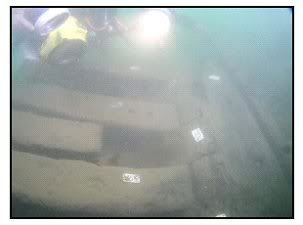
Foto CNANS.
A campanha - Arade 1 - 2005
Os destroços do navio Arade 1 foram localizados em 2001 pelo CNANS, no âmbito do projecto ProArade, que conta com a colaboração da Câmara e do Museu Municipal de Portimão (expressa desde 2004 por uma equipa de arqueologia subaquática dirigida por Cristóvão Fonseca), do Grupo de Estudos Oceânicos/GEO, e que contou em 2002 com a colaboração de equipas da Universidade de Texas A&M e do Museu de Arqueologia e Etnologia da Universidade de S. Paulo.
Em 2001 efectuou-se o registo preliminar dos vestígios deste navio, o que foi continuado e completado em 2002 por uma equipa de alunos da Universidade de Texas A&M dirigida por Filipe Castro, professor de arqueologia náutica nesta universidade. Esta parte do casco do navio foi desmontada em 2003 sob a direcção de Eric Rieth, co-adjuvado por João G. Alves e Paulo Rodrigues.
Na campanha de 2004, dirigida por Vanessa Loureiro e João G. Alves, assessorados cientificamente por Eric Rieth, Francisco Alves e Paulo Rodrigues, foi iniciada a escavação de uma segunda parte do casco do navio, descoberta no final da campanha de 2002, e que se encontrava na continuidade da primeira, mas dela totalmente separada por ruptura e enterrando-se profundamente no talude.
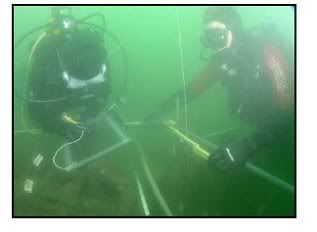
Foto CNANS.
A campanha de 2005, que se realiza entre16 de Maio e 31 de Julho, será novamente dirigida por Vanessa Loureiro e João G. Alves, assessorados cientificamente por Eric Rieth e Francisco Alves, tem por objectivo a escavação completa deste segundo conjunto arquitectural e a sua desmontagem completa após a realização dos habituais registos in situ.
Com efeito, dado o elevado grau de conservação e a importância científica dos vestígios, entendeu-se que os mesmos deveriam ser objecto de desmontagem integral com vista à realização de registos mais pormenorizados em laboratório.
Merece destaque o facto de o CNANS, a partir destes registos de pormenor, prever a execução de uma réplica dos vestígios do navio Arade 1 à escala natural, destinada ao Museu Municipal de Portimão, à imagem da que foi realizada a partir dos vestígios do navio do século XV Ria de Aveiro A e que constituiu o elemento central de uma exposição sobre o tema, realizada no Verão de 2004 no Museu Marítimo de Ílhavo.
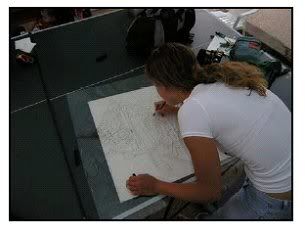
Foto CNANS.
Do ponto de vista técnico-metodológico a campanha Arade 1 2005 implica assim:
1. A continuação da escavação do segundo conjunto arquitectural do navio Arade 1 (abaixo da cota dos -10m).
Limpeza da área envolvente com especial ênfase para a região de bombordo, com o intuito de detectar peças de madeira deslocadas do seu contexto original;
2. A realização dos registos in situ da estrutura, designadamente o perfil axial, os perfis internos das secções do casco transversais à quilha, a planimetria total do navio e a planimetria do casco.
3. A recuperação da âncora de ferro descoberta no interior do casco do navio.
4. A desmontagem progressiva das estruturas escavadas e seu transporte para tratamento laboratorial nas instalações do CNANS.
Bibliografia
Vanessa Loureiro e João G. Alves - O navio Arade I. Relatório da campanha arqueológica de 2004.
Trabalhos do CNANS, 28. Lisboa, 2005.
____
www.dofundodomar.blogspot.com
CNANS
Foto CNANS.
A campanha - Arade 1 - 2005
Os destroços do navio Arade 1 foram localizados em 2001 pelo CNANS, no âmbito do projecto ProArade, que conta com a colaboração da Câmara e do Museu Municipal de Portimão (expressa desde 2004 por uma equipa de arqueologia subaquática dirigida por Cristóvão Fonseca), do Grupo de Estudos Oceânicos/GEO, e que contou em 2002 com a colaboração de equipas da Universidade de Texas A&M e do Museu de Arqueologia e Etnologia da Universidade de S. Paulo.
Em 2001 efectuou-se o registo preliminar dos vestígios deste navio, o que foi continuado e completado em 2002 por uma equipa de alunos da Universidade de Texas A&M dirigida por Filipe Castro, professor de arqueologia náutica nesta universidade. Esta parte do casco do navio foi desmontada em 2003 sob a direcção de Eric Rieth, co-adjuvado por João G. Alves e Paulo Rodrigues.
Na campanha de 2004, dirigida por Vanessa Loureiro e João G. Alves, assessorados cientificamente por Eric Rieth, Francisco Alves e Paulo Rodrigues, foi iniciada a escavação de uma segunda parte do casco do navio, descoberta no final da campanha de 2002, e que se encontrava na continuidade da primeira, mas dela totalmente separada por ruptura e enterrando-se profundamente no talude.
Foto CNANS.
A campanha de 2005, que se realiza entre16 de Maio e 31 de Julho, será novamente dirigida por Vanessa Loureiro e João G. Alves, assessorados cientificamente por Eric Rieth e Francisco Alves, tem por objectivo a escavação completa deste segundo conjunto arquitectural e a sua desmontagem completa após a realização dos habituais registos in situ.
Com efeito, dado o elevado grau de conservação e a importância científica dos vestígios, entendeu-se que os mesmos deveriam ser objecto de desmontagem integral com vista à realização de registos mais pormenorizados em laboratório.
Merece destaque o facto de o CNANS, a partir destes registos de pormenor, prever a execução de uma réplica dos vestígios do navio Arade 1 à escala natural, destinada ao Museu Municipal de Portimão, à imagem da que foi realizada a partir dos vestígios do navio do século XV Ria de Aveiro A e que constituiu o elemento central de uma exposição sobre o tema, realizada no Verão de 2004 no Museu Marítimo de Ílhavo.
Foto CNANS.
Do ponto de vista técnico-metodológico a campanha Arade 1 2005 implica assim:
1. A continuação da escavação do segundo conjunto arquitectural do navio Arade 1 (abaixo da cota dos -10m).
Limpeza da área envolvente com especial ênfase para a região de bombordo, com o intuito de detectar peças de madeira deslocadas do seu contexto original;
2. A realização dos registos in situ da estrutura, designadamente o perfil axial, os perfis internos das secções do casco transversais à quilha, a planimetria total do navio e a planimetria do casco.
3. A recuperação da âncora de ferro descoberta no interior do casco do navio.
4. A desmontagem progressiva das estruturas escavadas e seu transporte para tratamento laboratorial nas instalações do CNANS.
Bibliografia
Vanessa Loureiro e João G. Alves - O navio Arade I. Relatório da campanha arqueológica de 2004.
Trabalhos do CNANS, 28. Lisboa, 2005.
____
www.dofundodomar.blogspot.com
Wine bottle location piques the curiosity of Queen Anne's Revenge researchers
_______________________________________________________________________________________
The Daily News
By Patricia Smith
May 23, 2005
ATLANTIC BEACH - It was an odd place to find a wine bottle.
At least underwater archaeologists didn't expect to find one in the midsection bottom of a sunken ship they think belonged to the pirate Blackbeard.
"It was nestled in between two ballast stones," said Chris Southerly, field supervisor for the state's Queen Anne's Revenge Project, which is doing a monthlong dive at the site.
There it was, an intact onion-shaped bottle - the kind typically used for wine on board ships in the 18th century.
The bottles were durable with a sturdy base, said QAR Project Director Mark Wilde-Ramsing. "Perfect for a rocking ship," he said.
The bottle, found last week, was much like two others divers found on the shipwreck in earlier expeditions, Wilde-Ramsing said. The other two were found in the stern area, in what is believed to be the captain's quarters, along with various science instruments and gold dust.
But this latest one was found in bilge area, not a center of shipboard activity, Wilde-Ramsing said.
Archaeologists don't know if the bottle was put there intentionally.
"It's light enough that it could have been transported as part of the wrecking process," Southerly said.
Moreover, the crew may have reused empty wine bottles, Southerly said.
The bottle contained what appeared to be saltwater and sand, said QAR Project Conservator Sarah Watkins-Kenney.
Then there's another thought.
"It may be an indication that wine bottles were not just confined to the officers' quarters but were spread across the vessel," Southerly said.
That probably would not have been the case on an 18th century merchant ship or navy vessel, Southerly said.
"Typically, sailors would get their rations on a daily basis," he said. "Especially the alcohol would have been regulated on board."
But the discipline on ships that operated outside the law probably varied greatly from ship to ship, Southerly said.
"All the standard rules need not apply aboard a pirate vessel," he said.
Historical accounts show pirate ships did not abide by normal rules, said David Moore, nautical archaeologist and maritime historian for the N.C. Maritime Museum.
"The pirates would drink that stuff up as quickly as they got it so they always had their eyes open for a ship carrying wine," Moore said.
When they got it, a two-to-three-day party would ensue.
"They would do all kinds of strange things," Moore said. "They literally would take baths in the stuff."
Some maritime historians have argued that this lifestyle is what caused many sailors to take up piracy trying to escape what they viewed as oppressive restrictions placed on the military and merchant ships, Southerly said.
____
www.dofundodomar.blogspot.com
The Daily News
By Patricia Smith
May 23, 2005
ATLANTIC BEACH - It was an odd place to find a wine bottle.
At least underwater archaeologists didn't expect to find one in the midsection bottom of a sunken ship they think belonged to the pirate Blackbeard.
"It was nestled in between two ballast stones," said Chris Southerly, field supervisor for the state's Queen Anne's Revenge Project, which is doing a monthlong dive at the site.
There it was, an intact onion-shaped bottle - the kind typically used for wine on board ships in the 18th century.
The bottles were durable with a sturdy base, said QAR Project Director Mark Wilde-Ramsing. "Perfect for a rocking ship," he said.
The bottle, found last week, was much like two others divers found on the shipwreck in earlier expeditions, Wilde-Ramsing said. The other two were found in the stern area, in what is believed to be the captain's quarters, along with various science instruments and gold dust.
But this latest one was found in bilge area, not a center of shipboard activity, Wilde-Ramsing said.
Archaeologists don't know if the bottle was put there intentionally.
"It's light enough that it could have been transported as part of the wrecking process," Southerly said.
Moreover, the crew may have reused empty wine bottles, Southerly said.
The bottle contained what appeared to be saltwater and sand, said QAR Project Conservator Sarah Watkins-Kenney.
Then there's another thought.
"It may be an indication that wine bottles were not just confined to the officers' quarters but were spread across the vessel," Southerly said.
That probably would not have been the case on an 18th century merchant ship or navy vessel, Southerly said.
"Typically, sailors would get their rations on a daily basis," he said. "Especially the alcohol would have been regulated on board."
But the discipline on ships that operated outside the law probably varied greatly from ship to ship, Southerly said.
"All the standard rules need not apply aboard a pirate vessel," he said.
Historical accounts show pirate ships did not abide by normal rules, said David Moore, nautical archaeologist and maritime historian for the N.C. Maritime Museum.
"The pirates would drink that stuff up as quickly as they got it so they always had their eyes open for a ship carrying wine," Moore said.
When they got it, a two-to-three-day party would ensue.
"They would do all kinds of strange things," Moore said. "They literally would take baths in the stuff."
Some maritime historians have argued that this lifestyle is what caused many sailors to take up piracy trying to escape what they viewed as oppressive restrictions placed on the military and merchant ships, Southerly said.
____
www.dofundodomar.blogspot.com
Monday, May 23, 2005
Queen Anne's Revenge dive produces interesting artifacts
_______________________________________________________________________________________
The Daily News
By Patricia Smith
May 23, 2005
ATLANTIC BEACH - Mention Blackbeard's head, and it congers images of the pirate's decapitation after his final battle off Ocracoke.
But state divers found something at the Queen Anne's Revenge shipwreck site last week that gives a whole new meaning to the term.
"It's a pissdale; it's essentially a urinal" said Richard Lawrence, head of the N.C. Underwater Archaeology branch.
And they were apparently pretty common on 18th century vessels - at least in the officers' quarters, said David Moore, nautical archaeologist and maritime historian for the N.C. Maritime Museum.
"Basically it's just a tapered lead tube that leads from the 'seat of ease' as they called it out into the water," Moore said.
It is similar to one Moore saw while working on the wreckage of the Henrietta Marie, a slave ship that went down off Key West, Fla., in 1700. He has seen reports of pissdales found on other shipwrecks from the period.
Divers found the artifact in the area of the wreckage believed to have been the stern of the vessel. It's the same area of the wreckage from which divers have brought up scientific instruments.
"This could well have been in the captain's cabin because that's where we found it," Lawrence said.
The divers are in the middle of a monthlong expedition at the site, which was discovered in Beaufort Inlet in 1996.
The underwater archaeologists also confirmed that what they thought was another cannon in the forward area of the wreckage was indeed another gun.
"It's a big gun; it's probably a 6-pounder," said Queen Anne's Revenge Project Director Mark Wilde-Ramsing. "It's probably a sister gun to the one we found last fall."
That brings the total of cannons and rail guns found at the site to 24.
The 8-foot-long cannon is one of two the QAR team plans to raise from the water Tuesday. The other is a 6-foot gun that would likely have fired a 4-pound cannon ball.
Other artifacts the divers have retrieved this month include a batch of nails, an intact wine bottle, the remains of a cast iron pot, a piece of wood with a ring bolt, bar shot and cannonballs.
____
www.dofundodomar.blogspot.com
The Daily News
By Patricia Smith
May 23, 2005
ATLANTIC BEACH - Mention Blackbeard's head, and it congers images of the pirate's decapitation after his final battle off Ocracoke.
But state divers found something at the Queen Anne's Revenge shipwreck site last week that gives a whole new meaning to the term.
"It's a pissdale; it's essentially a urinal" said Richard Lawrence, head of the N.C. Underwater Archaeology branch.
And they were apparently pretty common on 18th century vessels - at least in the officers' quarters, said David Moore, nautical archaeologist and maritime historian for the N.C. Maritime Museum.
"Basically it's just a tapered lead tube that leads from the 'seat of ease' as they called it out into the water," Moore said.
It is similar to one Moore saw while working on the wreckage of the Henrietta Marie, a slave ship that went down off Key West, Fla., in 1700. He has seen reports of pissdales found on other shipwrecks from the period.
Divers found the artifact in the area of the wreckage believed to have been the stern of the vessel. It's the same area of the wreckage from which divers have brought up scientific instruments.
"This could well have been in the captain's cabin because that's where we found it," Lawrence said.
The divers are in the middle of a monthlong expedition at the site, which was discovered in Beaufort Inlet in 1996.
The underwater archaeologists also confirmed that what they thought was another cannon in the forward area of the wreckage was indeed another gun.
"It's a big gun; it's probably a 6-pounder," said Queen Anne's Revenge Project Director Mark Wilde-Ramsing. "It's probably a sister gun to the one we found last fall."
That brings the total of cannons and rail guns found at the site to 24.
The 8-foot-long cannon is one of two the QAR team plans to raise from the water Tuesday. The other is a 6-foot gun that would likely have fired a 4-pound cannon ball.
Other artifacts the divers have retrieved this month include a batch of nails, an intact wine bottle, the remains of a cast iron pot, a piece of wood with a ring bolt, bar shot and cannonballs.
____
www.dofundodomar.blogspot.com
Archaeological Conservation and its Consequences
______________________________________________________________
Nationalmuseet
By Eva Salomonsen, Kristiane Straetkvern and Irene Skals
August, 1996
A history of the techniques and ethics of conservation at the National Museum of Denmark through the last 150 years
A www version of the exhibition prepared for the IIC conference held in Copenhagen, August 1996
Some restoration methods used in the past are now seen to be directly damaging to the object. Conservators have, in the past, been much bolder in their reconstructions. On the other hand there are examples of ingenious adaptation of the chemical knowledge of the time which have saved objects which would otherwise have crumbled to dust. This exhibition is a respectful but critical appraisal of the evolution of the conservator's trade.
The exhibition was made by Eva Salomonsen, Kristiane Straetkvern and Irene Skals, with contributions by many colleagues, in particular Birthe Gottlieb (X-ray pictures) and John Lee (photographs). This www version of the exhibition is by Tim Padfield.
The tour is divided into three sections:
Waterlogged wood
Textile
Metal
____
www.dofundodomar.blogspot.com
Nationalmuseet
By Eva Salomonsen, Kristiane Straetkvern and Irene Skals
August, 1996
A history of the techniques and ethics of conservation at the National Museum of Denmark through the last 150 years
A www version of the exhibition prepared for the IIC conference held in Copenhagen, August 1996
Some restoration methods used in the past are now seen to be directly damaging to the object. Conservators have, in the past, been much bolder in their reconstructions. On the other hand there are examples of ingenious adaptation of the chemical knowledge of the time which have saved objects which would otherwise have crumbled to dust. This exhibition is a respectful but critical appraisal of the evolution of the conservator's trade.
The exhibition was made by Eva Salomonsen, Kristiane Straetkvern and Irene Skals, with contributions by many colleagues, in particular Birthe Gottlieb (X-ray pictures) and John Lee (photographs). This www version of the exhibition is by Tim Padfield.
The tour is divided into three sections:
Waterlogged wood
Textile
Metal
____
www.dofundodomar.blogspot.com
Sunday, May 22, 2005
Archaeologists believe the 100-year-old canoe came from Central America
__________________________________________________________________________________
TC Palm
By James Kirley
May 20, 2005

MOLLY BARTELS staff photographer.
County employee Tim Taylor hoists a dugout canoe to its final resting place
underneath a walkway at the Environmental Learning Center in Wabasso
on Thursday. Conservationists stabilized and preserved the more than
100-year-old artifact that can now be viewed by the public at the ELC.
WABASSO — Miskito Indians who gouged a 30-foot canoe out of a tree trunk in the late 19th century couldn't imagine it hanging in mid-air from a forklift, on its way to becoming an ocean science exhibit.
The primitive vessel's last voyage between Central America and Vero Beach was powered by ocean currents — liquid highways that have steered plants, animals and maybe even people between continents since prehistoric times.
"The canoe is sort of a hint," Vero Beach marine biologist Grant Gilmore said. "We tend to focus on man-made objects."
But lots of things ride the Caribbean Current to local shores from Honduras or Nicaragua — where state archaeologists believe the dugout canoe originated — and from other parts of Central and South America.
Several types of seeds collectively called sea beans arrive on the current, as have brown anole lizards that scamper through Treasure Coast yards, and Cuban tree frogs that ambush bugs next to porch lights.
"They ride on flotsam, on logs or dugout canoes — who knows what was riding along on that thing?" mused ecologist David Cox of Sebastian.

MOLLY BARTELS staff photographer.
County employee Solomon Berton, tries to figure out how he and a
group of volunteers are going to move a 30-foot dugout canoe that
weighs almost 800 pounds across a grassy area at the Environmental
Learning Center on Thursday. The canoe washed ashore on the beach
just south of Round Island Park in October 2002. The canoe has been
restored and will be on display at the Environmental Learning Center.
All that was temporarily lost on County Historian Ruth Stanbridge. She cringed Thursday as the forklift hoisted the artifact high into the air and pushed it through tall trees on its way to permanent display at the Environmental Learning Center on Wabasso Island.
"This may be the most exciting part of the trip," Cox said. "The first few thousand miles it was just bobbing along!"
That voyage ended October 2002, when a group of vacationing schoolteachers walking the beach near Round Island Park found the waterlogged dugout floating in the surf. They phoned Gilmore, who contacted Stanbridge, who contacted the Florida Bureau of Archaeological Research in Tallahassee.
They recommended the canoe be resubmerged to prevent the wood from drying and cracking. So county parks workers sank it in a freshwater pond behind their Hobart Park office.
It was visited by a state field archaeologist several weeks later. He decided it had been made using fire and metal tools, and estimated the canoe's age at a bit more than 100 years.
Dried in a shady area, the dugout was ready for moving to the Environmental Learning Center on Thursday.
Gilmore explained part of the Caribbean Current flows through the Florida Straits. Objects borne by it can then be picked up by the Gulf Stream, which flows north through the Atlantic Ocean and passes east of the Treasure Coast.
Fish make the trip, too. Gilmore said he recently found a species native to the Yucatan Peninsula near Belize living in Florida's Everglades.

"It was in a place where people wouldn't normally go to release aquarium fish," he said.
And the canoe reminded Gilmore of a theory he's nursed for years, that the extinct Ais Indians native to the Treasure Coast may have originated in Central America.
"We tend to think of the ocean as something that separates us," he said. "But the world's a lot smaller than we realize and the ocean brings us together."
____
www.dofundodomar.blogspot.com
TC Palm
By James Kirley
May 20, 2005
MOLLY BARTELS staff photographer.
County employee Tim Taylor hoists a dugout canoe to its final resting place
underneath a walkway at the Environmental Learning Center in Wabasso
on Thursday. Conservationists stabilized and preserved the more than
100-year-old artifact that can now be viewed by the public at the ELC.
WABASSO — Miskito Indians who gouged a 30-foot canoe out of a tree trunk in the late 19th century couldn't imagine it hanging in mid-air from a forklift, on its way to becoming an ocean science exhibit.
The primitive vessel's last voyage between Central America and Vero Beach was powered by ocean currents — liquid highways that have steered plants, animals and maybe even people between continents since prehistoric times.
"The canoe is sort of a hint," Vero Beach marine biologist Grant Gilmore said. "We tend to focus on man-made objects."
But lots of things ride the Caribbean Current to local shores from Honduras or Nicaragua — where state archaeologists believe the dugout canoe originated — and from other parts of Central and South America.
Several types of seeds collectively called sea beans arrive on the current, as have brown anole lizards that scamper through Treasure Coast yards, and Cuban tree frogs that ambush bugs next to porch lights.
"They ride on flotsam, on logs or dugout canoes — who knows what was riding along on that thing?" mused ecologist David Cox of Sebastian.
MOLLY BARTELS staff photographer.
County employee Solomon Berton, tries to figure out how he and a
group of volunteers are going to move a 30-foot dugout canoe that
weighs almost 800 pounds across a grassy area at the Environmental
Learning Center on Thursday. The canoe washed ashore on the beach
just south of Round Island Park in October 2002. The canoe has been
restored and will be on display at the Environmental Learning Center.
All that was temporarily lost on County Historian Ruth Stanbridge. She cringed Thursday as the forklift hoisted the artifact high into the air and pushed it through tall trees on its way to permanent display at the Environmental Learning Center on Wabasso Island.
"This may be the most exciting part of the trip," Cox said. "The first few thousand miles it was just bobbing along!"
That voyage ended October 2002, when a group of vacationing schoolteachers walking the beach near Round Island Park found the waterlogged dugout floating in the surf. They phoned Gilmore, who contacted Stanbridge, who contacted the Florida Bureau of Archaeological Research in Tallahassee.
They recommended the canoe be resubmerged to prevent the wood from drying and cracking. So county parks workers sank it in a freshwater pond behind their Hobart Park office.
It was visited by a state field archaeologist several weeks later. He decided it had been made using fire and metal tools, and estimated the canoe's age at a bit more than 100 years.
Dried in a shady area, the dugout was ready for moving to the Environmental Learning Center on Thursday.
Gilmore explained part of the Caribbean Current flows through the Florida Straits. Objects borne by it can then be picked up by the Gulf Stream, which flows north through the Atlantic Ocean and passes east of the Treasure Coast.
Fish make the trip, too. Gilmore said he recently found a species native to the Yucatan Peninsula near Belize living in Florida's Everglades.
"It was in a place where people wouldn't normally go to release aquarium fish," he said.
And the canoe reminded Gilmore of a theory he's nursed for years, that the extinct Ais Indians native to the Treasure Coast may have originated in Central America.
"We tend to think of the ocean as something that separates us," he said. "But the world's a lot smaller than we realize and the ocean brings us together."
____
www.dofundodomar.blogspot.com
Scientists learning more about shipwreck
__________________________________________________________________________________
Delaware online
By Molly Murray
May 20, 2005
Sunken vessel in Lewes found after sand dredging
What lies beneath the surface of Delaware Bay near Roosevelt Inlet is a 71-foot-long ship with little of the hull structure remaining, state archaeologists said Thursday.
It could be a collier brig, a brig or a sloop -- making it almost as big as Delaware's most famous shipwreck, the 18th century British brig DeBraak, said Charles Fithian, a state archaeologist and authority on the DeBraak.
This wreck, though, is earlier and may help historians and archaeologists gain better understanding of coastal trade and commerce in the mid-18th century, Fithian said.
Modern television talk show hosts have it all wrong, Fithian said. "They make globalization seem like it was something new but it wasn't."
Artifacts from the Lewes Beach shipwreck, now known by state officials as the Lewes Discovery Site, come from an array of places -- seltzer water bottles from Germany, porcelain that may be from China and pottery from Great Britain. There are tiny miniature ships and soldiers, a toy clock face, a miniature tea pot and on the larger scale -- two enormous millstones -- one 4 feet in diameter and the other 3 feet -- that were never used in a mill.
Archaeologists know this because the furrows that a miller would cut in the stone are missing, Fithian said.
"We don't know the origin. We suspect them to be British. We know they are not French."
As it turns out, the Lewes Discovery Site may be one of Delaware Bay's greatest maritime mysteries and its earliest known shipwreck.
It was discovered by accident after the Army Corps of Engineers pumped 165,000 cubic yards of sand on Lewes beach as part of a replenishment project that began shortly after Labor Day weekend.
State and federal officials now know the sand-pumping dredge hit a corner of the shipwreck.
There was no sign of the wreck on earlier underwater surveys done prior to the sand pumping.
Once the project was completed -- in October -- beachcombers started finding hundreds of shards of glass and pottery along a half-mile stretch of beach in front of Lewes Yacht Club.
State and federal officials investigated, and concluded just last month, that the artifacts on the beach matched a shipwreck about a half-mile off the beach in 14 feet of water.
In recent weeks, a team of divers tried to get a better idea of the size of the ship and what it was carrying.
"Every ship has a keel. It has a bow. It has a stern," said Craig Lukezic, a state archaeologist who also has been working on the project.
The first step was to find a structure, where timbers intersect and what types of fasteners were used, he said.
Whether they will ever be able to positively identify the ship is uncertain but state officials believe the wreck is vital to better understanding early Colonial trade both in the region and the world.
They believe the ship dates from the mid-1750s -- far earlier than the 1798 DeBraak, which sank in a sudden windstorm off Cape Henlopen in 1798.
"There is some ship's structure there," said Daniel R. Griffith, director of the state's newly formed Lewes Maritime Archaeology Project.
But what is missing -- they have found no masts, no rigging and no fittings -- may be more telling.
They have found and recovered hundreds of fragments of glass and pottery, a shoe sole and shoe buckles, but no sign of human remains, Griffith said.
State officials are trying to determine what additional work is needed.
The next step is to begin detailed research of historic records from the time period to see if archaeologists can learn more about the ship, where it was headed and why it carried millstones, pottery and tiny lead models of ships and soldiers.
"The story is not over," Fithian said. "We've got a long way to go."
____
www.dofundodomar.blogspot.com
Delaware online
By Molly Murray
May 20, 2005
Sunken vessel in Lewes found after sand dredging
What lies beneath the surface of Delaware Bay near Roosevelt Inlet is a 71-foot-long ship with little of the hull structure remaining, state archaeologists said Thursday.
It could be a collier brig, a brig or a sloop -- making it almost as big as Delaware's most famous shipwreck, the 18th century British brig DeBraak, said Charles Fithian, a state archaeologist and authority on the DeBraak.
This wreck, though, is earlier and may help historians and archaeologists gain better understanding of coastal trade and commerce in the mid-18th century, Fithian said.
Modern television talk show hosts have it all wrong, Fithian said. "They make globalization seem like it was something new but it wasn't."
Artifacts from the Lewes Beach shipwreck, now known by state officials as the Lewes Discovery Site, come from an array of places -- seltzer water bottles from Germany, porcelain that may be from China and pottery from Great Britain. There are tiny miniature ships and soldiers, a toy clock face, a miniature tea pot and on the larger scale -- two enormous millstones -- one 4 feet in diameter and the other 3 feet -- that were never used in a mill.
Archaeologists know this because the furrows that a miller would cut in the stone are missing, Fithian said.
"We don't know the origin. We suspect them to be British. We know they are not French."
As it turns out, the Lewes Discovery Site may be one of Delaware Bay's greatest maritime mysteries and its earliest known shipwreck.
It was discovered by accident after the Army Corps of Engineers pumped 165,000 cubic yards of sand on Lewes beach as part of a replenishment project that began shortly after Labor Day weekend.
State and federal officials now know the sand-pumping dredge hit a corner of the shipwreck.
There was no sign of the wreck on earlier underwater surveys done prior to the sand pumping.
Once the project was completed -- in October -- beachcombers started finding hundreds of shards of glass and pottery along a half-mile stretch of beach in front of Lewes Yacht Club.
State and federal officials investigated, and concluded just last month, that the artifacts on the beach matched a shipwreck about a half-mile off the beach in 14 feet of water.
In recent weeks, a team of divers tried to get a better idea of the size of the ship and what it was carrying.
"Every ship has a keel. It has a bow. It has a stern," said Craig Lukezic, a state archaeologist who also has been working on the project.
The first step was to find a structure, where timbers intersect and what types of fasteners were used, he said.
Whether they will ever be able to positively identify the ship is uncertain but state officials believe the wreck is vital to better understanding early Colonial trade both in the region and the world.
They believe the ship dates from the mid-1750s -- far earlier than the 1798 DeBraak, which sank in a sudden windstorm off Cape Henlopen in 1798.
"There is some ship's structure there," said Daniel R. Griffith, director of the state's newly formed Lewes Maritime Archaeology Project.
But what is missing -- they have found no masts, no rigging and no fittings -- may be more telling.
They have found and recovered hundreds of fragments of glass and pottery, a shoe sole and shoe buckles, but no sign of human remains, Griffith said.
State officials are trying to determine what additional work is needed.
The next step is to begin detailed research of historic records from the time period to see if archaeologists can learn more about the ship, where it was headed and why it carried millstones, pottery and tiny lead models of ships and soldiers.
"The story is not over," Fithian said. "We've got a long way to go."
____
www.dofundodomar.blogspot.com
Beach visitors instructed to turn in potential artifacts
__________________________________________________________________________________
WMDT
May 20, 2005
LEWES, Del. - Residents and beach-season visitors to Lewes are being given instructions how to handle any potentially historic artifacts they might find in the sand.
The state posted signs yesterday informing beach goers that they can take the items to the nearby Zwaanendael Museum for examination.
Since December, the Lewes beach has been the site of an archaeological dig after a beach dredging project deposited items from what is believed to be a cargo ship that sank in the 1700s.
____
www.dofundodomar.blogspot.com
WMDT
May 20, 2005
LEWES, Del. - Residents and beach-season visitors to Lewes are being given instructions how to handle any potentially historic artifacts they might find in the sand.
The state posted signs yesterday informing beach goers that they can take the items to the nearby Zwaanendael Museum for examination.
Since December, the Lewes beach has been the site of an archaeological dig after a beach dredging project deposited items from what is believed to be a cargo ship that sank in the 1700s.
____
www.dofundodomar.blogspot.com
Saturday, May 21, 2005
Waiting on Sunken Treasure
__________________________________________________________________________________
Sci-Tech Today
May 19, 2005
Although the "finders keepers" principle applies to most shipwrecks in international waters, archaeologists have taken some consolation in the fact that the rights to "sovereign" vessels like the Sussex are retained by the country under whose flag they sailed, wherever they sank.
The British warship HMS Sussex, lost in a storm off Gibraltar in 1694 with billions of dollars worth of gold bullion and 500 seamen, will have to stay lost a little longer.
Tampa-based Odyssey Marine Exploration, which was poised this spring to start archaeological and treasure recovery work on what it believes to be the more than 300-year-old shipwreck, has put the project on hold after last-minute objections from Andalusia.
The Spanish region's government, despite prior central government approval of the project, last month sent its Guardia Civil patrols to board Odyssey's research vessel and now demands a say-so in one of the most anticipated --- and controversial --- deep-water excavations ever planned.
Odyssey, eager to stay on good terms with anyone claiming maritime interests in the shipwreck-rich Mediterranean, announced last week that it would concentrate on five other "high-value targets" until things are ironed out with Andalusia's department of culture.
"We'd all like to see the Sussex project move ahead, but we have other projects that could prove as valuable," says Odyssey co-founder Greg Stemm. He says the company plans to return to the Sussex later in the year.
The ease with which the firm has shifted operations to other sites is a testimonial to how many potentially lucrative shipwrecks litter the floor of the Mediterranean, and how successful the firm's advanced deep-water search technology has been in locating them.
The sudden snag in the Sussex project, after years of preparation, also provides a glimpse of the political and emotional gulf that divides those who seek treasure in the deep ocean floor and those who see it as a repository of maritime history.
Odyssey, which last year recovered 51,000 gold and silver coins and thousands of other artifacts from the Civil War-era wreck of the SS Republic off the Georgia coast, claims that it serves both goals: raising saleable artifacts that it says have little value to archaeology and items of unique cultural importance for preservation and exhibit.
The total value of the Republic operation has yet to be determined, but with two ships in its fleet and a third under lease, Odyssey has set out to become the leading for-profit shipwreck exploration company in the world.
Archeologists fear such ambitions are no idle boast. Although there are an estimated 3 million undiscovered shipwrecks worldwide, archaeologists say advanced deep-water technology such as Odyssey's side-scan sonar and deep-diving robots will expose these cultural "time capsules" to commercial exploitation.
"The problem is that salvage operations are driven by time and money, not by what can be learned from the wreck" says Robert Neyland, the chief archaeologist for the U.S. Navy, who headed recovery of the Confederate submarine H.L. Hunley. "Commercial salvage and archaeology are not compatible."
Although the "finders keepers" principle applies to most shipwrecks in international waters, archaeologists have taken some consolation in the fact that the rights to "sovereign" vessels like the Sussex are retained by the country under whose flag they sailed, wherever they sank.
But to the horror of British archaeologists, Odyssey has struck a first-of-a-kind deal with the British defense ministry that provides a sliding scale for the division of treasure, the conservation of artifacts, and the sale of media rights.
Because the Sussex, the flagship of a 13-ship fleet, sank while it was carrying a vast sum of money and six tons of gold intended to assure the loyalty of the Duke of Savoy to England in the war with France, both parties to the agreement could wind up with billions.
George Lambrick, director of the Council for British Archaeology, calls the deal "a blatant piece of heritage asset stripping" that will "legitimize commercial treasure hunting for financial rewards on a grand scale."
The British government would get 60 percent of any take over $500 million. "This deal would not have been struck if millions --- perhaps billions --- of dollars were not at stake," Limbrick says.
"With its eye firmly on booty not culture, it looks as if the government is reneging on the basic principles of archaeological management that it has championed elsewhere," he says.
At least on the surface, the deal is at odds with the United Nations Educational, Scientific and Cultural Organization Convention on the Protection of Underwater Cultural Heritage, a 2001 international agreement that has yet to be ratified. It states that "underwater cultural heritage shall not be commercially exploited."
Lambrick says he's concerned that the Sussex agreement will set "a dangerous precedent for the exploitation of wrecks in other waters" from 2,000-year-old Roman galleys in the Mediterranean to treasure-laden Spanish galleons in the Gulf of Mexico.
When it comes to sunken treasure, the glimmer of gold --- like the will of a rich uncle --- has a way of bringing potential heirs out of the woodwork. Odyssey, for instance, last year paid $1.6 million to Atlantic Mutual Insurance Co. , which had insured a portion of the SS Republic's cargo a century and a half ago --- to resolve its claim to the wreck.
With a formal agreement from Great Britain in hand and the approval of the project by the Spanish government, the only remaining obstacles to the Sussex project appeared to be technical ones.
Then the mouse roared. Andalusian authorities contend that it's possible a British flagship sailing through the straits of Gibraltar on its way to France in 1694 just might have had something that belonged to Spain on board.
Or perhaps because of the wreck's proximity to Spain, it's not the Sussex at all, but a Spanish vessel.
And even though the wreck lies outside territorial waters in what Spain has designated "an adjacent area," Andalusia insists that it, too, must approve the project --- perhaps in return for a small share of the take.
____
www.dofundodomar.blogspot.com
Sci-Tech Today
May 19, 2005
Although the "finders keepers" principle applies to most shipwrecks in international waters, archaeologists have taken some consolation in the fact that the rights to "sovereign" vessels like the Sussex are retained by the country under whose flag they sailed, wherever they sank.
The British warship HMS Sussex, lost in a storm off Gibraltar in 1694 with billions of dollars worth of gold bullion and 500 seamen, will have to stay lost a little longer.
Tampa-based Odyssey Marine Exploration, which was poised this spring to start archaeological and treasure recovery work on what it believes to be the more than 300-year-old shipwreck, has put the project on hold after last-minute objections from Andalusia.
The Spanish region's government, despite prior central government approval of the project, last month sent its Guardia Civil patrols to board Odyssey's research vessel and now demands a say-so in one of the most anticipated --- and controversial --- deep-water excavations ever planned.
Odyssey, eager to stay on good terms with anyone claiming maritime interests in the shipwreck-rich Mediterranean, announced last week that it would concentrate on five other "high-value targets" until things are ironed out with Andalusia's department of culture.
"We'd all like to see the Sussex project move ahead, but we have other projects that could prove as valuable," says Odyssey co-founder Greg Stemm. He says the company plans to return to the Sussex later in the year.
The ease with which the firm has shifted operations to other sites is a testimonial to how many potentially lucrative shipwrecks litter the floor of the Mediterranean, and how successful the firm's advanced deep-water search technology has been in locating them.
The sudden snag in the Sussex project, after years of preparation, also provides a glimpse of the political and emotional gulf that divides those who seek treasure in the deep ocean floor and those who see it as a repository of maritime history.
Odyssey, which last year recovered 51,000 gold and silver coins and thousands of other artifacts from the Civil War-era wreck of the SS Republic off the Georgia coast, claims that it serves both goals: raising saleable artifacts that it says have little value to archaeology and items of unique cultural importance for preservation and exhibit.
The total value of the Republic operation has yet to be determined, but with two ships in its fleet and a third under lease, Odyssey has set out to become the leading for-profit shipwreck exploration company in the world.
Archeologists fear such ambitions are no idle boast. Although there are an estimated 3 million undiscovered shipwrecks worldwide, archaeologists say advanced deep-water technology such as Odyssey's side-scan sonar and deep-diving robots will expose these cultural "time capsules" to commercial exploitation.
"The problem is that salvage operations are driven by time and money, not by what can be learned from the wreck" says Robert Neyland, the chief archaeologist for the U.S. Navy, who headed recovery of the Confederate submarine H.L. Hunley. "Commercial salvage and archaeology are not compatible."
Although the "finders keepers" principle applies to most shipwrecks in international waters, archaeologists have taken some consolation in the fact that the rights to "sovereign" vessels like the Sussex are retained by the country under whose flag they sailed, wherever they sank.
But to the horror of British archaeologists, Odyssey has struck a first-of-a-kind deal with the British defense ministry that provides a sliding scale for the division of treasure, the conservation of artifacts, and the sale of media rights.
Because the Sussex, the flagship of a 13-ship fleet, sank while it was carrying a vast sum of money and six tons of gold intended to assure the loyalty of the Duke of Savoy to England in the war with France, both parties to the agreement could wind up with billions.
George Lambrick, director of the Council for British Archaeology, calls the deal "a blatant piece of heritage asset stripping" that will "legitimize commercial treasure hunting for financial rewards on a grand scale."
The British government would get 60 percent of any take over $500 million. "This deal would not have been struck if millions --- perhaps billions --- of dollars were not at stake," Limbrick says.
"With its eye firmly on booty not culture, it looks as if the government is reneging on the basic principles of archaeological management that it has championed elsewhere," he says.
At least on the surface, the deal is at odds with the United Nations Educational, Scientific and Cultural Organization Convention on the Protection of Underwater Cultural Heritage, a 2001 international agreement that has yet to be ratified. It states that "underwater cultural heritage shall not be commercially exploited."
Lambrick says he's concerned that the Sussex agreement will set "a dangerous precedent for the exploitation of wrecks in other waters" from 2,000-year-old Roman galleys in the Mediterranean to treasure-laden Spanish galleons in the Gulf of Mexico.
When it comes to sunken treasure, the glimmer of gold --- like the will of a rich uncle --- has a way of bringing potential heirs out of the woodwork. Odyssey, for instance, last year paid $1.6 million to Atlantic Mutual Insurance Co. , which had insured a portion of the SS Republic's cargo a century and a half ago --- to resolve its claim to the wreck.
With a formal agreement from Great Britain in hand and the approval of the project by the Spanish government, the only remaining obstacles to the Sussex project appeared to be technical ones.
Then the mouse roared. Andalusian authorities contend that it's possible a British flagship sailing through the straits of Gibraltar on its way to France in 1694 just might have had something that belonged to Spain on board.
Or perhaps because of the wreck's proximity to Spain, it's not the Sussex at all, but a Spanish vessel.
And even though the wreck lies outside territorial waters in what Spain has designated "an adjacent area," Andalusia insists that it, too, must approve the project --- perhaps in return for a small share of the take.
____
www.dofundodomar.blogspot.com
Experienced scuba diver drowns diving for artifacts in Florida
__________________________________________________________________________________
CDNN
by Jorge Sanchez and Jamal Thalji
May 17, 2005
RED LEVEL, Florida -- A scuba diver drowned while diving for artifacts in the Withlacoochee River Saturday morning.
Lemley Lawton Parker, 27, of Dade City was scuba diving with friends when he broke to the surface, shouting that he needed help, according to a report from the Citrus County Sheriff's Office.
His cries were heard by Tina Tetterton, 25, aboard the party's dive boat on the Withlacoochee River in northwestern Citrus.
"She took the boat closer to where he was and threw him the anchor line," said Gail Tierney, public information officer for the Sheriff's Office. "But he didn't seem to be able to grab it and then he went back under again."
Tetterton started screaming, Tierney said, and her husband, Larry, who had been diving, also surfaced and discovered what was happening. He dived down and came up with Parker's body, according to the sheriff's report.
Larry Tetterton took the body to the riverbank and started CPR, the report said, while a call was made to 911.
Citrus emergency medical service crews arrived and also performed CPR, but Parker could not be revived. He was taken to Seven Rivers Regional Medical Center in Crystal River, where he was pronounced dead.
His body was taken to the Medical Examiner's Office for an autopsy, according to the Sheriff's Office, which is investigating the drowning.
Tetterton said the three shared a common interest in archaeology and had attended a seminar in Gainesville a week before. He said they selected the dive area because the water quality would be sufficiently clear.
"He was as genuine and original a person as you could ever meet," Tetterton said of his friend Parker, who worked as an aluminum enclosure installer.
Parker's family said he was an avid fossil hunter.
Jack and Mary Ann Bailey remembered their son for his love of the outdoors. His American Indian heritage had inspired his hobby the past four years.
His most prized possessions sit in collector's boxes at his parent's house, including a small group of spearheads, some of which are 8,000 to 12,000 years old.
"He was infatuated with it," his mother said. "He was overwhelmed by it."
Tetterton said he doesn't know what caused the drowning. Parker was unable to speak to him after he pulled him from the river.
The drowning occurred near Sunflower Point, a street that ends at the river, shortly after 11 a.m. Saturday.
The divers were in the Withlacoochee about a mile west of the Lake Rousseau Dam, according to the sheriff's report.
They were searching for artifacts such as arrowheads in the river.
The Tettertons live in Hernando and had known Parker for about three years, but this was their first diving trip together.
The parents said no one can tell them what happened to their son. He was asthmatic, but there is no indication what role that may have played in his death. He was an experienced swimmer and scuba diver. His oxygen tank was fine, his mother said, with plenty of pressure in it.
The river, they were told, was 12 feet to 15 feet deep at most, and their son stood 6 feet 5.
"The outdoors, that was his thing," his mother said. "That's where he felt most comfortable. That's the last place we would expect something like that to happen. I would expect him to be run over with a car before something like this."
____
www.dofundodomar.blogspot.com
CDNN
by Jorge Sanchez and Jamal Thalji
May 17, 2005
RED LEVEL, Florida -- A scuba diver drowned while diving for artifacts in the Withlacoochee River Saturday morning.
Lemley Lawton Parker, 27, of Dade City was scuba diving with friends when he broke to the surface, shouting that he needed help, according to a report from the Citrus County Sheriff's Office.
His cries were heard by Tina Tetterton, 25, aboard the party's dive boat on the Withlacoochee River in northwestern Citrus.
"She took the boat closer to where he was and threw him the anchor line," said Gail Tierney, public information officer for the Sheriff's Office. "But he didn't seem to be able to grab it and then he went back under again."
Tetterton started screaming, Tierney said, and her husband, Larry, who had been diving, also surfaced and discovered what was happening. He dived down and came up with Parker's body, according to the sheriff's report.
Larry Tetterton took the body to the riverbank and started CPR, the report said, while a call was made to 911.
Citrus emergency medical service crews arrived and also performed CPR, but Parker could not be revived. He was taken to Seven Rivers Regional Medical Center in Crystal River, where he was pronounced dead.
His body was taken to the Medical Examiner's Office for an autopsy, according to the Sheriff's Office, which is investigating the drowning.
Tetterton said the three shared a common interest in archaeology and had attended a seminar in Gainesville a week before. He said they selected the dive area because the water quality would be sufficiently clear.
"He was as genuine and original a person as you could ever meet," Tetterton said of his friend Parker, who worked as an aluminum enclosure installer.
Parker's family said he was an avid fossil hunter.
Jack and Mary Ann Bailey remembered their son for his love of the outdoors. His American Indian heritage had inspired his hobby the past four years.
His most prized possessions sit in collector's boxes at his parent's house, including a small group of spearheads, some of which are 8,000 to 12,000 years old.
"He was infatuated with it," his mother said. "He was overwhelmed by it."
Tetterton said he doesn't know what caused the drowning. Parker was unable to speak to him after he pulled him from the river.
The drowning occurred near Sunflower Point, a street that ends at the river, shortly after 11 a.m. Saturday.
The divers were in the Withlacoochee about a mile west of the Lake Rousseau Dam, according to the sheriff's report.
They were searching for artifacts such as arrowheads in the river.
The Tettertons live in Hernando and had known Parker for about three years, but this was their first diving trip together.
The parents said no one can tell them what happened to their son. He was asthmatic, but there is no indication what role that may have played in his death. He was an experienced swimmer and scuba diver. His oxygen tank was fine, his mother said, with plenty of pressure in it.
The river, they were told, was 12 feet to 15 feet deep at most, and their son stood 6 feet 5.
"The outdoors, that was his thing," his mother said. "That's where he felt most comfortable. That's the last place we would expect something like that to happen. I would expect him to be run over with a car before something like this."
____
www.dofundodomar.blogspot.com
Archaeology and the Fate of Amelia Earhart
__________________________________________________________________________________
Archaeology.About.com
from Thomas F. King, TIGHAR
The Loss of an Aviation PioneerOn July 2, 1937, aviation pioneers Amelia Earhart and Fred Noonan vanished into legend. The two explorers--Earhart piloting, Noonan navigating--were trying to be the first to circumnavigate the globe at the equator, and they’d made it all the way around from Oakland, California eastward to Lae, New Guinea.
On the morning of the 2nd their fuel-heavy Lockheed Electra 10E took off from Lae heading for Howland Island, a tiny speck of coral in the mid-Pacific, where they were to refuel and fly to Honolulu, and thence back to Oakland.
They didn’t make it. The US Coast Guard Cutter Itasca, lying off Howland, received messages from them--the last saying that they were flying “on the line 157-337”--but couldn’t establish two-way communication or a radio direction-finding fix. Earhart and Noonan couldn’t see the island, or communicate with Itasca.
The messages ended, and that was that.The U.S. didn’t give Earhart up easily. She was a tremendous celebrity--a heroine at a time when people badly needed heroines. First woman across the Atlantic, first woman to fly nonstop across the U.S. First to fly to the mainland from Hawaii. Women’s altitude record holder. She was an inspiration to young women everywhere. You, she insisted and demonstrated, can do anything a man can do.
So the nation wasn’t ready to shrug its shoulders and accept that she was gone. Nor was her husband and partner George Putnam, who had been her supporter and agent from the start. Putnam did everything but break down doors at the War Department, the State Department, and the White House, insisting that the Navy, the Coast Guard, the British in the nearby Crown Colony of the Gilbert and Ellice Islands turn the Pacific upside down looking for her.
They tried; the aircraft carrier Lexington, the battleship Colorado, and other Navy and Coast Guard ships and planes criss-crossed the area where she’d last been heard. The British deployed island residents to search the shores of the Gilbert and Ellice Islands for debris, and sent a chartered boat out to investigate a location where Putnam--possibly on the advice of a medium--thought Earhart might be. But everyone came up empty-handed. Earhart’s fate, Noonan’s fate, remain a mystery.
Mysteries demand solutions, and many answers to the Earhart/Noonan mystery have been proposed over the years. They ran out of gas and crashed at sea. They were captured by the Japanese and executed. They were involved in an elaborate espionage operation against the Japanese, and were secreted in other countries, or in the U.S. under assumed names. They were seized by aliens, or blundered through a Bermuda Triangle-type rip in the time-space continuum. Books have been written, television shows produced, archives searched, islanders and World War II GIs and Japanese officials interviewed. Lots of assertions have been made, lots of allegations have been confidently stated but lightly substantiated.
Proponents of the various “theories” typically ignore or dismiss all others but their own, though there are some vituperative arguments behind the scenes. But no one has proved anything. In the late 1980s, a tiny non-profit group in Wilmington, Delaware--The International Group for Historic Aircraft Recovery or TIGHAR (pronounced “tiger”)--entered the fray. Organized by the dynamic husband-wife team of Ric Gillespie and Pat Thrasher, who continue to oversee its operations today, one of TIGHAR’s purposes is to apply scientific techniques to investigating aviation historical mysteries.
TIGHAR had avoided the Earhart arguments because none of the hypotheses put forward seemed testable using available methods, but then two retired navigators, Tom Gannon and Tom Willi, approached Gillespie with a “new” idea that was testable--using, among others, the methods of archaeology.
As an archaeologist with Pacific island experience and a dearth of common sense, I got involved in TIGHAR’s work, and we’ve been at it ever since. Our adventures in pursuit of Earhart and Noonan are recounted in a book that several of my colleagues and I published a few years ago, and republished in 2004 in updated, expanded form, called Amelia Earhart’s Shoes (AltaMira Press, 2004).
Ric Gillespie is finishing work on a more exhaustive book about the disappearance, the search, and our studies--particularly a study of the many radio messages received after Earhart’s disappearance that were at first thought to have come from her and later were dismissed as mistakes and hoaxes.
We hope that book, tentatively titled The Suitcase in My Closet, will be in bookstores within the next year or so. Our project is an interdisciplinary one--our all-volunteer research team includes oceanographers, meteorologists, experts in navigation, radio science, island geology and ecology, forensic anthropology, and a host of other fields. In this article I’d like to focus on how my own science--archaeology--is contributing to the study.
____
www.dofundodomar.blogspot.com
Archaeology.About.com
from Thomas F. King, TIGHAR
The Loss of an Aviation PioneerOn July 2, 1937, aviation pioneers Amelia Earhart and Fred Noonan vanished into legend. The two explorers--Earhart piloting, Noonan navigating--were trying to be the first to circumnavigate the globe at the equator, and they’d made it all the way around from Oakland, California eastward to Lae, New Guinea.
On the morning of the 2nd their fuel-heavy Lockheed Electra 10E took off from Lae heading for Howland Island, a tiny speck of coral in the mid-Pacific, where they were to refuel and fly to Honolulu, and thence back to Oakland.
They didn’t make it. The US Coast Guard Cutter Itasca, lying off Howland, received messages from them--the last saying that they were flying “on the line 157-337”--but couldn’t establish two-way communication or a radio direction-finding fix. Earhart and Noonan couldn’t see the island, or communicate with Itasca.
The messages ended, and that was that.The U.S. didn’t give Earhart up easily. She was a tremendous celebrity--a heroine at a time when people badly needed heroines. First woman across the Atlantic, first woman to fly nonstop across the U.S. First to fly to the mainland from Hawaii. Women’s altitude record holder. She was an inspiration to young women everywhere. You, she insisted and demonstrated, can do anything a man can do.
So the nation wasn’t ready to shrug its shoulders and accept that she was gone. Nor was her husband and partner George Putnam, who had been her supporter and agent from the start. Putnam did everything but break down doors at the War Department, the State Department, and the White House, insisting that the Navy, the Coast Guard, the British in the nearby Crown Colony of the Gilbert and Ellice Islands turn the Pacific upside down looking for her.
They tried; the aircraft carrier Lexington, the battleship Colorado, and other Navy and Coast Guard ships and planes criss-crossed the area where she’d last been heard. The British deployed island residents to search the shores of the Gilbert and Ellice Islands for debris, and sent a chartered boat out to investigate a location where Putnam--possibly on the advice of a medium--thought Earhart might be. But everyone came up empty-handed. Earhart’s fate, Noonan’s fate, remain a mystery.
Mysteries demand solutions, and many answers to the Earhart/Noonan mystery have been proposed over the years. They ran out of gas and crashed at sea. They were captured by the Japanese and executed. They were involved in an elaborate espionage operation against the Japanese, and were secreted in other countries, or in the U.S. under assumed names. They were seized by aliens, or blundered through a Bermuda Triangle-type rip in the time-space continuum. Books have been written, television shows produced, archives searched, islanders and World War II GIs and Japanese officials interviewed. Lots of assertions have been made, lots of allegations have been confidently stated but lightly substantiated.
Proponents of the various “theories” typically ignore or dismiss all others but their own, though there are some vituperative arguments behind the scenes. But no one has proved anything. In the late 1980s, a tiny non-profit group in Wilmington, Delaware--The International Group for Historic Aircraft Recovery or TIGHAR (pronounced “tiger”)--entered the fray. Organized by the dynamic husband-wife team of Ric Gillespie and Pat Thrasher, who continue to oversee its operations today, one of TIGHAR’s purposes is to apply scientific techniques to investigating aviation historical mysteries.
TIGHAR had avoided the Earhart arguments because none of the hypotheses put forward seemed testable using available methods, but then two retired navigators, Tom Gannon and Tom Willi, approached Gillespie with a “new” idea that was testable--using, among others, the methods of archaeology.
As an archaeologist with Pacific island experience and a dearth of common sense, I got involved in TIGHAR’s work, and we’ve been at it ever since. Our adventures in pursuit of Earhart and Noonan are recounted in a book that several of my colleagues and I published a few years ago, and republished in 2004 in updated, expanded form, called Amelia Earhart’s Shoes (AltaMira Press, 2004).
Ric Gillespie is finishing work on a more exhaustive book about the disappearance, the search, and our studies--particularly a study of the many radio messages received after Earhart’s disappearance that were at first thought to have come from her and later were dismissed as mistakes and hoaxes.
We hope that book, tentatively titled The Suitcase in My Closet, will be in bookstores within the next year or so. Our project is an interdisciplinary one--our all-volunteer research team includes oceanographers, meteorologists, experts in navigation, radio science, island geology and ecology, forensic anthropology, and a host of other fields. In this article I’d like to focus on how my own science--archaeology--is contributing to the study.
____
www.dofundodomar.blogspot.com
Wednesday, May 18, 2005
New Book to Feature Odyssey Marine and SS Republic Shipwreck; "Lost Gold of the Republic'' to Arrive in Bookstores in September 2005
__________________________________________________________________________________
Business Wire
May 17, 2005
TAMPA, Fla. Odyssey Marine Exploration (AMEX:OMR), a leader in the field of deep-ocean shipwreck exploration, will be featured in a new book being released in September 2005 called "Lost Gold of the Republic." The book, written by veteran journalist Priit Vesilind, details the Company's pioneering shipwreck exploration history while retelling the fascinating story of the sinking and eventual discovery of the Civil War-era SS Republic.
In October 1865, the Republic - a steamship traveling from New York to New Orleans with a reported $400,000 in specie - sank in a hurricane off the coast of Georgia. The shipwreck sat undisturbed at the bottom of the ocean until late summer 2003, when Odyssey Marine Exploration finally located the legendary ship. As Odyssey Marine began bringing the 19th century objects to the surface, news of the Republic's treasure spread like wildfire and made headlines around the world.
In Lost Gold of the Republic, Vesilind tells the full story of this modern-day adventure - filled with immense risk and even greater rewards. Re-creating the drama and tension of the Republic's final hours and Odyssey's quest to find the sunken ship, Vesilind describes how Odyssey's unconventional business model, use of cutting-edge technology, and ground-breaking excavation and recovery methods, put the company at the forefront of deep-ocean exploration.
In alternating chapters, Vesilind juxtaposes the struggles Odyssey faced prior to the discovery of the wreck - including battles to stay financially afloat, competition to be the first to find the Republic, equipment failures, and a suspicious Coast Guard and Customs Office - with the vessel's own remarkable history. Christened the SS Tennessee, the ship sat at the vortex of history, ferrying passengers and cargo to and from Central America. It was also used at various times by both the North and the South during the Civil War.
About the Book
LOST GOLD OF THE REPUBLIC: The Remarkable Quest for the Greatest Shipwreck Treasure of the Civil War Era
By Priit J. Vesilind
Publisher: Shipwreck Heritage Press
Publication date: September 6, 2005
Price: $24.50/hardcover
Pages: 320 pages; includes 32 pages of color photographs and
illustrations
ISBN: 1-933034-06-8
About the Author
Priit J. Vesilind was born in Estonia in 1943. He and his family immigrated to the United States in 1949, and he spent his childhood in western Pennsylvania. He earned a BA in English from Colgate University and an MA in Communications Photography from Syracuse University. During his 30-year career at National Geographic magazine, where he rose to be the Adventure and Expeditions Editor and Senior Writer, 35 of his articles covering underwater archaeology, adventure, expeditions, and cultural geo-politics were published in the magazine. Prior to that, he worked as a reporter and editor for the Atlanta Journal, Syracuse Herald-Tribune, and Providence Journal. In addition to LOST GOLD OF THE REPUBLIC, he is also the author of three other books, including On Assignment, USA for National Geographic Books (1997). Currently a freelance writer, he lives with his wife in Manassas, Virginia.
____
www.dofundodomar.blogspot.com
Business Wire
May 17, 2005
TAMPA, Fla. Odyssey Marine Exploration (AMEX:OMR), a leader in the field of deep-ocean shipwreck exploration, will be featured in a new book being released in September 2005 called "Lost Gold of the Republic." The book, written by veteran journalist Priit Vesilind, details the Company's pioneering shipwreck exploration history while retelling the fascinating story of the sinking and eventual discovery of the Civil War-era SS Republic.
In October 1865, the Republic - a steamship traveling from New York to New Orleans with a reported $400,000 in specie - sank in a hurricane off the coast of Georgia. The shipwreck sat undisturbed at the bottom of the ocean until late summer 2003, when Odyssey Marine Exploration finally located the legendary ship. As Odyssey Marine began bringing the 19th century objects to the surface, news of the Republic's treasure spread like wildfire and made headlines around the world.
In Lost Gold of the Republic, Vesilind tells the full story of this modern-day adventure - filled with immense risk and even greater rewards. Re-creating the drama and tension of the Republic's final hours and Odyssey's quest to find the sunken ship, Vesilind describes how Odyssey's unconventional business model, use of cutting-edge technology, and ground-breaking excavation and recovery methods, put the company at the forefront of deep-ocean exploration.
In alternating chapters, Vesilind juxtaposes the struggles Odyssey faced prior to the discovery of the wreck - including battles to stay financially afloat, competition to be the first to find the Republic, equipment failures, and a suspicious Coast Guard and Customs Office - with the vessel's own remarkable history. Christened the SS Tennessee, the ship sat at the vortex of history, ferrying passengers and cargo to and from Central America. It was also used at various times by both the North and the South during the Civil War.
About the Book
LOST GOLD OF THE REPUBLIC: The Remarkable Quest for the Greatest Shipwreck Treasure of the Civil War Era
By Priit J. Vesilind
Publisher: Shipwreck Heritage Press
Publication date: September 6, 2005
Price: $24.50/hardcover
Pages: 320 pages; includes 32 pages of color photographs and
illustrations
ISBN: 1-933034-06-8
About the Author
Priit J. Vesilind was born in Estonia in 1943. He and his family immigrated to the United States in 1949, and he spent his childhood in western Pennsylvania. He earned a BA in English from Colgate University and an MA in Communications Photography from Syracuse University. During his 30-year career at National Geographic magazine, where he rose to be the Adventure and Expeditions Editor and Senior Writer, 35 of his articles covering underwater archaeology, adventure, expeditions, and cultural geo-politics were published in the magazine. Prior to that, he worked as a reporter and editor for the Atlanta Journal, Syracuse Herald-Tribune, and Providence Journal. In addition to LOST GOLD OF THE REPUBLIC, he is also the author of three other books, including On Assignment, USA for National Geographic Books (1997). Currently a freelance writer, he lives with his wife in Manassas, Virginia.
____
www.dofundodomar.blogspot.com
Tuesday, May 17, 2005
Historians, archaeologists set course for Savannah
__________________________________________________________________________________
Savannah Now
By Chuck Mobley
May 14, 2005
Coastal Georgia Center will host an in-depth look at "North American Maritime History: Southern Connections," with special attention on the CSS Georgia.
It's got a highfalutin' international title - The Joint Meeting of the North American Society for Oceanic History, The National Maritime Historical Society and the Society for Nautical Research, UK - but the focus of this three-day conference will be Southern sailors and Southern waters.
"There are a lot of Georgians coming home to speak here," said Savannah archaeologist Judy Wood, one of the conference's organizers. "We wanted to show the connection to local history and local events."
About 100 people have registered for the meeting, she said. The public can attend any of the lectures or presentations.
"They can just walk up and pay $5 to enter," she said before adding a light-hearted word of caution. "They may not get any coffee and doughnuts. Those were pre-ordered according to the number of people who had pre-registered."
Five dollars will give you an opportunity to listen to some of the field's top experts.
Virginia Steele Wood from the St. Simons area speaks Thursday on a Revolutionary War battle in which American gunboat galleys defeated several Royal Navy ships. A naval specialist at the Library of Congress, she's author of "Live Oaking: Southern Timber for Tall Ships."
"A lot of the timber for Old Ironsides (the USS Constitution) came from Georgia," said Judy Wood.
Another St. Simons native, Charles Pearson, speaks Friday on the rice trade that flourished along the Georgia coast during the antebellum era. "He found out that one of his ancestors was a captain of a rice schooner," said Judy Wood, "and he's done an incredible amount of research on this trade."
Two speakers will concentrate on the CSS Georgia, a Confederate ironclad that lies in the Savannah River just a short distance from where the conference is taking place.
Stephen James will talk on "Archaeological Evaluation of the CSS Georgia, Savannah Harbor," while Gordon P. Watts will take a different tack on the somewhat mysterious ship in his adress called, "The CSS Georgia: Its Reconstruction Based on Historical, Photographic and Archaeological Evidence."
James will also speak at the Savannah History Museum Theater on Wednesday to Coastal Heritage Society members and their guests.
The conference is co-sponsored by the Coastal Heritage Society, the Georgia Ports Authority and the Historic Preservation Division of the Georgia Department of Natural Resources. -->
CSS GEORGIA TIMELINE
The Civil War
In March, 1862, the first naval battle between two ironclad warships occurred as the USS Monitor and the CSS Virginia fought to a draw at Hampton Roads, Va.
After that battle, Ladies Gunboat Associations sprung up across the South. Several Georgia cities - Savannah, Augusta, Macon, Milledgeville and Rome - collected $75,000. The state pitched in an additional $50,000 and construction began on the CSS Georgia.
When launched in mid-1862, the Georgia exhibited a frightful shortcoming - her engines would not propel her against the tide. She thus became a floating battery and was moored adjacent to Fort Jackson. Although she couldn't steam, the specter of facing the Georgia was so daunting Union naval forces never challenged her.
In December of 1864, as Confederate forces evacuated the city, the decision was made to scuttle the Georgia. She sank quickly, dragged down by her guns and armor - approximately 500 tons of railroad iron.
Deconstruction during Reconstruction
In 1866, dynamite was dropped on the Georgia. Federal officials hoped to clear the harbor of the wreckage and salvage some of the railroad iron. The salvage efforts, however, were largely unsuccessful.
In 1871, the U.S. Army Corps of Engineers considered removing the Georgia from her resting place in the river channel, but the proposal was deemed too expensive. She sat at the bottom, surrounded by silt and silence, for decades.
Renewed interest
A 1968 dredging operation in the Savannah River turned up something unexpected - rusted iron rails wrapped around some machinery. It was the Georgia, rediscovered and the immediate subject of renewed interest.
A 1984 dive on the wreck brought up many artifacts, including two of its cannons. They are now on display at Old Fort Jackson.
In 1987, the Georgia was placed on the National Register of Historic Places.
In 2003, a $375,000 archaeology study - required as part of the harbor deepening proposal - sent divers back to the Georgia. They found one of the ironclad's propellers and three guns: a 9-inch Dahlgren, a 32-pound rifle and a 24-pound howitzer. Divers also came across large sections of the Georgia's railroad-iron casemate and pieces of its engine and boiler.
In 2004, the Coastal Heritage Society took over Battlefield Park downtown and announced plans to revitalize the area. One of the buildings at the adjacent Roundhouse Railroad Museum has 88,000 square feet and is big enough to house the Georgia, if efforts to raise the ship ever prove successful.
CONFERENCE DETAILS
What: North American Maritime History - Southern Connection
The organizations: The North American Society for Oceanic History, The National Maritime Historical Society and North American Members of the Society for Nautical Research, UK
Where: The Coastal Georgia Center for Continuing Education, 305 Fahm St.
When: Wednesday though Saturday
More info: (912) 598-3346 or go to the Web site www.chsgeorgia.org and click on NASOH Conference for a link to a page with full details.
THURSDAY SPEAKERS
8:45 a.m.: "Command of the Ocean, " by N.A.M. Rodger, author of "The Wooden World" and "Command of the Ocean: A Naval History of Britain, 1649-1815."
9:15 a.m.: "Beyond the SS Savannah: Southern Contributions to America's Maritime Heritage," by Rusty Fleetwood, author of "Tidecraft: The Boats of Lower South Carolina and Georgia" and "Charleston Merchants in the Eighteenth Century" by Carl Swanson of East Carolina University.
10:30 a.m.: "The Georgia Navy's Remarkable Victory, 19 April 1778," by Virginia Steele Wood, author of "Live Oaking: Southern Timber for Tall Ships;" "An English Rose for the Southern Coast: The Discovery, Restoration, and Operation of the 1877 Iron Barque Elissa," by Patricia Bellis Bixel of the Maine Maritime Museum and "Underwater Archaeology & Northeast Florida's Hidden Maritime Heritage," by Robin E. Moore of the Lighthouse Archaeological Maritime Program.
1 p.m.: "The Capture of the USS Water Witch in Ossabaw Sound, Georgia on June 3, 1864," by Maurice Melton of Albany State University; "The Archaeology of Civil War Naval Operations on the Ogeechee River, Georgia," by Jason Burns, underwater archaeologist for the Georgia Department of Natural Resources; "In Situ Archaeological Evaluation of the CSS Georgia, Savannah Harbor," by Stephen James of Panamerican Consultants and "The CSS Georgia: Its Reconstruction Based on Historical, Photographic, and Archaeological Evidence," by Gordon P. Watts Jr. of Tidewater Atlantic Research.
3:15 p.m.: "United States Lifesaving Service and the Outer Banks of North Carolina," by Brian T. Crumley, U.S. Army Center for Military History; "Failed to Surface: The Loss and Relocation of the USS 0-9," by Susan Langley, underwater archaeologist for the Maryland Historical Trust and "U.S. Light Station Keepers' Log as Maritime Primary Source," by Kimberly L. Eslinger, Registrar of the St. Augustine Lighthouse & Museum.
FRIDAY SPEAKERS
8:15 a.m.: "Sailors in the Holy Land: The 1848 American Expedition to the Dead Sea," by Andrew C.A. Jampoler of Leesburg, Va.; "We are Mere Scarecrows: A Southern Officer on Anti-Slave Trade Patrol, 1857-1859," by Joseph C. Mosier, archivist at Chrysler Museum in Norfolk, Va.; "Blue & Gray on Chesapeake Bay," by William S. Dudley, former director of the Naval Historical Center and "Success Is All that Was Expected: Military Operations Against Charleston in Civil War," by Robert M. Browning Jr., chief historian of the U.S. Coast Guard.
10:30 a.m.: "The Baltimore Incident & Impressment's Challenge to American Independence," by Mary Lynn Fehler of Texas Christian University; "Rough Rice & Sea Island Cotton: The Georgia Coasting Trade, 1800-1862," by Charles E. Pearson, senior archaeologist for Coastal Environments; "The Right of Search & the Suppression of the African Slave Trade," by Claire Phelan of Texas Christian University, and "And all the men knew the color of the sea: Archaeological and Historical Investigations of a Cuban Filibuster," by Annemarie Van Hemmen of the St. Augustine Lighthouse & Museum.
SATURDAY SPEAKERS
8:30 a.m.: "WAVES: Naval War College Oral History Program," by Evelyn M. Cherpak, Naval Historical Collection; Naval War College; "Anglo-American Sailor Clothing and Tools, 1750-1815," by Lawrence E. Babits of East Carolina University and Matthew Brenckle of the USS Constitution Museum and "Life & Death Aboard the Monitor USS Patapsco off Charleston, 1864-1865," by C. Herbert Gilliland of the Naval Academy.
COASTAL HERITAGE SOCIETY LECTURE
What: Stephen James of Panamerican Consultants Inc. speaking on "In Situ Archaeological Evaluation of the CSS Georgia, Savannah Harbor."
When: 6:30 p.m. Wednesday.
Where: The Savannah History Museum Theater at Martin Luther King Jr. Boulevard and Liberty St.
Details: The lecture is free to CHS members and their guests. Light refreshments will be served at 6 p.m.
More info: Call (912) 651-3673 or e-mail admin@chsgeorgia.org
____
www.dofundodomar.blogspot.com
Savannah Now
By Chuck Mobley
May 14, 2005
Coastal Georgia Center will host an in-depth look at "North American Maritime History: Southern Connections," with special attention on the CSS Georgia.
It's got a highfalutin' international title - The Joint Meeting of the North American Society for Oceanic History, The National Maritime Historical Society and the Society for Nautical Research, UK - but the focus of this three-day conference will be Southern sailors and Southern waters.
"There are a lot of Georgians coming home to speak here," said Savannah archaeologist Judy Wood, one of the conference's organizers. "We wanted to show the connection to local history and local events."
About 100 people have registered for the meeting, she said. The public can attend any of the lectures or presentations.
"They can just walk up and pay $5 to enter," she said before adding a light-hearted word of caution. "They may not get any coffee and doughnuts. Those were pre-ordered according to the number of people who had pre-registered."
Five dollars will give you an opportunity to listen to some of the field's top experts.
Virginia Steele Wood from the St. Simons area speaks Thursday on a Revolutionary War battle in which American gunboat galleys defeated several Royal Navy ships. A naval specialist at the Library of Congress, she's author of "Live Oaking: Southern Timber for Tall Ships."
"A lot of the timber for Old Ironsides (the USS Constitution) came from Georgia," said Judy Wood.
Another St. Simons native, Charles Pearson, speaks Friday on the rice trade that flourished along the Georgia coast during the antebellum era. "He found out that one of his ancestors was a captain of a rice schooner," said Judy Wood, "and he's done an incredible amount of research on this trade."
Two speakers will concentrate on the CSS Georgia, a Confederate ironclad that lies in the Savannah River just a short distance from where the conference is taking place.
Stephen James will talk on "Archaeological Evaluation of the CSS Georgia, Savannah Harbor," while Gordon P. Watts will take a different tack on the somewhat mysterious ship in his adress called, "The CSS Georgia: Its Reconstruction Based on Historical, Photographic and Archaeological Evidence."
James will also speak at the Savannah History Museum Theater on Wednesday to Coastal Heritage Society members and their guests.
The conference is co-sponsored by the Coastal Heritage Society, the Georgia Ports Authority and the Historic Preservation Division of the Georgia Department of Natural Resources. -->
CSS GEORGIA TIMELINE
The Civil War
In March, 1862, the first naval battle between two ironclad warships occurred as the USS Monitor and the CSS Virginia fought to a draw at Hampton Roads, Va.
After that battle, Ladies Gunboat Associations sprung up across the South. Several Georgia cities - Savannah, Augusta, Macon, Milledgeville and Rome - collected $75,000. The state pitched in an additional $50,000 and construction began on the CSS Georgia.
When launched in mid-1862, the Georgia exhibited a frightful shortcoming - her engines would not propel her against the tide. She thus became a floating battery and was moored adjacent to Fort Jackson. Although she couldn't steam, the specter of facing the Georgia was so daunting Union naval forces never challenged her.
In December of 1864, as Confederate forces evacuated the city, the decision was made to scuttle the Georgia. She sank quickly, dragged down by her guns and armor - approximately 500 tons of railroad iron.
Deconstruction during Reconstruction
In 1866, dynamite was dropped on the Georgia. Federal officials hoped to clear the harbor of the wreckage and salvage some of the railroad iron. The salvage efforts, however, were largely unsuccessful.
In 1871, the U.S. Army Corps of Engineers considered removing the Georgia from her resting place in the river channel, but the proposal was deemed too expensive. She sat at the bottom, surrounded by silt and silence, for decades.
Renewed interest
A 1968 dredging operation in the Savannah River turned up something unexpected - rusted iron rails wrapped around some machinery. It was the Georgia, rediscovered and the immediate subject of renewed interest.
A 1984 dive on the wreck brought up many artifacts, including two of its cannons. They are now on display at Old Fort Jackson.
In 1987, the Georgia was placed on the National Register of Historic Places.
In 2003, a $375,000 archaeology study - required as part of the harbor deepening proposal - sent divers back to the Georgia. They found one of the ironclad's propellers and three guns: a 9-inch Dahlgren, a 32-pound rifle and a 24-pound howitzer. Divers also came across large sections of the Georgia's railroad-iron casemate and pieces of its engine and boiler.
In 2004, the Coastal Heritage Society took over Battlefield Park downtown and announced plans to revitalize the area. One of the buildings at the adjacent Roundhouse Railroad Museum has 88,000 square feet and is big enough to house the Georgia, if efforts to raise the ship ever prove successful.
CONFERENCE DETAILS
What: North American Maritime History - Southern Connection
The organizations: The North American Society for Oceanic History, The National Maritime Historical Society and North American Members of the Society for Nautical Research, UK
Where: The Coastal Georgia Center for Continuing Education, 305 Fahm St.
When: Wednesday though Saturday
More info: (912) 598-3346 or go to the Web site www.chsgeorgia.org and click on NASOH Conference for a link to a page with full details.
THURSDAY SPEAKERS
8:45 a.m.: "Command of the Ocean, " by N.A.M. Rodger, author of "The Wooden World" and "Command of the Ocean: A Naval History of Britain, 1649-1815."
9:15 a.m.: "Beyond the SS Savannah: Southern Contributions to America's Maritime Heritage," by Rusty Fleetwood, author of "Tidecraft: The Boats of Lower South Carolina and Georgia" and "Charleston Merchants in the Eighteenth Century" by Carl Swanson of East Carolina University.
10:30 a.m.: "The Georgia Navy's Remarkable Victory, 19 April 1778," by Virginia Steele Wood, author of "Live Oaking: Southern Timber for Tall Ships;" "An English Rose for the Southern Coast: The Discovery, Restoration, and Operation of the 1877 Iron Barque Elissa," by Patricia Bellis Bixel of the Maine Maritime Museum and "Underwater Archaeology & Northeast Florida's Hidden Maritime Heritage," by Robin E. Moore of the Lighthouse Archaeological Maritime Program.
1 p.m.: "The Capture of the USS Water Witch in Ossabaw Sound, Georgia on June 3, 1864," by Maurice Melton of Albany State University; "The Archaeology of Civil War Naval Operations on the Ogeechee River, Georgia," by Jason Burns, underwater archaeologist for the Georgia Department of Natural Resources; "In Situ Archaeological Evaluation of the CSS Georgia, Savannah Harbor," by Stephen James of Panamerican Consultants and "The CSS Georgia: Its Reconstruction Based on Historical, Photographic, and Archaeological Evidence," by Gordon P. Watts Jr. of Tidewater Atlantic Research.
3:15 p.m.: "United States Lifesaving Service and the Outer Banks of North Carolina," by Brian T. Crumley, U.S. Army Center for Military History; "Failed to Surface: The Loss and Relocation of the USS 0-9," by Susan Langley, underwater archaeologist for the Maryland Historical Trust and "U.S. Light Station Keepers' Log as Maritime Primary Source," by Kimberly L. Eslinger, Registrar of the St. Augustine Lighthouse & Museum.
FRIDAY SPEAKERS
8:15 a.m.: "Sailors in the Holy Land: The 1848 American Expedition to the Dead Sea," by Andrew C.A. Jampoler of Leesburg, Va.; "We are Mere Scarecrows: A Southern Officer on Anti-Slave Trade Patrol, 1857-1859," by Joseph C. Mosier, archivist at Chrysler Museum in Norfolk, Va.; "Blue & Gray on Chesapeake Bay," by William S. Dudley, former director of the Naval Historical Center and "Success Is All that Was Expected: Military Operations Against Charleston in Civil War," by Robert M. Browning Jr., chief historian of the U.S. Coast Guard.
10:30 a.m.: "The Baltimore Incident & Impressment's Challenge to American Independence," by Mary Lynn Fehler of Texas Christian University; "Rough Rice & Sea Island Cotton: The Georgia Coasting Trade, 1800-1862," by Charles E. Pearson, senior archaeologist for Coastal Environments; "The Right of Search & the Suppression of the African Slave Trade," by Claire Phelan of Texas Christian University, and "And all the men knew the color of the sea: Archaeological and Historical Investigations of a Cuban Filibuster," by Annemarie Van Hemmen of the St. Augustine Lighthouse & Museum.
SATURDAY SPEAKERS
8:30 a.m.: "WAVES: Naval War College Oral History Program," by Evelyn M. Cherpak, Naval Historical Collection; Naval War College; "Anglo-American Sailor Clothing and Tools, 1750-1815," by Lawrence E. Babits of East Carolina University and Matthew Brenckle of the USS Constitution Museum and "Life & Death Aboard the Monitor USS Patapsco off Charleston, 1864-1865," by C. Herbert Gilliland of the Naval Academy.
COASTAL HERITAGE SOCIETY LECTURE
What: Stephen James of Panamerican Consultants Inc. speaking on "In Situ Archaeological Evaluation of the CSS Georgia, Savannah Harbor."
When: 6:30 p.m. Wednesday.
Where: The Savannah History Museum Theater at Martin Luther King Jr. Boulevard and Liberty St.
Details: The lecture is free to CHS members and their guests. Light refreshments will be served at 6 p.m.
More info: Call (912) 651-3673 or e-mail admin@chsgeorgia.org
____
www.dofundodomar.blogspot.com
Naval Undersea Museum unloads historic torpedoes
__________________________________________________________________________________
The Northwest Navigator
By Mary Popejoy
May 13, 2005

Photo by Ray Narimatsu
Rigger Kelsey, left, and Ron Roehmholdt, exhibits director
at the Naval Undersea Museum, unload one of 13 World War II
submarine torpedoes received at the museum May 4.
The Naval Undersea Warfare Museum at Keyport welcomed 13 World War II Mk 14 Torpedoes into their space May 4 after 11 years of paperwork, preparation and persistency.
The journey began in 1994 when Dusty Rhodes, Industrial Specialist (Ordnance and Electronics) and a former Master Chief Torpedoman of Naval Undersea Warfare Center (NUWC) Keyport, discovered the historical torpedoes at the Army Ammunition Depot in Hawthorne, Nev.
“We were climbing through magazines in the storage areas at Hawthorne, and Bob Bennett, one of the guys who was helping me out said that he had found some of the “big boy” torpedoes in crates,” said Rhodes. “I went over to where he was standing and noticed a Naval Ammunition Logistical Code (NALC) of 1502 stenciled on one crate. I recognized the number from my days in the Fleet as a Torpedoman’s Mate as being a Mk 14 Torpedo,” he added.
They soon discovered they had eleven of the famous torpedoes. Once Rhodes checked them out he found that they were on the Army’s demilitarization list. As Single Manager of Conventional Ammunition it is the army’s responsibility to coordinate and fund the destruction or demilitarization of virtually all explosives or weapons within the Department of Defense (DoD). This method is the Army’s way of tracking the destruction of weapons or explosives.
“Back in 1994 I had to ensure the priority of these torpedoes was low enough to permit me the time to sell the concept of transitioning them to museum status. It was,” said Rhodes.
After many discussions with the Army, they established a partnership to allow the famous torpedoes to be transitioned to museum status to be placed on display, vice being destroyed. Two additional MK 14 Torpedo main assemblies were subsequently discovered in a storage building and the army agreed to melt the explosives from two additional MK 16 Mod 6 Warheads to increase the number of torpedoes from 11 to 13.
“In Oct. 2003, the warheads were removed from the torpedo and exploders checked for explosives. The igniters, alcohol fuel and air flasks were also drained,” said Rhodes. “The next step was to turn the warheads over to the Army so they could put the warheads through a melt out process to remove the HBX 1 explosives and then through a flash furnace and burn the any residual explosive out. They then did a swab test to certify that the warheads were inert.
Once that was done, the warheads were reattached to the main assemblies of the torpedoes,” said Rhodes.
He added that safety was paramount during the process.
“We didn’t know what we were going to see inside the weapons, so we took every conceivable safety caution imaginable so we could be prepared for the worst case scenario,” added Rhodes.
Once the torpedoes were cleared, they were shipped from Nevada and taken to the Keyport Museum where they will be refurbished so they can be suitable for display in historic ships, museums or qualified organizations.
In order to get one of these fine pieces of history there is a certain criteria that must be met.
“Organizations who want to put one of these on display must meet the security and the environmental criteria because we want them to keep their beauty for many years to come,” said Bill Galvani, director of Keyport Museum.
Preserving these torpedoes allows history to be a part of our present.
“Having these torpedoes preserved gives the young people of today and in the future an idea of what we used back during WWII to keep our country free because we do not start wars just for the fun of it,” said Rhodes.
And for Rhodes having this project come full circle before his retirement from government service is simply bitter sweet.
“I am ecstatic that 11 years of intense effort finally paid off, but I couldn’t have done it without the help of the Keyport Museum, the army depot in Hawthorne, our NUWC Keyport Detachment in Hawthorne, the U.S. Army Joint Munitions Command in Rock Island, Ill., the Day-Zimmer Corporation, Hawthorne, NV, TMCS (SW) Terry Pheabus (ret), BAE Systems Keyport and TMC Bob Pallat (ret) Akron, Ohio. Everyone worked together as a team and made this process a huge success,” he added.
____
www.dofundodomar.blogspot.com
The Northwest Navigator
By Mary Popejoy
May 13, 2005
Photo by Ray Narimatsu
Rigger Kelsey, left, and Ron Roehmholdt, exhibits director
at the Naval Undersea Museum, unload one of 13 World War II
submarine torpedoes received at the museum May 4.
The Naval Undersea Warfare Museum at Keyport welcomed 13 World War II Mk 14 Torpedoes into their space May 4 after 11 years of paperwork, preparation and persistency.
The journey began in 1994 when Dusty Rhodes, Industrial Specialist (Ordnance and Electronics) and a former Master Chief Torpedoman of Naval Undersea Warfare Center (NUWC) Keyport, discovered the historical torpedoes at the Army Ammunition Depot in Hawthorne, Nev.
“We were climbing through magazines in the storage areas at Hawthorne, and Bob Bennett, one of the guys who was helping me out said that he had found some of the “big boy” torpedoes in crates,” said Rhodes. “I went over to where he was standing and noticed a Naval Ammunition Logistical Code (NALC) of 1502 stenciled on one crate. I recognized the number from my days in the Fleet as a Torpedoman’s Mate as being a Mk 14 Torpedo,” he added.
They soon discovered they had eleven of the famous torpedoes. Once Rhodes checked them out he found that they were on the Army’s demilitarization list. As Single Manager of Conventional Ammunition it is the army’s responsibility to coordinate and fund the destruction or demilitarization of virtually all explosives or weapons within the Department of Defense (DoD). This method is the Army’s way of tracking the destruction of weapons or explosives.
“Back in 1994 I had to ensure the priority of these torpedoes was low enough to permit me the time to sell the concept of transitioning them to museum status. It was,” said Rhodes.
After many discussions with the Army, they established a partnership to allow the famous torpedoes to be transitioned to museum status to be placed on display, vice being destroyed. Two additional MK 14 Torpedo main assemblies were subsequently discovered in a storage building and the army agreed to melt the explosives from two additional MK 16 Mod 6 Warheads to increase the number of torpedoes from 11 to 13.
“In Oct. 2003, the warheads were removed from the torpedo and exploders checked for explosives. The igniters, alcohol fuel and air flasks were also drained,” said Rhodes. “The next step was to turn the warheads over to the Army so they could put the warheads through a melt out process to remove the HBX 1 explosives and then through a flash furnace and burn the any residual explosive out. They then did a swab test to certify that the warheads were inert.
Once that was done, the warheads were reattached to the main assemblies of the torpedoes,” said Rhodes.
He added that safety was paramount during the process.
“We didn’t know what we were going to see inside the weapons, so we took every conceivable safety caution imaginable so we could be prepared for the worst case scenario,” added Rhodes.
Once the torpedoes were cleared, they were shipped from Nevada and taken to the Keyport Museum where they will be refurbished so they can be suitable for display in historic ships, museums or qualified organizations.
In order to get one of these fine pieces of history there is a certain criteria that must be met.
“Organizations who want to put one of these on display must meet the security and the environmental criteria because we want them to keep their beauty for many years to come,” said Bill Galvani, director of Keyport Museum.
Preserving these torpedoes allows history to be a part of our present.
“Having these torpedoes preserved gives the young people of today and in the future an idea of what we used back during WWII to keep our country free because we do not start wars just for the fun of it,” said Rhodes.
And for Rhodes having this project come full circle before his retirement from government service is simply bitter sweet.
“I am ecstatic that 11 years of intense effort finally paid off, but I couldn’t have done it without the help of the Keyport Museum, the army depot in Hawthorne, our NUWC Keyport Detachment in Hawthorne, the U.S. Army Joint Munitions Command in Rock Island, Ill., the Day-Zimmer Corporation, Hawthorne, NV, TMCS (SW) Terry Pheabus (ret), BAE Systems Keyport and TMC Bob Pallat (ret) Akron, Ohio. Everyone worked together as a team and made this process a huge success,” he added.
____
www.dofundodomar.blogspot.com


