 Do fundo do mar... Sea bottom

Wednesday, November 30, 2005
Divers Retrieve Timbers from Two Ancient Shipwrecks
_________________________________________________________________
Dive News
November 27, 2005
The Institute for Maritime Studies of the University of Haifa, Israel, announced that items from several shipwrecks were recently excavated by a large diving cadre though the University. One vessel dates back to the Byzantine period (approximately at the end of the 5th century CE) and the other from the early Islamic period at the beginning of the 8th century CE...
The Byzantine wreck is the remains of a ship which carried building stones. Eighty stones were found stacked neatly in ithe ship's hold. During other years' diving seasons, the stones were removed layer by layer, exposing the ship's internal planking shwon to be protected by matting.
In the 2005 season the divers dismantled the planking and studied the interior of the hull. The last step was the sawing out of a section of the ship's hull for detailed study. The timbers from this section were retrieved from the seabed and transferred to the recently installed conservation laboratory at the University of Haifa.
The waterlogged wood is delicate and unable to withstand any physical pressure. It would simply crumble to dust if not kept submerged in water. As a result experts treated the ancient timbers with great care in an atmosphere of 100% relative humidity. Having the timbers at the university laboratory enables research about their origin and the structure of the ancient vessel itself. This approach also will make it possible to conserve, restore, and reassemble at some future date.
The shipwreck from the Islamic period was found at a depth of the first shipwreck excavated in the Mediterranean dated to the 8th century. In addition to a large section of the hull, the site included other items including ceramic pots holding fish and food remnants in their original positions, wooden artifacts, and anchors.
About 80 divers participated in the 2005 season, including about fifty volunteers, 10 from abroad (England, U.S.A. and the Netherlands), and about three dozen students, most from the.
The Dor/Tantura expedition is a combined venture of the Recanati Institute for Maritime Studies at the University of Haifa, K. Raveh, and the Nautical Archaeology Society of Great Britain (NAS), headed by Chris Brandon.
Source: University of Haifa
____
www.dofundodomar.blogspot.com
Dive News
November 27, 2005
The Institute for Maritime Studies of the University of Haifa, Israel, announced that items from several shipwrecks were recently excavated by a large diving cadre though the University. One vessel dates back to the Byzantine period (approximately at the end of the 5th century CE) and the other from the early Islamic period at the beginning of the 8th century CE...
The Byzantine wreck is the remains of a ship which carried building stones. Eighty stones were found stacked neatly in ithe ship's hold. During other years' diving seasons, the stones were removed layer by layer, exposing the ship's internal planking shwon to be protected by matting.
In the 2005 season the divers dismantled the planking and studied the interior of the hull. The last step was the sawing out of a section of the ship's hull for detailed study. The timbers from this section were retrieved from the seabed and transferred to the recently installed conservation laboratory at the University of Haifa.
The waterlogged wood is delicate and unable to withstand any physical pressure. It would simply crumble to dust if not kept submerged in water. As a result experts treated the ancient timbers with great care in an atmosphere of 100% relative humidity. Having the timbers at the university laboratory enables research about their origin and the structure of the ancient vessel itself. This approach also will make it possible to conserve, restore, and reassemble at some future date.
The shipwreck from the Islamic period was found at a depth of the first shipwreck excavated in the Mediterranean dated to the 8th century. In addition to a large section of the hull, the site included other items including ceramic pots holding fish and food remnants in their original positions, wooden artifacts, and anchors.
About 80 divers participated in the 2005 season, including about fifty volunteers, 10 from abroad (England, U.S.A. and the Netherlands), and about three dozen students, most from the.
The Dor/Tantura expedition is a combined venture of the Recanati Institute for Maritime Studies at the University of Haifa, K. Raveh, and the Nautical Archaeology Society of Great Britain (NAS), headed by Chris Brandon.
Source: University of Haifa
____
www.dofundodomar.blogspot.com


Battleship film revives Japan's pride in wartime generation
_________________________________________________________________
Telegraph
November 28, 2005

The £3million replica deck, made for the film Men of
the Yamato, has attracted 400,000 Japanese visitors.
Sixty years after the colossal battleship Yamato was sunk, the pride of Japan's wartime navy is once again an object of fascination.
Almost 400,000 visitors have flocked to see a full-scale replica of the deck of the Yamato in Onomichi, western Japan. The ship was reconstructed for the shooting of a film, Men of the Yamato, which will be released next month.
The Yamato, the largest battleship ever built, was considered indestructible by the Japanese. But little more than three years after it was completed it was sunk in the East China Sea in April 1945 on a suicidal mission that cost the lives of almost its entire crew of 3,000 men.
The film does not glorify the sacrifice, graphically portraying the anguish of the crew's families and the bloody end to which the men came as their ship was swarmed by US Navy planes.
But, like other recent Japanese war movies, it glosses over Tokyo's aggression and focuses instead on the bravery and comradeship of the men who fought.
Growing tension in East Asia, particularly since North Korea launched a missile over Japanese airspace in 1998, has led to a rethink of the post-war commitment to pacifism. As Japan's Self Defence Forces have been despatched to provide logistical support for the US-led war in Afghanistan and to Iraq for post-war reconstruction, it has become more acceptable to be interested in military matters.
The true hero of the film is the Yamato itself. The production company Toei spent £3 million building the replica deck to ensure the film gives a powerful sense of the scale of the ship and the awe it inspired in the wartime nation.
The ship displaced 65,000 tons and was 862 feet long but was largely obsolete by the time it was built. The Japanese attack on Pearl Harbour amply demonstrated the vulnerability of battleships to aerial attack.
The anniversary of the ship's sinking was also marked in April by the opening of a museum dedicated to the Yamato in Kure, near Hiroshima, where the original was built. The museum displays items recovered from the Yamato after it was located on the sea bed in 1985.
Under pressure to take a larger share of the burden of fighting in 1945, the Japanese navy elected to turn the Yamato into a gigantic kamikaze ship. With neither air cover nor enough fuel to return, the Yamato was ordered to sail to Okinawa, where the Americans were fighting their way on to Japanese soil.
It was destroyed the day after setting sail, becoming the epitome of the "smashed jewel", a rallying cry for the entire nation to achieve beauty in defeat by dying without surrendering.
The Yamato continues to loom large in popular consciousness. One of the country's most famous cartoon series is Spaceship Yamato, set in a future when the Yamato is recovered from the sea and flown into space. Yamato model ships are the must-have toy for boys.
The Yamato offers the Japanese a relatively safe outlet for feelings of pride in - and sympathy for - the war generation. Few express admiration for the wartime leaders or for soldiers who fought in China, for example, where massacres were committed.
But the navy's reputation was not sullied by atrocities while its leader, Admiral Isoroku Yamamoto, opposed the catastrophic war with the United States.
The young sailors of the Yamato are widely seen as victims, who fought bravely to protect their country even as they were betrayed.
The film's director, Junya Sato, has stressed it is an anti-war film. "We need to think about what needs to be done so that Japan doesn't go to war again. Making a film about the Yamato is a step in that direction," he said.
However, others fear a negative reaction from a war movie which focuses only on Japanese suffering.
"Given the strained relations with China I wonder whether this is a good time to make this movie. It could be misunderstood as glorifying the ship and the war," said one visitor to the reconstructed Yamato.
Telegraph
November 28, 2005
The £3million replica deck, made for the film Men of
the Yamato, has attracted 400,000 Japanese visitors.
Sixty years after the colossal battleship Yamato was sunk, the pride of Japan's wartime navy is once again an object of fascination.
Almost 400,000 visitors have flocked to see a full-scale replica of the deck of the Yamato in Onomichi, western Japan. The ship was reconstructed for the shooting of a film, Men of the Yamato, which will be released next month.
The Yamato, the largest battleship ever built, was considered indestructible by the Japanese. But little more than three years after it was completed it was sunk in the East China Sea in April 1945 on a suicidal mission that cost the lives of almost its entire crew of 3,000 men.
The film does not glorify the sacrifice, graphically portraying the anguish of the crew's families and the bloody end to which the men came as their ship was swarmed by US Navy planes.
But, like other recent Japanese war movies, it glosses over Tokyo's aggression and focuses instead on the bravery and comradeship of the men who fought.
Growing tension in East Asia, particularly since North Korea launched a missile over Japanese airspace in 1998, has led to a rethink of the post-war commitment to pacifism. As Japan's Self Defence Forces have been despatched to provide logistical support for the US-led war in Afghanistan and to Iraq for post-war reconstruction, it has become more acceptable to be interested in military matters.
The true hero of the film is the Yamato itself. The production company Toei spent £3 million building the replica deck to ensure the film gives a powerful sense of the scale of the ship and the awe it inspired in the wartime nation.
The ship displaced 65,000 tons and was 862 feet long but was largely obsolete by the time it was built. The Japanese attack on Pearl Harbour amply demonstrated the vulnerability of battleships to aerial attack.
The anniversary of the ship's sinking was also marked in April by the opening of a museum dedicated to the Yamato in Kure, near Hiroshima, where the original was built. The museum displays items recovered from the Yamato after it was located on the sea bed in 1985.
Under pressure to take a larger share of the burden of fighting in 1945, the Japanese navy elected to turn the Yamato into a gigantic kamikaze ship. With neither air cover nor enough fuel to return, the Yamato was ordered to sail to Okinawa, where the Americans were fighting their way on to Japanese soil.
It was destroyed the day after setting sail, becoming the epitome of the "smashed jewel", a rallying cry for the entire nation to achieve beauty in defeat by dying without surrendering.
The Yamato continues to loom large in popular consciousness. One of the country's most famous cartoon series is Spaceship Yamato, set in a future when the Yamato is recovered from the sea and flown into space. Yamato model ships are the must-have toy for boys.
The Yamato offers the Japanese a relatively safe outlet for feelings of pride in - and sympathy for - the war generation. Few express admiration for the wartime leaders or for soldiers who fought in China, for example, where massacres were committed.
But the navy's reputation was not sullied by atrocities while its leader, Admiral Isoroku Yamamoto, opposed the catastrophic war with the United States.
The young sailors of the Yamato are widely seen as victims, who fought bravely to protect their country even as they were betrayed.
The film's director, Junya Sato, has stressed it is an anti-war film. "We need to think about what needs to be done so that Japan doesn't go to war again. Making a film about the Yamato is a step in that direction," he said.
However, others fear a negative reaction from a war movie which focuses only on Japanese suffering.
"Given the strained relations with China I wonder whether this is a good time to make this movie. It could be misunderstood as glorifying the ship and the war," said one visitor to the reconstructed Yamato.
Tuesday, November 29, 2005
Effort launched to rebuild the USS Arizona Memorial
_________________________________________________________________
The Arizona Republic
By Peter Corbett
November 18, 2005

PARADISE VALLEY - A vow that millions of Americans made long ago, "Remember Pearl Harbor!", has not been forgotten in Arizona.
Sixty-four years after the deadly attack, a statewide campaign to raise $3 million for the USS Arizona Memorial kicked off Thursday evening at the Paradise Valley home of Clive Cussler, a bestselling author and expert on shipwrecks.
Organizers made their pitch in front of some of the Valley's big-fish donors, explaining that they hope a national fund-raising effort will collect $34 million to rebuild the deteriorating memorial on the island of Oahu, Hawaii.
"The Arizona memorial is sinking. It's in bad shape and needs to be replaced," said retired Rear Admiral Ron Tucker, co-chairman of Arizona's fund-raising committee for the Pearl Harbor Memorial Fund.
The national group plans to fund construction of a new visitor center and veterans museum on the harbor.
It was there on Dec. 7, 1941, that Japanese bombers attacked U.S. battleships, including the USS Arizona. The ship went down in nine minutes with more than 1,100 sailors entombed in its hull.
Gov. Janet Napolitano and Sen. John McCain,both honorary members of the fund's national board, urged Arizona leaders to lend their support.
The governor said that Arizona has long had an intrinsic connection to the Arizona Memorial. "I think it's very important that Arizona meet its commitment" to rebuilding the memorial, she said.
The state is halfway toward its goal after two donations were announced at Thursday's event.
Bill Swanson, chairman of Raytheon Co. in Tucson, pledged $1 million on behalf of his company.
Gerrit van Huisstede, CEO of Wells Fargo Bank Arizona and co-chairman of Arizona's fund-raising committee, presented a check for $500,000.
Two of Arizona's 200 Pearl Harbor survivors attended the fund-raiser, including John Finn, 97, the oldest surviving Medal of Honor winner.
Also, Lambert Modder, 84, of Mesa, who was a 19-year-old Navy hospital corpsman at Pearl Harbor.
Today, he visits schools where students and even teachers know little or nothing about Pearl Harbor.
____
www.dofundodomar.blogspot.com
The Arizona Republic
By Peter Corbett
November 18, 2005
PARADISE VALLEY - A vow that millions of Americans made long ago, "Remember Pearl Harbor!", has not been forgotten in Arizona.
Sixty-four years after the deadly attack, a statewide campaign to raise $3 million for the USS Arizona Memorial kicked off Thursday evening at the Paradise Valley home of Clive Cussler, a bestselling author and expert on shipwrecks.
Organizers made their pitch in front of some of the Valley's big-fish donors, explaining that they hope a national fund-raising effort will collect $34 million to rebuild the deteriorating memorial on the island of Oahu, Hawaii.
"The Arizona memorial is sinking. It's in bad shape and needs to be replaced," said retired Rear Admiral Ron Tucker, co-chairman of Arizona's fund-raising committee for the Pearl Harbor Memorial Fund.
The national group plans to fund construction of a new visitor center and veterans museum on the harbor.
It was there on Dec. 7, 1941, that Japanese bombers attacked U.S. battleships, including the USS Arizona. The ship went down in nine minutes with more than 1,100 sailors entombed in its hull.
Gov. Janet Napolitano and Sen. John McCain,both honorary members of the fund's national board, urged Arizona leaders to lend their support.
The governor said that Arizona has long had an intrinsic connection to the Arizona Memorial. "I think it's very important that Arizona meet its commitment" to rebuilding the memorial, she said.
The state is halfway toward its goal after two donations were announced at Thursday's event.
Bill Swanson, chairman of Raytheon Co. in Tucson, pledged $1 million on behalf of his company.
Gerrit van Huisstede, CEO of Wells Fargo Bank Arizona and co-chairman of Arizona's fund-raising committee, presented a check for $500,000.
Two of Arizona's 200 Pearl Harbor survivors attended the fund-raiser, including John Finn, 97, the oldest surviving Medal of Honor winner.
Also, Lambert Modder, 84, of Mesa, who was a 19-year-old Navy hospital corpsman at Pearl Harbor.
Today, he visits schools where students and even teachers know little or nothing about Pearl Harbor.
____
www.dofundodomar.blogspot.com
British warship sunk during war with US may hold lost treasures of White House
_________________________________________________________________
The Independent
By David Usborne
November 27, 2005
The wreck of HMS 'Fantome', sunk in 1814, is at the mercy of plundering divers off the coast of Nova Scotia
Nearly two hundred years after the almost forgotten War of 1812 between Britain and the then fledgling United States, a new skirmish has broken out over the fate of a British warship wrecked off the coast of Nova Scotia and believed to contain precious artefacts hauled from the sacked White House in Washington.
American divers sparked the dispute after they recently located the wreck of what many believe is HMS Fantome, a British Navy brig that led a convoy of ships from Washington to Halifax after British troops stormed the American capital and burned down the White House.
A Halifax-based documentary film-maker and marine explorer, John Chisolm, has launched a campaign to petition the Canadian provincial government in Nova Scotia to rescind the permit it has given to a Massachusetts marine exploration company to explore the wreck, on the grounds that its divers are plundering important treasures.
Under Nova Scotian law, anyone can explore wrecks such as the Fantome and, provided they pay 10 per cent royalties on their finds to the government, they can make off with whatever booty they find.
Experts have long assumed that the Fantome and the other vessels in the doomed convoy lie on the dangerous shoals in the relatively shallow waters just outside Halifax harbour.
The ships went down during a vicious storm on 24 November 1814, only weeks after the British burned the White House. They were bound for what was then the most important garrison in British North America.
What treasures lay in the hold has never been established, but it is believed that gold was among them. Adding to the mystery, Mr Chisolm last week told The Independent on Sunday that someone had stolen the relevant documents in the Nova Scotian archives that might have answered that and many other questions about the Fantome.
He said he now plans to travel to London to continue the search for information about the Fantome's cargo in the records of the Admiralty.
In the meantime, he is pessimistic that the Nova Scotian government will cancel the permit it gave Chameau Explorations Ltd to visit the wreck.
He says that only in recent days has he learnt that a variety of treasure-hunters over many years have already lifted a good deal of material from the wreck, including gold bullion.
Mr Chisolm argues that before anything else is taken, he or someone else should be authorised to visit the wreck and properly photograph it and determine what remains.
"We are not asking for the moon," he said. "We are just saying that before some silverware or other artefacts from the White House turn up on eBay we should stop for a second and figure out what we should be doing with the wreck."
If he gets no answer soon from the Nova Scotian government, Mr Chisolm intends going to the site himself to start work on exploring the wreck before nothing is left. Never mind, he says, that the gathering winter weather makes things "a little nutty out there right now".
The existing White House was built to replace the one that the British set alight. Only two items were saved for certain from the conflagration, according to historians. One was a painting of George Washington rescued by the then First Lady, Dolly Madison. The other was a jewellery box given to President Franklin Roosevelt in 1939 by a Canadian who said that one of his forebears had taken it from Washington.
While no one has yet said for sure that the wreck is the Fantome, it seems increasingly likely. "I am convinced from the findings that they do have a vessel from that period and that it's a British military vessel," said David Christianson, of the Nova Scotia Museum of Natural History, who issued the permit to the American company diving there.
"If it is the Fantome, it certainly is significant to our history."
____
www.dofundodomar.blogspot.com
The Independent
By David Usborne
November 27, 2005
The wreck of HMS 'Fantome', sunk in 1814, is at the mercy of plundering divers off the coast of Nova Scotia
Nearly two hundred years after the almost forgotten War of 1812 between Britain and the then fledgling United States, a new skirmish has broken out over the fate of a British warship wrecked off the coast of Nova Scotia and believed to contain precious artefacts hauled from the sacked White House in Washington.
American divers sparked the dispute after they recently located the wreck of what many believe is HMS Fantome, a British Navy brig that led a convoy of ships from Washington to Halifax after British troops stormed the American capital and burned down the White House.
A Halifax-based documentary film-maker and marine explorer, John Chisolm, has launched a campaign to petition the Canadian provincial government in Nova Scotia to rescind the permit it has given to a Massachusetts marine exploration company to explore the wreck, on the grounds that its divers are plundering important treasures.
Under Nova Scotian law, anyone can explore wrecks such as the Fantome and, provided they pay 10 per cent royalties on their finds to the government, they can make off with whatever booty they find.
Experts have long assumed that the Fantome and the other vessels in the doomed convoy lie on the dangerous shoals in the relatively shallow waters just outside Halifax harbour.
The ships went down during a vicious storm on 24 November 1814, only weeks after the British burned the White House. They were bound for what was then the most important garrison in British North America.
What treasures lay in the hold has never been established, but it is believed that gold was among them. Adding to the mystery, Mr Chisolm last week told The Independent on Sunday that someone had stolen the relevant documents in the Nova Scotian archives that might have answered that and many other questions about the Fantome.
He said he now plans to travel to London to continue the search for information about the Fantome's cargo in the records of the Admiralty.
In the meantime, he is pessimistic that the Nova Scotian government will cancel the permit it gave Chameau Explorations Ltd to visit the wreck.
He says that only in recent days has he learnt that a variety of treasure-hunters over many years have already lifted a good deal of material from the wreck, including gold bullion.
Mr Chisolm argues that before anything else is taken, he or someone else should be authorised to visit the wreck and properly photograph it and determine what remains.
"We are not asking for the moon," he said. "We are just saying that before some silverware or other artefacts from the White House turn up on eBay we should stop for a second and figure out what we should be doing with the wreck."
If he gets no answer soon from the Nova Scotian government, Mr Chisolm intends going to the site himself to start work on exploring the wreck before nothing is left. Never mind, he says, that the gathering winter weather makes things "a little nutty out there right now".
The existing White House was built to replace the one that the British set alight. Only two items were saved for certain from the conflagration, according to historians. One was a painting of George Washington rescued by the then First Lady, Dolly Madison. The other was a jewellery box given to President Franklin Roosevelt in 1939 by a Canadian who said that one of his forebears had taken it from Washington.
While no one has yet said for sure that the wreck is the Fantome, it seems increasingly likely. "I am convinced from the findings that they do have a vessel from that period and that it's a British military vessel," said David Christianson, of the Nova Scotia Museum of Natural History, who issued the permit to the American company diving there.
"If it is the Fantome, it certainly is significant to our history."
____
www.dofundodomar.blogspot.com
Monday, November 28, 2005
05-354 'Sunken treasure' investment promoter convicted
_________________________________________________________________
ASIC
November 11, 2005
Mr Scott Robert Soutter, 41, of Warana in Queensland, has pleaded guilty in the Brisbane Magistrates Court to one count of carrying on a financial services business without holding an Australian Financial Services Licence (AFSL).
Mr Soutter was convicted of the charge, brought by the Australian Securities and Investments Commission (ASIC), which alleged that Mr Soutter acted as a commission agent introducing numerous people to invest in a sunken treasure investment scheme known as the 'Hatcher Unit Trust'.
Mr Soutter was released on his own recognisance in the amount of $2,000 to be of good behaviour for two years. He was also ordered to pay costs.
The Hatcher Unit Trust, which ASIC allege is an unregistered managed investment scheme, was set up to raise money from the public to fund the recovery of sunken treasure from shipwrecks located in South-East Asia.
The schemes allegedly promised returns of up to 1365 per cent to investors.Many of the 130 Hatcher Unity Trust investors, who invested approximately US$535,000, lived in south-east Queensland.
The alleged principals of the Hatcher Unit Trust, Mr Christopher Paul Woolgrove and Mr John Lancelot Carson are due to appear for a committal hearing in Brisbane in February 2006.
____
www.dofundodomar.blogspot.com
ASIC
November 11, 2005
Mr Scott Robert Soutter, 41, of Warana in Queensland, has pleaded guilty in the Brisbane Magistrates Court to one count of carrying on a financial services business without holding an Australian Financial Services Licence (AFSL).
Mr Soutter was convicted of the charge, brought by the Australian Securities and Investments Commission (ASIC), which alleged that Mr Soutter acted as a commission agent introducing numerous people to invest in a sunken treasure investment scheme known as the 'Hatcher Unit Trust'.
Mr Soutter was released on his own recognisance in the amount of $2,000 to be of good behaviour for two years. He was also ordered to pay costs.
The Hatcher Unit Trust, which ASIC allege is an unregistered managed investment scheme, was set up to raise money from the public to fund the recovery of sunken treasure from shipwrecks located in South-East Asia.
The schemes allegedly promised returns of up to 1365 per cent to investors.Many of the 130 Hatcher Unity Trust investors, who invested approximately US$535,000, lived in south-east Queensland.
The alleged principals of the Hatcher Unit Trust, Mr Christopher Paul Woolgrove and Mr John Lancelot Carson are due to appear for a committal hearing in Brisbane in February 2006.
____
www.dofundodomar.blogspot.com
1942's missing subs found
_________________________________________________________________
The Age
November 26, 2005
Off Sydney Heads lies what could be the M24 and her gallant crew, reports Steve Meachem.
HAS the Japanese midget submarine that terrorised Sydney 63 years ago finally been found? If so, should it be raised? Or left in peace, in honour of the two submariners — Sub-Lieutenant Katsuhisa Ban and Petty Officer Mamoru Ashibe — who briefly turned the harbour city into the front line of World War II?
The answer to the first question is, almost certainly yes. Now debate will focus on what should happen to it. The RSL has already said that the submarine should not be touched, but honoured as an official war grave.
At 7pm on Monday the man who believes he has found the wreck will present his evidence in a live TV special, M24: The Last Sunrise, from Garden Island in Sydney Harbour.
Officially, Sydney-based filmmaker Damien Lay is not claiming he has definitely found the M24, the last of three midget submarines that launched a surprise attack on Sydney on Sunday, May 31, 1942, sinking HMAS Kuttabul and killing 21 Australian sailors and British marines.
Protocol demands that declaration must come from the NSW Heritage Office, the body responsible for historic shipwrecks around Sydney.
But Lay is clearly confident his team has solved the most fascinating enigma in Australian maritime history. His divers have inspected the wreck, which lies 20 metres down in sand off Sydney Heads.
Lay spent nearly four years researching the attack on Sydney for his 90-minute documentary, He's Coming South, which had its world premiere on Foxtel's history channel on November 11.
"We didn't set out to find the M24," says Lay. But halfway through his research he came across two things — "a theory, and a discovery" — which convinced him he had a good chance of solving the mystery.
One was "a theory based on historical evidence that was really quite extraordinary", the other a sighting by a diver who said he saw something 15 years ago that might be the M24.
After tests with seismic and other equipment, Lay was even more certain divers should investigate. "We did a number of technical surveys of the site, and that's all in the evidence we will present on Monday night," he says.
"It is difficult to locate the precise site. It's a challenging area and comes with a number of difficulties, including visibility and weather conditions."
The divers found something "lying in a sandy area, in approximately 20 metres of water, accessible to an experienced diver". That worries Don Rowe, president of the NSW Returned and Services League, who believes it could attract recreational divers. "If it's found to be the Japanese mini-submarine, it is a war grave and should not be desecrated or interfered with," Mr Rowe said.
"There are a number of Australian ships which sank with sailors aboard. None of those have been disturbed or raised. It should not be any different for the crew of a Japanese submarine.
We have always respected the skills of the submariners who launched the attack."
John White, senior curator of military technology at the Australian War Memorial in Canberra, says M24 "is a Japanese warship and … Japan will ultimately have the final say".
Lay says: "These were courageous men, extremely dedicated to their mission and their country.
Putting aside the atrocities of war, they were men, and they had families. They deserve the utmost respect, the same respect their submariner colleagues were given in 1942."
M24: The Last Sunrise, will be on Foxtel's History Channel, FOX8 and Sky News Australia from 7pm, on Monday.
____
www.dofundodomar.blogspot.com
The Age
November 26, 2005
Off Sydney Heads lies what could be the M24 and her gallant crew, reports Steve Meachem.
HAS the Japanese midget submarine that terrorised Sydney 63 years ago finally been found? If so, should it be raised? Or left in peace, in honour of the two submariners — Sub-Lieutenant Katsuhisa Ban and Petty Officer Mamoru Ashibe — who briefly turned the harbour city into the front line of World War II?
The answer to the first question is, almost certainly yes. Now debate will focus on what should happen to it. The RSL has already said that the submarine should not be touched, but honoured as an official war grave.
At 7pm on Monday the man who believes he has found the wreck will present his evidence in a live TV special, M24: The Last Sunrise, from Garden Island in Sydney Harbour.
Officially, Sydney-based filmmaker Damien Lay is not claiming he has definitely found the M24, the last of three midget submarines that launched a surprise attack on Sydney on Sunday, May 31, 1942, sinking HMAS Kuttabul and killing 21 Australian sailors and British marines.
Protocol demands that declaration must come from the NSW Heritage Office, the body responsible for historic shipwrecks around Sydney.
But Lay is clearly confident his team has solved the most fascinating enigma in Australian maritime history. His divers have inspected the wreck, which lies 20 metres down in sand off Sydney Heads.
Lay spent nearly four years researching the attack on Sydney for his 90-minute documentary, He's Coming South, which had its world premiere on Foxtel's history channel on November 11.
"We didn't set out to find the M24," says Lay. But halfway through his research he came across two things — "a theory, and a discovery" — which convinced him he had a good chance of solving the mystery.
One was "a theory based on historical evidence that was really quite extraordinary", the other a sighting by a diver who said he saw something 15 years ago that might be the M24.
After tests with seismic and other equipment, Lay was even more certain divers should investigate. "We did a number of technical surveys of the site, and that's all in the evidence we will present on Monday night," he says.
"It is difficult to locate the precise site. It's a challenging area and comes with a number of difficulties, including visibility and weather conditions."
The divers found something "lying in a sandy area, in approximately 20 metres of water, accessible to an experienced diver". That worries Don Rowe, president of the NSW Returned and Services League, who believes it could attract recreational divers. "If it's found to be the Japanese mini-submarine, it is a war grave and should not be desecrated or interfered with," Mr Rowe said.
"There are a number of Australian ships which sank with sailors aboard. None of those have been disturbed or raised. It should not be any different for the crew of a Japanese submarine.
We have always respected the skills of the submariners who launched the attack."
John White, senior curator of military technology at the Australian War Memorial in Canberra, says M24 "is a Japanese warship and … Japan will ultimately have the final say".
Lay says: "These were courageous men, extremely dedicated to their mission and their country.
Putting aside the atrocities of war, they were men, and they had families. They deserve the utmost respect, the same respect their submariner colleagues were given in 1942."
M24: The Last Sunrise, will be on Foxtel's History Channel, FOX8 and Sky News Australia from 7pm, on Monday.
____
www.dofundodomar.blogspot.com
Sunday, November 27, 2005
A conturbada viagem do Destroyer ao Brasil
_________________________________________________________________
Do Fundo do Mar
By Elísio Gomes Filho
November 27, 2005

Jhon Ericsson, inventor do "Destroyer" e do USS Monitor.
Mas cabe corrigir o que disse Fock, uma vez que no dia 26 de janeiro de 1894, entrou pela barra de Recife o paquete América, incorporado com o nome de Andrada e transformado em cruzador-auxiliar, o qual foi fortemente artilhado. Vinha esse navio de 1.877 toneladas, rebocando duas torpedeiras, uma de porto, a Sabino Vieira, e a outra, o Destroyer, cujo nome foi mudado para Piratini.
____
www.dofundodomar.blogspot.com
Do Fundo do Mar
By Elísio Gomes Filho
November 27, 2005
Em separata do anuário sueco Daedalus, publicada em 1962, o professor Bengt Hildebrand reproduz uma curiosa narrativa feita por um certo Nils Fock.
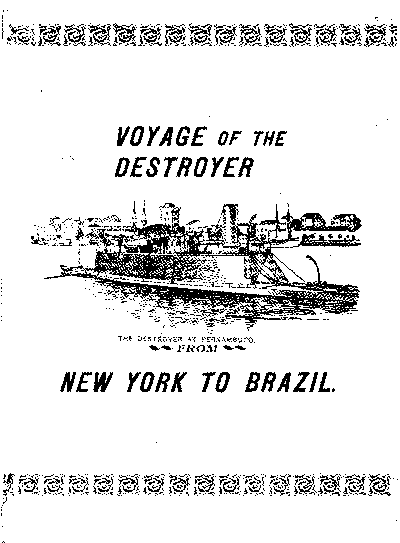
Trata-se de uma viagem à América do Sul realizada em 1893, a bordo do Destroyer, um navio que foi adquirido pelo governo de Floriano Peixoto, quando estava às voltas com uma séria revolta que eclodiu dentro de sua Marinha de Guerra do Brasil: a Revolta da Armada.
Nils Fock apresentara-se como oficial da Marinha sueca, mas, pelo número de profissões que diz ter exercido, tudo indica que ele era um experiente e culto aventureiro. Depois de prestar serviços diversos na Alemanha, na Argélia, na Suécia e na Grã-Bretanha, em 1893 era engenheiro ou técnico no setor de armamento de The Pneumatic Gun Co. , em Nova York.
Na efervescente cidade norte-americana, Nils Fock foi convidado pelo ministro brasileiro Salvador Mendonça para ser o artilheiro-chefe do Destroyer, o qual teria um fim melancólico nas águas do Brasil. É preciso que se diga que a aventurosa narrativa de Nils Fock encontra-se repleta de informações inverídicas, mas tentaremos depurá-la quando possível.
Torna-se interessante compará-la a outra descrição da viagem do Destroyer e que foi feita por outro grande aventureiro, o famoso navegador Joshua Slocum. Em um livro publicado, “Viagem do Destroyer de Nova York ao Brasil” (Imprensa de Robinson Printing Co., 1894) Joshua Slocum, narra suas aventuras no Destroyer, onde teria vindo ao Brasil como “navegador em comando”. A primeira edição do livro se tornou rara, uma vez que de 500 exemplares, só se conhece a existência de três.
Jhon Ericsson, inventor do "Destroyer" e do USS Monitor.
A Esquadra de Papelão de Floriano Peixoto
Segundo Nils Fock, o Destroyer era uma invenção recente de um conterrâneo seu, o célebre Jhon Ericsson e que foi construído em caráter experimental, mas que não apresentando resultado satisfatório, a Marinha do EUA abandonara-o. Mas de acordo com as informações do apêndice do livro do pesquisador Hélio Leôncio Martins (A Revolta da Armada), o Destroyer era uma embarcação que estava sendo testada nos EUA, pois era semi-submersa, isto é, ao aproximar-se do inimigo afundava, mantendo acima do nível apenas 45 cm de obras mortas.
Segundo Nils Fock, o Destroyer era uma invenção recente de um conterrâneo seu, o célebre Jhon Ericsson e que foi construído em caráter experimental, mas que não apresentando resultado satisfatório, a Marinha do EUA abandonara-o. Mas de acordo com as informações do apêndice do livro do pesquisador Hélio Leôncio Martins (A Revolta da Armada), o Destroyer era uma embarcação que estava sendo testada nos EUA, pois era semi-submersa, isto é, ao aproximar-se do inimigo afundava, mantendo acima do nível apenas 45 cm de obras mortas.
Dispunha de um canhão de aço, com 10 metros de comprimento, que ficava 2,13 metros abaixo da linha d’água e disparava projetis com 300 libras (150kg) usando dinamite como explosivo. Tinha o projétil, 27 pés (8,23 metros) de comprimento e 10 polegadas de diâmetro, pesava 1.525 libras (762 kg) e tinha alcance de 200 metros. Era na verdade, um torpedo com propulsão de canhão.
Cabe informar que na ânsia em que estava o governo de Floriano Peixoto de formar rapidamente uma esquadra que viesse a combater os revolucionários, adquiriu o Destroyer – um tipo de navio semi-submarino, e que certamente aos olhos dos brasileiros vinha apresentar algum valor militar.
Ora, o ministro do Brasil nos EUA, Salvador Mendonça, e o almirante Joaquim Francisco Abreu, na Europa, procuravam adquirir os navios de guerra, ou capazes de serem armados, encontrados onde fosse possível. Mas pela capacidade ofensiva, deu-se prioridade na aquisição das novas torpedeiras, que com seus torpedos automóveis - segundo idéia preconizada pelo almirante francês Aube - podiam vencer os navios encouraçados.
Os brasileiros também eram atraídos por equipamentos e armas experimentais (prometendo, segundo seus inventores, resultados surpreendentes), que estavam sendo desenvolvidos em diversos países. E as unidades que iam conseguindo comprar seguiam para Pernambuco, com guarnições internacionais contratadas.
A primeira aquisição que formaria a esquadra legal e que seria batizada pelos revoltosos de Esquadra de Papelão – foi o caça-torpedeiro Aurora, construído em estaleiros ingleses, e que foi rebatizado com o nome de Gustavo Sampaio, em homenagem ao tenente do Exército que fora atingido e morto na Fortaleza da Laje. Era o melhor navio da esquadra de Floriano, do tipo que já estava sendo construído nos países mais adiantados.
Transportando lama para o Brasil
Pelas informações de Nils Fock, as condições de navegabilidade do Destroyer eram precárias, mas foram feitos alguns reparos e tratou-se de contratar uma guarnição para levá-lo até o Brasil, constituída, em sua maioria, por escandinavos. No convés do Destroyer, por não merecer muita confiança o tal canhão submerso, instalaram dois canhões de tiro rápido, de 37 mm, e um tubo lança-torpedos.
Transportando lama para o Brasil
Pelas informações de Nils Fock, as condições de navegabilidade do Destroyer eram precárias, mas foram feitos alguns reparos e tratou-se de contratar uma guarnição para levá-lo até o Brasil, constituída, em sua maioria, por escandinavos. No convés do Destroyer, por não merecer muita confiança o tal canhão submerso, instalaram dois canhões de tiro rápido, de 37 mm, e um tubo lança-torpedos.
Transformaram então a invenção de Jhon Ericsson numa “torpedeira-submarino”. Reunida a tripulação, o ministro Salvador Mendonça apresentou-a ao comandante, também contratado, o tenente Buck (possivelmente, um norte-americano).
Conta Fock que como continuavam as dúvidas sobre as qualidades náuticas do Destroyer, decidiram que seria melhor rebocá-lo até a ilha de Fernando de Noronha, arvorando a bandeira dos EUA, onde seria trocada pela nacional, continuando o navio com a viagem com seus próprios meios até Recife.
Na primeira experiência feita ainda em Nova York, o comandante Buck pediu “máquinas adiante, toda a força”, a fim de verificar que velocidade o barco alcançaria. Ao tentar pará-lo, dando atrás, o maquinista, entorpecido por uísque, enganou-se e ainda mais o acelerou, fazendo o navio chocar-se com violência contra um cais de madeira, fazendo ir pelos ares, pranchas de madeira e pessoas ao mar. O estado em que então ficou o Destroyer era deplorável. Encontrava-se, afundado, cheio de lama fedorenta, apresentando uma pá da hélice solta e os canhões tomados de água. Posto a flutuar, ligeiramente reparado, fez-se novamente ao mar, agora rumo ao sul, sendo rebocado pelo Santuit.
O que vinha caracterizar o Destroyer, era a emanação do cheiro fétido da lama, proveniente do fundo do rio Hudson, a qual não foi retirada. Por medida de segurança, a tripulação seguia no rebocador Santuit, evitando principalmente, o cheiro insuportável que impregnava o Destroyer.
O Destroyer acabou sendo alvo do Timbira
O humor do comandante Buck também não era lá dos melhores, especialmente porque seu estoque de uísque havia sido furtado. Um temporal que pegaram pelo caminho, piorou o que já era ruim. O Destroyer deixou de ser avistado e, temendo o que pudesse acontecer com o rebocador Santuit, o comandante Buck resolveu cortar o cabo de reboque, o que só não foi feito, devido à intervenção de Nils Fock, que lhe apontou um revólver, que segundo afirmou, estava descarregado. O tempo melhorou. O sueco Fock foi então a bordo do Destroyer e encontrou-o alagado, com as bombas de esgoto inutilizadas. Com esforço, conseguiu esgotar parte da água e foi possível continuar a viagem até a ilha de Martinica, onde arribaram para que o navio passasse por indispensáveis reparos.
O Destroyer acabou sendo alvo do Timbira
O humor do comandante Buck também não era lá dos melhores, especialmente porque seu estoque de uísque havia sido furtado. Um temporal que pegaram pelo caminho, piorou o que já era ruim. O Destroyer deixou de ser avistado e, temendo o que pudesse acontecer com o rebocador Santuit, o comandante Buck resolveu cortar o cabo de reboque, o que só não foi feito, devido à intervenção de Nils Fock, que lhe apontou um revólver, que segundo afirmou, estava descarregado. O tempo melhorou. O sueco Fock foi então a bordo do Destroyer e encontrou-o alagado, com as bombas de esgoto inutilizadas. Com esforço, conseguiu esgotar parte da água e foi possível continuar a viagem até a ilha de Martinica, onde arribaram para que o navio passasse por indispensáveis reparos.
No dia de Ano Novo de 1894, a torpedeira-submarino de Floriano Peixoto largou de Martinica, rumando em direção a Fernando de Noronha, onde encontrou as velozes torpedeiras adquiridas na Alemanha. E de acordo com a narrativa de Nils Fock, o Destroyer, então já nacionalizado, arvorando a bandeira brasileira, rumou para o porto de Recife.
Mas cabe corrigir o que disse Fock, uma vez que no dia 26 de janeiro de 1894, entrou pela barra de Recife o paquete América, incorporado com o nome de Andrada e transformado em cruzador-auxiliar, o qual foi fortemente artilhado. Vinha esse navio de 1.877 toneladas, rebocando duas torpedeiras, uma de porto, a Sabino Vieira, e a outra, o Destroyer, cujo nome foi mudado para Piratini.
Voltando a narrativa de Nils: Em Recife, a inspeção do Destroyer foi feita pelos almirantes João Duarte de Gonçalves e para surpresa geral (é o que Nils Fock quem assim o diz), os brasileiros consideraram o Destroyer em condições de navegar e, mesmo, de entrar em combate. E como o comandante Buck conseguira repor o seu estoque de uísque e que dele usava e abusava, a confiabilidade em sua eficiência, que já não era muito grande, desaparecera completamente. E assim fora destituído e colocaram em seu lugar, nada menos do que o Nils Fock. Daí por diante, pode-se bem avaliar os vôos da imaginação de Fock. Afirma que foi promovido a capitão-de-fragata, recrutou uma guarnição de índios e, em viagem plena de aventuras, veio até o Rio de Janeiro, o que nunca aconteceu com a Piratini.
Nils Fock ainda teve a ousadia de registrar que na barra da Guanabara, tentou interceptar o Aquidabã, a unidade mais poderosa da esquadra rebelde, que conseguiu escapar. Recebeu em seguida, grandes homenagens, condecorações e, das mãos do presidente Floriano Peixoto, um cheque incobrável. Depois da aventura no Brasil, Nils Fock, viveu outras, e retornou para a Suécia, vindo a falecer no ano de 1925.
Mas em verdade, em pleno desacordo com o que narrou o sueco, bem que se tentou a incorporação da Piratini à força naval de Peixoto. O seu comandante brasileiro, capitão-tenente Alexandre Batista Franco, se esforçou, mas a participação da Piratini foi efêmera, uma vez que o navio devido ao seu mal estado teve que regressar a Salvador, depois de apenas um dia de navegação.
Em 1898, o cruzador-torpedeiro Timbira afundou o que restava do seu casco, o qual teria quase quarenta metros de comprimento, por cerca de quatro de largura.
Elísio Gomes Filho é historiador, sendo responsável pelo site www.nomar.com.br (Historiadores do Mar)
Fonte bibliográfica consultada: A Revolta da Armada, de Hélio Leôncio Martins, Bibliex, Rio de Janeiro, 1997.
Elísio Gomes Filho é historiador, sendo responsável pelo site www.nomar.com.br (Historiadores do Mar)
Fonte bibliográfica consultada: A Revolta da Armada, de Hélio Leôncio Martins, Bibliex, Rio de Janeiro, 1997.
____
www.dofundodomar.blogspot.com
ASI to fish out Elephanta island’s Roman links
_________________________________________________________________
The Indian Express
By Bhavna Vij-Aurora
November 14, 2005
NEW DELHI - Underwater archaeologists are set to uncover unknown secrets of Elephanta island, buried in the Arabian Sea. Extensive explorations on the island—its shores and the beaches—have revealed a treasure indicating existence of a rich trade with the late Roman Empire during the 4th to 7th century AD.
The findings establish it as a significant port of the period—a fact hitherto unknown. And that people on the west coast liked imported goods and Roman wine. The small island, east of Mumbai, was, so far, best known for its cave temples and rock-cut images, specially of the monolithic elephant which once stood on its southern tip.
With the Underwater Archaeology Wing of the Archaeological Survey of India (ASI) finding late Roman amphorae, coins and sherds of pottery — including red polished ware, black slipped ware, red ware and some gray ware — on Elephanta, the stage is now set for a proper excavation around the island. The finding had come as a surprise, since so far, large number of amphorae were found only in Kanchipuram and Arikamedu.
Amphora is one of the principal vessel shapes in Greek pottery. They are handled pots used to transport a variety of things including olives, cereals, oil, wine, fish and even metal.
Head of ASI’s Underwater Archaeology Wing Dr Alok Tripathi had been quietly exploring the island since 1988, but it’s only in the last two years that extensive explorations were done. The richest site turned out to be the area around village Mora Bandar on the island.
‘‘The discovery of a large variety of amphorae and other antiquities on the island may solve some of the historical riddles,’’ said Tripathi. In addition to indicating continuity of trade with the western world during 5th-7th century AD, the findings may also answer why Chalukya King Pulakesin II of Badami had invaded this small island with a tiny population and limited natural resources in 634 AD.
‘‘We probably know why he did it. Elephanta appears to have been a prosperous island with a thriving trade,’’ said the underwater archaeologist. It is all the more significant since around the same period, the cave temple on the island, enshrining Mahesmurti, was excavated.
Since the explorations had yielded rich treasures, the next logical thing is to undertake detailed survey and excavation. Tripathi said that the area around Mora Bandar is strewn with a large number of potsherds. ‘‘Even the sand on the shore, at the north and the east of the village, is full of potsherds washed away and rolled by the waves,’’ he said.
‘‘We will start excavation in the ongoing field season of 2005-06. Since exploration results have been encouraging, we expect Elephanta to be a rich heritage site,’’ Tripathi added. This is the second site which the wing will excavate, after Mahabalipuram.
____
www.dofundodomar.blogspot.com
The Indian Express
By Bhavna Vij-Aurora
November 14, 2005
NEW DELHI - Underwater archaeologists are set to uncover unknown secrets of Elephanta island, buried in the Arabian Sea. Extensive explorations on the island—its shores and the beaches—have revealed a treasure indicating existence of a rich trade with the late Roman Empire during the 4th to 7th century AD.
The findings establish it as a significant port of the period—a fact hitherto unknown. And that people on the west coast liked imported goods and Roman wine. The small island, east of Mumbai, was, so far, best known for its cave temples and rock-cut images, specially of the monolithic elephant which once stood on its southern tip.
With the Underwater Archaeology Wing of the Archaeological Survey of India (ASI) finding late Roman amphorae, coins and sherds of pottery — including red polished ware, black slipped ware, red ware and some gray ware — on Elephanta, the stage is now set for a proper excavation around the island. The finding had come as a surprise, since so far, large number of amphorae were found only in Kanchipuram and Arikamedu.
Amphora is one of the principal vessel shapes in Greek pottery. They are handled pots used to transport a variety of things including olives, cereals, oil, wine, fish and even metal.
Head of ASI’s Underwater Archaeology Wing Dr Alok Tripathi had been quietly exploring the island since 1988, but it’s only in the last two years that extensive explorations were done. The richest site turned out to be the area around village Mora Bandar on the island.
‘‘The discovery of a large variety of amphorae and other antiquities on the island may solve some of the historical riddles,’’ said Tripathi. In addition to indicating continuity of trade with the western world during 5th-7th century AD, the findings may also answer why Chalukya King Pulakesin II of Badami had invaded this small island with a tiny population and limited natural resources in 634 AD.
‘‘We probably know why he did it. Elephanta appears to have been a prosperous island with a thriving trade,’’ said the underwater archaeologist. It is all the more significant since around the same period, the cave temple on the island, enshrining Mahesmurti, was excavated.
Since the explorations had yielded rich treasures, the next logical thing is to undertake detailed survey and excavation. Tripathi said that the area around Mora Bandar is strewn with a large number of potsherds. ‘‘Even the sand on the shore, at the north and the east of the village, is full of potsherds washed away and rolled by the waves,’’ he said.
‘‘We will start excavation in the ongoing field season of 2005-06. Since exploration results have been encouraging, we expect Elephanta to be a rich heritage site,’’ Tripathi added. This is the second site which the wing will excavate, after Mahabalipuram.
____
www.dofundodomar.blogspot.com
Saturday, November 26, 2005
Verhoeven returning to 'Batavia's Graveyard' - based on real shipwreck events
_________________________________________________________________
Timeout.com
By Chris Tilly
November 22, 2005

The Dutch director may yet make his historical epic about a terrible mutiny off the coast of Australia.
Having spent three years stuck in development hell, it looks like Paul Verhoeven's 'Batavia's Graveyard' may soon get off the ground.
The 'Basic Instinct' director's long term labour of love was first announced in 2002, but stalled when financing fell through.
Now however, the Dutch Film Fund is investing in the project, which revolves around the bloodthirsty aftermath of the shipwreck of the Batavia in 1629.
The director's long-time collaborator Gerard Soeteman is currently working on the script, which will be based on Mike Dash's book of the same name.
'It's a story in the direction of the Bounty but it's much more about the development of a fascistic regime,' Verhoeven told Screen Daily. 'That story has always fascinated us. We said if we don’t write it now, we will never make it.
'Before then Verhoeven will make 'Black Book', a thriller set in Holland during World War II.
www.dofundodomar.blogspot.com
Timeout.com
By Chris Tilly
November 22, 2005
The Dutch director may yet make his historical epic about a terrible mutiny off the coast of Australia.
Having spent three years stuck in development hell, it looks like Paul Verhoeven's 'Batavia's Graveyard' may soon get off the ground.
The 'Basic Instinct' director's long term labour of love was first announced in 2002, but stalled when financing fell through.
Now however, the Dutch Film Fund is investing in the project, which revolves around the bloodthirsty aftermath of the shipwreck of the Batavia in 1629.
The director's long-time collaborator Gerard Soeteman is currently working on the script, which will be based on Mike Dash's book of the same name.
'It's a story in the direction of the Bounty but it's much more about the development of a fascistic regime,' Verhoeven told Screen Daily. 'That story has always fascinated us. We said if we don’t write it now, we will never make it.
'Before then Verhoeven will make 'Black Book', a thriller set in Holland during World War II.
www.dofundodomar.blogspot.com
Internet Archaeology Book Giveaway
_________________________________________________________________
Do Fundo do Mar
By Pedro Caleja
November 26, 2005

This month, Internet Archaeology is offering us the
chance to win: Beneath the Seven Seas. Adventures
with the Institute of Nautical Archaeology, edited by
George Bass. (Hardback, 256pp, 433 illustrations, 410
in colour). Published 2005 by Thames and Hudson.
Internet Archaeology is in its 10th year. To celebrate, they are giving all individuals the opportunity to take 10% off the cost of their next subscription to the journal, plus the chance to win an archaeological 'book of the month' in their free draw.
How to Enter
All you have to do is to fill out the short form here. A winner will then be drawn at random from the collected names each month. The first draw will take place on 30th November (1400 GMT). The winner will be contacted directly by email. (See rules)
____
www.dofundodomar.blogspot.com
Do Fundo do Mar
By Pedro Caleja
November 26, 2005
This month, Internet Archaeology is offering us the
chance to win: Beneath the Seven Seas. Adventures
with the Institute of Nautical Archaeology, edited by
George Bass. (Hardback, 256pp, 433 illustrations, 410
in colour). Published 2005 by Thames and Hudson.
Internet Archaeology is in its 10th year. To celebrate, they are giving all individuals the opportunity to take 10% off the cost of their next subscription to the journal, plus the chance to win an archaeological 'book of the month' in their free draw.
How to Enter
All you have to do is to fill out the short form here. A winner will then be drawn at random from the collected names each month. The first draw will take place on 30th November (1400 GMT). The winner will be contacted directly by email. (See rules)
____
www.dofundodomar.blogspot.com
Friday, November 25, 2005
Science Trumps Lore In Secrets
_________________________________________________________________
SciFi.com
November 23, 2005
 Nautical researcher David Bright, whose efforts to find an infamous missing plane in the Bermuda Triangle are chronicled in the upcoming SCI FI Channel investigative news special The Bermuda Triangle: Startling New Secrets, told SCI FI Wire that he did not go into the project with any preconceived notions about what he would or would not find. "Absolutely not," Bright said in an interview. "I think the beauty of what we were doing is because we all had varying backgrounds on the project. They all came into play. What we did is before we even went out we did a bit of what we call 'What if?' scenarios. So in order to get to that point, what we really needed to do was to essentially do an awful lot of research."
The special documents Bright's expedition—which included a team of more than 20 scientists and technological experts—as they searched for the truth behind the Bermuda Triangle's most famous incidents. In 1945, a squadron of bombers called Flight 19 was lost during a training mission off the coast of Florida. The rescue plane sent to find them a few hours later also disappeared. None of the planes has ever been found.
Based on all the scientific data currently available, Bright and his team used a methodical approach to finding the missing search plane. "We built in a scenario, or a search pattern, that was predicated on currents and tides and weather and taking also into account the fact that there could be certain scenarios where the ship exploded in midair and pieces would come down," Bright said. "Or the ship exploded as it hit the water after it came down. Or the fact that it may have hit the water and parts of it could have essentially blown up, but yet the remainder part of it could have gone on a little further with the tides. ... We came up with all these different scenarios and then developed search pattens based upon all of the different scenarios."
Bright would not reveal what his team uncovered during their seven days at sea, but he did say that he came away from the project satisfied. "What we were doing scientifically, especially with the game plan, was very strategically aligned with what we expected to see," he said. "And it actually worked out quite well for us. So, although I can't tell you what we found, I can tell you we were very excited about the science that we did out there, and that none of us would have done anything differently."
The Bermuda Triangle: Startling New Secrets airs Nov. 27 at 9 p.m. PT/ET. The special, from NBC News Productions, is hosted by NBC/MSNBC news anchor Lester Holt.
____
www.dofundodomar.blogspot.com
SciFi.com
November 23, 2005
Nautical researcher David Bright, whose efforts to find an infamous missing plane in the Bermuda Triangle are chronicled in the upcoming SCI FI Channel investigative news special The Bermuda Triangle: Startling New Secrets, told SCI FI Wire that he did not go into the project with any preconceived notions about what he would or would not find. "Absolutely not," Bright said in an interview. "I think the beauty of what we were doing is because we all had varying backgrounds on the project. They all came into play. What we did is before we even went out we did a bit of what we call 'What if?' scenarios. So in order to get to that point, what we really needed to do was to essentially do an awful lot of research."The special documents Bright's expedition—which included a team of more than 20 scientists and technological experts—as they searched for the truth behind the Bermuda Triangle's most famous incidents. In 1945, a squadron of bombers called Flight 19 was lost during a training mission off the coast of Florida. The rescue plane sent to find them a few hours later also disappeared. None of the planes has ever been found.
Based on all the scientific data currently available, Bright and his team used a methodical approach to finding the missing search plane. "We built in a scenario, or a search pattern, that was predicated on currents and tides and weather and taking also into account the fact that there could be certain scenarios where the ship exploded in midair and pieces would come down," Bright said. "Or the ship exploded as it hit the water after it came down. Or the fact that it may have hit the water and parts of it could have essentially blown up, but yet the remainder part of it could have gone on a little further with the tides. ... We came up with all these different scenarios and then developed search pattens based upon all of the different scenarios."
Bright would not reveal what his team uncovered during their seven days at sea, but he did say that he came away from the project satisfied. "What we were doing scientifically, especially with the game plan, was very strategically aligned with what we expected to see," he said. "And it actually worked out quite well for us. So, although I can't tell you what we found, I can tell you we were very excited about the science that we did out there, and that none of us would have done anything differently."
The Bermuda Triangle: Startling New Secrets airs Nov. 27 at 9 p.m. PT/ET. The special, from NBC News Productions, is hosted by NBC/MSNBC news anchor Lester Holt.
____
www.dofundodomar.blogspot.com
Churchill funeral barge for sale
_________________________________________________________________
The Australian
November 23, 2005
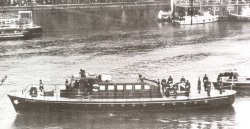
Havengore.
THE barge that bore the body of British World War II leader Winston Churchill down the River Thames during his state funeral 40 years ago will go on sale next month and is expected to make over one million pounds ($2.31 million).
The 26.5m Havengore entered the annals of history on January 30, 1965 when it carried Churchill's flag-draped coffin past dock cranes with their jibs lowered in mute tribute to the nation's hero.
"This is quite unique. It is a piece of Churchill history," said a spokesman for Sotheby's, which will auction the barge in London on Dec. 15.
Havengore, commissioned in 1954 and launched two years later, had a dual life as a working survey boat in the Thames estuary and a ceremonial transport craft carrying royalty and overseas visitors.
Decommissioned in 1995 and completely restored, the barge now works only on ceremonial occasions - most recently leading a flotilla of small ships down the Thames in tribute to naval hero Horatio Nelson in September.
____
www.dofundodomar.blogspot.com
The Australian
November 23, 2005
Havengore.
THE barge that bore the body of British World War II leader Winston Churchill down the River Thames during his state funeral 40 years ago will go on sale next month and is expected to make over one million pounds ($2.31 million).
The 26.5m Havengore entered the annals of history on January 30, 1965 when it carried Churchill's flag-draped coffin past dock cranes with their jibs lowered in mute tribute to the nation's hero.
"This is quite unique. It is a piece of Churchill history," said a spokesman for Sotheby's, which will auction the barge in London on Dec. 15.
Havengore, commissioned in 1954 and launched two years later, had a dual life as a working survey boat in the Thames estuary and a ceremonial transport craft carrying royalty and overseas visitors.
Decommissioned in 1995 and completely restored, the barge now works only on ceremonial occasions - most recently leading a flotilla of small ships down the Thames in tribute to naval hero Horatio Nelson in September.
____
www.dofundodomar.blogspot.com
Thursday, November 24, 2005
Flints give Cyprus oldest seafaring link in Med
_________________________________________________________________
Reuters
By Michele Kambas
November 22, 2005
NICOSIA - Archaeologists have discovered what they believe is the earliest evidence yet of long distance seafaring in the eastern Mediterranean, undermining beliefs that ancient mariners never ventured into open seas.
Fragments of stone implements believed to be up to 12,000 years old have been found at two sites of Cyprus, suggesting roving mariners used the areas as temporary camp sites after forays from what is today Syria and Turkey.
The flints are unlike anything found in the geological make-up of Cyprus, and more than 1,000 years older than the timing of the first permanent settlers to the island.
The discovery adds to a body of evidence contradicting the widespread belief that ancient mariners would never venture out of sight of land or had limited navigational capabilities.
"If this is verified this would be the earliest evidence of seafaring in the East Mediterranean," said Pavlos Flourentzos, director of Cyprus's department of antiquities.
Cyprus, lying at least 30 miles away from any other land mass, was not settled by man 12,000 years ago, but there is evidence it was populated by pygmy elephants and hippopotamuses.
Its earliest inhabitants, dated from the 9th millennium BC, are believed to be from the land mass which now rings it north and east.
Flint fragments were found at sites on the southeast and the west of the island by Albert J. Ammerman, an archaeologist at Colgate University in Hamilton, New York.
The site on the southeast is a hilly outcrop overlooking Nissi Beach, one of the most popular beaches on the island.
"Its a rock where they now do bungee jumping," Flourentzos told Reuters. "Ammerman was with his children on this particular beach when he found the fragments."
The disclosures were contained in an archaeological paper Ammerman released at a conference in Philadelphia in the United States in mid-November.
"They have yielded good evidence for the earliest voyaging in the Mediterranean and for the increased mobility of people at the end of the ice age and the beginning of agriculture," Ammerman was quoted as saying in Tuesday's edition of the New York Times.
____
www.dofundodomar.blogspot.com
Reuters
By Michele Kambas
November 22, 2005
NICOSIA - Archaeologists have discovered what they believe is the earliest evidence yet of long distance seafaring in the eastern Mediterranean, undermining beliefs that ancient mariners never ventured into open seas.
Fragments of stone implements believed to be up to 12,000 years old have been found at two sites of Cyprus, suggesting roving mariners used the areas as temporary camp sites after forays from what is today Syria and Turkey.
The flints are unlike anything found in the geological make-up of Cyprus, and more than 1,000 years older than the timing of the first permanent settlers to the island.
The discovery adds to a body of evidence contradicting the widespread belief that ancient mariners would never venture out of sight of land or had limited navigational capabilities.
"If this is verified this would be the earliest evidence of seafaring in the East Mediterranean," said Pavlos Flourentzos, director of Cyprus's department of antiquities.
Cyprus, lying at least 30 miles away from any other land mass, was not settled by man 12,000 years ago, but there is evidence it was populated by pygmy elephants and hippopotamuses.
Its earliest inhabitants, dated from the 9th millennium BC, are believed to be from the land mass which now rings it north and east.
Flint fragments were found at sites on the southeast and the west of the island by Albert J. Ammerman, an archaeologist at Colgate University in Hamilton, New York.
The site on the southeast is a hilly outcrop overlooking Nissi Beach, one of the most popular beaches on the island.
"Its a rock where they now do bungee jumping," Flourentzos told Reuters. "Ammerman was with his children on this particular beach when he found the fragments."
The disclosures were contained in an archaeological paper Ammerman released at a conference in Philadelphia in the United States in mid-November.
"They have yielded good evidence for the earliest voyaging in the Mediterranean and for the increased mobility of people at the end of the ice age and the beginning of agriculture," Ammerman was quoted as saying in Tuesday's edition of the New York Times.
____
www.dofundodomar.blogspot.com
Museum Serves As A Grim Reminder Of The Great Lakes' Fury
_________________________________________________________________
Greenwich Times
By Denis Horgan
November 06, 2005
WHITEFISH POINT, Mich. -- The Invincible wasn't. The Invincible was the first major ship known to sail on Lake Superior. On Nov. 14, 1816, the 60-foot vessel also became the first ship known to sink in the lake, lost in a great storm off Whitefish Point - as if nature would not be mocked by the affront of naming a craft as invulnerable.
The SS Edmund Fitzgerald was 12 times longer than the Invincible, and at 729 feet and with all the marvels of modern technology, it, too, was believed to be unsinkable, or certainly able to hold her own in the wild weather of Lake Superior's winters.
On Nov. 10, 1975, it, too, went down, with all 29 hands lost in a great storm off Whitefish Point.The lake and its unique weather systems demand respect.
Whitefish Point reaches out into some of the most dangerous waters on the continent, with shoals, harsh currents and so many other great dangers to vessels and crews alike. The region has grimly harvested shipwreck after shipwreck as ship traffic funnels into the Soo Locks at Saulte Ste. Marie.
While other maritime cultures build great monuments to their admirals and seafarers and merchant marines, here the respect goes to those lost when the waters and winds collect a high toll. The Great Lakes Shipwreck Museum tells a grimmer story than the jolly sea tales told so many places elsewhere.
The Shipwreck Museum honors the 30,000 mariners who have lost their lives in more than 6,000 shipwrecks on the Great Lakes over time. It collects memorabilia, records and artifacts of the vessels and crews swallowed up by the great lakes they plied for commerce or pleasure. It amasses information and detail of the huge losses so that no bit of it should be forgotten. Mostly, it honors those men and women and their craft, gone forever.
The Edmund Fitzgerald, commemorated by Gordon Lightfoot's haunting ballad, holds center stage. Its 200-pound ship's bell has been recovered and put on display at the museum.
No trace has ever been found of the captain or crew; theories as to what brought down the great vessel are debated more than 30 years later.
Walking at water's edge, you have the sense of being at an ocean beach, a seemingly unending body of water reaching out beyond the horizon, sand and rock under foot, gulls calling out overhead. During so much of the year, the scene is calm and peaceful.
The red-roofed, white-walled buildings and light tower seem dazzlingly attractive and evocative of life on the shore: bright, clean, pleasant. When the season's sun hits these buildings, one nearly has to turn away, so sharp is the gleam.
In winter, though, huge muscular storms tear out of Canada, whipping this lake to an ocean's wildness. Thirty-foot waves are common in November. Thirty-foot waves. Even the most gigantic ships, the lengths of several football fields, appreciate that none is truly safe in such moments. The Edmund Fitzgerald, broken in two and rusting under 500 feet of water, attests to that.
Hauling taconite iron pellets from Superior, Wis., to a processing plant on Zug Island near Detroit, the Mighty Fitz sailed into a monster storm and, just 17 miles off shore and within sight of the storm-battered Whitestone Light, went down to her doom.
Though there are hearings and studies and theories galore, no one really knows what took place that horrid November night. Some believe the great ship gouged out a portion of herself hitting underwater shoals; others believe that freakish wave conditions lifted each end of the long vessel, and she cracked in the middle under her own great weight; many others think that improperly fastened hatches on her great cargo hold allowed storm water to enter below, sloshing forward to haul the vessel down by the nose.
The ship, already legendary for its size and record-setting passages of cargo, has assumed mythic stature since its hard demise. Lightfoot's song called the world's attention to the pain and loss to be endured carrying bits of rock from one place to another. The museum displays models and artifacts retrieved from down below; there are files and photographs and portraits and maps, charting the business of sailing the Great lakes, often at vast peril; there are diving suits and lighthouse lenses and seafaring gear; there is, above all else, respect for those who have been taken by nature's might and man's mistakes in judgment.
The museum and unmanned light station focus attention on the loss, death and destruction upon the Great Lakes, but the larger and greater message is in tribute to those who risk their lives in the ancient calling of taking to the waterways in ships.
For more information see http://www.shipwreckmuseum.com/, or call 800-635-1742.; http://www.ssefo.com/, www.ship-wrecks.org/shipwreck/index.jsp or www.boatnerd.com.
____
www.dofundodomar.blogspot.com
Greenwich Times
By Denis Horgan
November 06, 2005
WHITEFISH POINT, Mich. -- The Invincible wasn't. The Invincible was the first major ship known to sail on Lake Superior. On Nov. 14, 1816, the 60-foot vessel also became the first ship known to sink in the lake, lost in a great storm off Whitefish Point - as if nature would not be mocked by the affront of naming a craft as invulnerable.
The SS Edmund Fitzgerald was 12 times longer than the Invincible, and at 729 feet and with all the marvels of modern technology, it, too, was believed to be unsinkable, or certainly able to hold her own in the wild weather of Lake Superior's winters.
On Nov. 10, 1975, it, too, went down, with all 29 hands lost in a great storm off Whitefish Point.The lake and its unique weather systems demand respect.
Whitefish Point reaches out into some of the most dangerous waters on the continent, with shoals, harsh currents and so many other great dangers to vessels and crews alike. The region has grimly harvested shipwreck after shipwreck as ship traffic funnels into the Soo Locks at Saulte Ste. Marie.
While other maritime cultures build great monuments to their admirals and seafarers and merchant marines, here the respect goes to those lost when the waters and winds collect a high toll. The Great Lakes Shipwreck Museum tells a grimmer story than the jolly sea tales told so many places elsewhere.
The Shipwreck Museum honors the 30,000 mariners who have lost their lives in more than 6,000 shipwrecks on the Great Lakes over time. It collects memorabilia, records and artifacts of the vessels and crews swallowed up by the great lakes they plied for commerce or pleasure. It amasses information and detail of the huge losses so that no bit of it should be forgotten. Mostly, it honors those men and women and their craft, gone forever.
The Edmund Fitzgerald, commemorated by Gordon Lightfoot's haunting ballad, holds center stage. Its 200-pound ship's bell has been recovered and put on display at the museum.
No trace has ever been found of the captain or crew; theories as to what brought down the great vessel are debated more than 30 years later.
Walking at water's edge, you have the sense of being at an ocean beach, a seemingly unending body of water reaching out beyond the horizon, sand and rock under foot, gulls calling out overhead. During so much of the year, the scene is calm and peaceful.
The red-roofed, white-walled buildings and light tower seem dazzlingly attractive and evocative of life on the shore: bright, clean, pleasant. When the season's sun hits these buildings, one nearly has to turn away, so sharp is the gleam.
In winter, though, huge muscular storms tear out of Canada, whipping this lake to an ocean's wildness. Thirty-foot waves are common in November. Thirty-foot waves. Even the most gigantic ships, the lengths of several football fields, appreciate that none is truly safe in such moments. The Edmund Fitzgerald, broken in two and rusting under 500 feet of water, attests to that.
Hauling taconite iron pellets from Superior, Wis., to a processing plant on Zug Island near Detroit, the Mighty Fitz sailed into a monster storm and, just 17 miles off shore and within sight of the storm-battered Whitestone Light, went down to her doom.
Though there are hearings and studies and theories galore, no one really knows what took place that horrid November night. Some believe the great ship gouged out a portion of herself hitting underwater shoals; others believe that freakish wave conditions lifted each end of the long vessel, and she cracked in the middle under her own great weight; many others think that improperly fastened hatches on her great cargo hold allowed storm water to enter below, sloshing forward to haul the vessel down by the nose.
The ship, already legendary for its size and record-setting passages of cargo, has assumed mythic stature since its hard demise. Lightfoot's song called the world's attention to the pain and loss to be endured carrying bits of rock from one place to another. The museum displays models and artifacts retrieved from down below; there are files and photographs and portraits and maps, charting the business of sailing the Great lakes, often at vast peril; there are diving suits and lighthouse lenses and seafaring gear; there is, above all else, respect for those who have been taken by nature's might and man's mistakes in judgment.
The museum and unmanned light station focus attention on the loss, death and destruction upon the Great Lakes, but the larger and greater message is in tribute to those who risk their lives in the ancient calling of taking to the waterways in ships.
For more information see http://www.shipwreckmuseum.com/, or call 800-635-1742.; http://www.ssefo.com/, www.ship-wrecks.org/shipwreck/index.jsp or www.boatnerd.com.
____
www.dofundodomar.blogspot.com
Wednesday, November 23, 2005
Greeks prepare for diving odyssey
_________________________________________________________________
Dive Magazine
By Simon Rogerson
November 18, 2005


Dive operators say that the Greek government’s decision to end its draconian restrictions on scuba diving will usher in a golden era of underwater exploration. As thousands of miles of coastline open up to divers for the first time in 50 years, local professionals say that hundreds of wrecks are waiting to be discovered.
Greece has long been seen as a tantalising option for divers, with its clear waters and long history of shipping and shipwrecks – but the country’s culture ministry has always been concerned that unfettered diving would result in artefacts being removed. Now, after years of lobbying by the dive industry and pressure from government insiders, thousands of miles of coastline will open up for the first time in more than 50 years.
As a result of a campaign led by diver and government adviser Manilos Alifierakis, new laws have been drafted that will allow access to 18,000 miles of coastline, rather than the meagre 126 dive sites designated under a 2002 ruling.
‘This is a major change,’ said Phrederika Miltiadow of Odyssey Dive Centre in Hakidiki on the Greek mainland. ‘Before this, we were able to dive in five per cent of the area around us, now the change in law means we can explore all the marks we have recorded on our sonar.
‘There are wrecks that have never been seen by divers, reefs which we have no idea about. We’re about to enter a new age of exploration, and we’re going to have heaps of new dive sites before we even begin to think what could be waiting for us in the trimix range. The same will be true all over Greece and its islands.’
The new laws will also open dive sites around the Greek Islands, which are noted for their clear water. Pavlos Manallos of the Crete Underwater Centre said he was expecting to double or triple his list of quality dive sites. ‘We had a dozen sites we use regularly, but this means more variety, more exploration and better diving,’ he told DIVE. ‘It’s a very exciting time.’
Under the new rules, diving federations from other EU countries will be recognised (as was not always previously the case), but dive centres will have to apply for licences. Government adviser Manilos Alifierakis has said Greece is likely to create a system of marine parks in order to monitor and manage diving tourism in the future.
____
www.dofundodomar.blogspot.com
Dive Magazine
By Simon Rogerson
November 18, 2005
Dive operators say that the Greek government’s decision to end its draconian restrictions on scuba diving will usher in a golden era of underwater exploration. As thousands of miles of coastline open up to divers for the first time in 50 years, local professionals say that hundreds of wrecks are waiting to be discovered.
Greece has long been seen as a tantalising option for divers, with its clear waters and long history of shipping and shipwrecks – but the country’s culture ministry has always been concerned that unfettered diving would result in artefacts being removed. Now, after years of lobbying by the dive industry and pressure from government insiders, thousands of miles of coastline will open up for the first time in more than 50 years.
As a result of a campaign led by diver and government adviser Manilos Alifierakis, new laws have been drafted that will allow access to 18,000 miles of coastline, rather than the meagre 126 dive sites designated under a 2002 ruling.
‘This is a major change,’ said Phrederika Miltiadow of Odyssey Dive Centre in Hakidiki on the Greek mainland. ‘Before this, we were able to dive in five per cent of the area around us, now the change in law means we can explore all the marks we have recorded on our sonar.
‘There are wrecks that have never been seen by divers, reefs which we have no idea about. We’re about to enter a new age of exploration, and we’re going to have heaps of new dive sites before we even begin to think what could be waiting for us in the trimix range. The same will be true all over Greece and its islands.’
The new laws will also open dive sites around the Greek Islands, which are noted for their clear water. Pavlos Manallos of the Crete Underwater Centre said he was expecting to double or triple his list of quality dive sites. ‘We had a dozen sites we use regularly, but this means more variety, more exploration and better diving,’ he told DIVE. ‘It’s a very exciting time.’
Under the new rules, diving federations from other EU countries will be recognised (as was not always previously the case), but dive centres will have to apply for licences. Government adviser Manilos Alifierakis has said Greece is likely to create a system of marine parks in order to monitor and manage diving tourism in the future.
____
www.dofundodomar.blogspot.com
“La Carrera de Indias y su Patrimonio Sumergido”
_________________________________________________________________
Do Fundo do Mar
By Pedro Caleja
November 23, 2005
Curso: “La Carrera de Indias y su Patrimonio Sumergido”. Curso organizado por APASub, en colaboración con el Centro de Estudios del Estado de Feria, dependiente del Ayuntamiento de Zafra -Badajoz- y el Área de Historia de América de la Universidad de Extremadura.
Patrocinado por el Ministerio de Cultura. Zafra -Badajoz-, 2, 3 y 4 de Diciembre. Adjuntamos tríptico y programa.
PROGRAMACIÓN DEL CURSO LA CARRERA DE LAS INDIAS Y SU PATRIMONIO SUMERGIDO. ZAFRA, DEL 2 AL 4 DE DICIEMBRE DE 2005
DÍA 2 DE DICIEMBRE
16,00h Inauguración. D. Fernando Serrano Mangas y D. Carlos Cabrera Tejedor, Directores del curso.
16,30h Conferencia a cargo de D. Pablo Emilio Pérez-Mallaína Bueno, Catedrático de Hª de América de la Universidad de Sevilla, Los hombres del mar en la Carrera de Indias en el siglo XVI y XVII
17,30h Debate
18,00h Conferencia a cargo de Dª Victoria Stapells y Dª Genoveva Enríquez, Investigadoras Navales, La experiencia de dos investigadoras de archivo. El rastreo de un naufragio
19,00h Debate
DÍA 3 DE DICIEMBRE
09,30h Visita guiada a la ciudad
10,30h Conferencia a cargo de Dª Carmen García Rivero, Directora del Centro de Arqueología Subacuática de la Junta de Andalucía (CAS), Proyectos e intervenciones del CAS. El Proyecto Trafalgar
11,30h Debate
12,00h Conferencia a cargo de D. Juan Manuel Gracia Menocal, Presidente de las Asociación de Rescate de Galeones Españoles, El patrimonio sumergido desde la perspectiva privada
13,00h Debate
16,00h Visita guiada al Convento de Santa Clara
17,00h Conferencia a cargo de D. Claudio Lozano Guerra-Librero, Profesor de la Universidad de Huelva, La prospección subacuática de Mata del Difunto. Los navíos de Trafalgar en la costa de Huelva
18,00h Debate
18,30h Conferencia a cargo de Dª Luisa Martín-Merás, Directora Técnica del Museo Naval de Madrid, La gestión de un museo marítimo nacional: el Museo Naval de Madrid
19,30h Debate
DÍA 4 DE DICIEMBRE
10,30h Conferencia a cargo de D. Fernando Serrano Mangas, Profesor Titular de Hª de América de la Universidad de Extremadura, Los naufragios de la Carrera de Indias. Siglos XVI y XVII
11,30h Debate
12,00h Conferencia a cargo de D. José Luis Casado Soto, Director del Museo Marítimo del Cantábrico (Santander), El patrimonio marítimo, frágil fuente del conocimiento histórico
13,00h Debate
14,00h Clausura del Curso
____
www.dofundodomar.blogspot.com
Do Fundo do Mar
By Pedro Caleja
November 23, 2005
Curso: “La Carrera de Indias y su Patrimonio Sumergido”. Curso organizado por APASub, en colaboración con el Centro de Estudios del Estado de Feria, dependiente del Ayuntamiento de Zafra -Badajoz- y el Área de Historia de América de la Universidad de Extremadura.
Patrocinado por el Ministerio de Cultura. Zafra -Badajoz-, 2, 3 y 4 de Diciembre. Adjuntamos tríptico y programa.
PROGRAMACIÓN DEL CURSO LA CARRERA DE LAS INDIAS Y SU PATRIMONIO SUMERGIDO. ZAFRA, DEL 2 AL 4 DE DICIEMBRE DE 2005
DÍA 2 DE DICIEMBRE
16,00h Inauguración. D. Fernando Serrano Mangas y D. Carlos Cabrera Tejedor, Directores del curso.
16,30h Conferencia a cargo de D. Pablo Emilio Pérez-Mallaína Bueno, Catedrático de Hª de América de la Universidad de Sevilla, Los hombres del mar en la Carrera de Indias en el siglo XVI y XVII
17,30h Debate
18,00h Conferencia a cargo de Dª Victoria Stapells y Dª Genoveva Enríquez, Investigadoras Navales, La experiencia de dos investigadoras de archivo. El rastreo de un naufragio
19,00h Debate
DÍA 3 DE DICIEMBRE
09,30h Visita guiada a la ciudad
10,30h Conferencia a cargo de Dª Carmen García Rivero, Directora del Centro de Arqueología Subacuática de la Junta de Andalucía (CAS), Proyectos e intervenciones del CAS. El Proyecto Trafalgar
11,30h Debate
12,00h Conferencia a cargo de D. Juan Manuel Gracia Menocal, Presidente de las Asociación de Rescate de Galeones Españoles, El patrimonio sumergido desde la perspectiva privada
13,00h Debate
16,00h Visita guiada al Convento de Santa Clara
17,00h Conferencia a cargo de D. Claudio Lozano Guerra-Librero, Profesor de la Universidad de Huelva, La prospección subacuática de Mata del Difunto. Los navíos de Trafalgar en la costa de Huelva
18,00h Debate
18,30h Conferencia a cargo de Dª Luisa Martín-Merás, Directora Técnica del Museo Naval de Madrid, La gestión de un museo marítimo nacional: el Museo Naval de Madrid
19,30h Debate
DÍA 4 DE DICIEMBRE
10,30h Conferencia a cargo de D. Fernando Serrano Mangas, Profesor Titular de Hª de América de la Universidad de Extremadura, Los naufragios de la Carrera de Indias. Siglos XVI y XVII
11,30h Debate
12,00h Conferencia a cargo de D. José Luis Casado Soto, Director del Museo Marítimo del Cantábrico (Santander), El patrimonio marítimo, frágil fuente del conocimiento histórico
13,00h Debate
14,00h Clausura del Curso
____
www.dofundodomar.blogspot.com
Tuesday, November 22, 2005
Mini-sub mystery may be solved
_________________________________________________________________
News.com.au
By Paul Pottinger
November 20, 2005

A destroyed sub is hoisted out of Sydney Harbor in 1942.
ONE of the great mysteries of World War II - the fate of the missing Japanese midget submarine that attacked Sydney Harbour - could be revealed next week.
The State Government's Heritage Office will investigate the almost four years of research handed to them by the makers of M24: The Last Sunrise.
And in a live telecast on Fox 8 on November 28, cameras will explore what is believed to be the location of the missing two-man submarine.
M24 was part of a force of three midget subs that torpedoed one ship and killed 21 Allied sailors on the night of May 31, 1942.
"Over the past four years we've looked at all of the existing evidence and theories of where M24 might be," producer Damien Lay of Animax Films said.
Mr Lay said he was not "100 per cent" sure their new theory was right but viewers could make up their own minds.
The fate of M24 has vexed historians for 63 years.
Launched from two mother submarines off Sydney, the three midgets made their way into the harbour around dusk.
Targetting US and Australian warship, they instead torpedoed the ferry Kuttabul.
Subs M14 and M21 were depth-charged, with one crew killed and the other shooting themselves.
Though believed damaged, M24 was never recovered.
The midgets were to have rendezvoused with the mother subs south of Sydney. It seems possible, however, that M24 went north before being scuttled.
Given that the wreck site of the missing sub would be a classed as a war grave, Mr Lay said it could only be approached by Government-authorised divers.
____
www.dofundodomar.blogspot.com
News.com.au
By Paul Pottinger
November 20, 2005
A destroyed sub is hoisted out of Sydney Harbor in 1942.
ONE of the great mysteries of World War II - the fate of the missing Japanese midget submarine that attacked Sydney Harbour - could be revealed next week.
The State Government's Heritage Office will investigate the almost four years of research handed to them by the makers of M24: The Last Sunrise.
And in a live telecast on Fox 8 on November 28, cameras will explore what is believed to be the location of the missing two-man submarine.
M24 was part of a force of three midget subs that torpedoed one ship and killed 21 Allied sailors on the night of May 31, 1942.
"Over the past four years we've looked at all of the existing evidence and theories of where M24 might be," producer Damien Lay of Animax Films said.
Mr Lay said he was not "100 per cent" sure their new theory was right but viewers could make up their own minds.
The fate of M24 has vexed historians for 63 years.
Launched from two mother submarines off Sydney, the three midgets made their way into the harbour around dusk.
Targetting US and Australian warship, they instead torpedoed the ferry Kuttabul.
Subs M14 and M21 were depth-charged, with one crew killed and the other shooting themselves.
Though believed damaged, M24 was never recovered.
The midgets were to have rendezvoused with the mother subs south of Sydney. It seems possible, however, that M24 went north before being scuttled.
Given that the wreck site of the missing sub would be a classed as a war grave, Mr Lay said it could only be approached by Government-authorised divers.
____
www.dofundodomar.blogspot.com
For Titanic explorer, technology and awe go together
_________________________________________________________________
The Virginian-Pilot
By Lauren Roth
November 19, 2005
NORFOLK — When Robert D. Ballard led an expedition to find the remains of the Titanic in 1985, museum displays, movies and soundtracks were far from his mind.
“I wasn’t driven by a need to find the Titanic. I was driven by a need to demonstrate our technology,” said Ballard, whose ocean-floor discoveries and technological advances have ushered in a new era of deep-sea archaeology.
Ballard was the keynote speaker Friday morning at the Maritime Heritage Education Conference , held at Nauticus . Most of his audience members were education specialists from national parks, museums or governments.
Ballard has focused his career on creating and using technology to explore the bottom of the sea.
He has led more than 125 undersea expeditions, exploring shipwrecks including the World War II aircraft carrier Yorktown, the battleship Bismarck, Phoenician ships and John F. Kennedy’s PT-109 .
But for the past 16 years, Ballard also has been capitalizing on children’s fascination with his deep-sea work to get middle-schoolers interested in science.
His Jason Project , named after the mythical explorer who sought the golden fleece with the Argonauts, includes an annual expedition students can experience through video feeds and the Internet. Based in Ashland , the Jason Project has worked with 1.5 million students and 20,000 teachers since 1989 .
In February, Hampton Roads students took part in the Disappearing Wetlands curriculum, which explored how levees and barrier islands affect marshes in the Louisiana Bayou .
Nauticus hosted students from Norfolk and Newport News public schools and Norfolk Academy, who watched the broadcast in the auditorium . Nauticus plans to invite students and teachers to participate in 2007’s expedition, which will focus on oceans.
Ballard said he tries to create “jaw drop” moments of awe through technology. One example is self-guided tours of underwater protected areas called marine sanctuaries. He also has helped students tag along on deep-sea visits via video feeds.
Those possibilities intrigued 8-year-old Ben Smith, a second-grader at Kingston Elementary School in Virginia Beach. One of a few members of the public in the audience, Ben said he has considered the Titanic one of his favorite things for half his life.
Ballard, a former commander in the Naval Reserve , called on the United States to sign the United Nations Convention on the Law of the Sea . The 1982 document would provide an international constitution for the oceans. Ballard said almost all shipwrecks would be protected.
Ballard also has been a vocal part of the debate over salvaging the Titanic. He said during his speech the ship should be preserved, much like an old house.
“We should seriously be looking at conserving and preserving the Titanic,” he said. “We preserve things on land. It would be a piece of cake to clean and paint the Titanic .”
____
www.dofundodomar.blogspot.com
The Virginian-Pilot
By Lauren Roth
November 19, 2005
NORFOLK — When Robert D. Ballard led an expedition to find the remains of the Titanic in 1985, museum displays, movies and soundtracks were far from his mind.
“I wasn’t driven by a need to find the Titanic. I was driven by a need to demonstrate our technology,” said Ballard, whose ocean-floor discoveries and technological advances have ushered in a new era of deep-sea archaeology.
Ballard was the keynote speaker Friday morning at the Maritime Heritage Education Conference , held at Nauticus . Most of his audience members were education specialists from national parks, museums or governments.
Ballard has focused his career on creating and using technology to explore the bottom of the sea.
He has led more than 125 undersea expeditions, exploring shipwrecks including the World War II aircraft carrier Yorktown, the battleship Bismarck, Phoenician ships and John F. Kennedy’s PT-109 .
But for the past 16 years, Ballard also has been capitalizing on children’s fascination with his deep-sea work to get middle-schoolers interested in science.
His Jason Project , named after the mythical explorer who sought the golden fleece with the Argonauts, includes an annual expedition students can experience through video feeds and the Internet. Based in Ashland , the Jason Project has worked with 1.5 million students and 20,000 teachers since 1989 .
In February, Hampton Roads students took part in the Disappearing Wetlands curriculum, which explored how levees and barrier islands affect marshes in the Louisiana Bayou .
Nauticus hosted students from Norfolk and Newport News public schools and Norfolk Academy, who watched the broadcast in the auditorium . Nauticus plans to invite students and teachers to participate in 2007’s expedition, which will focus on oceans.
Ballard said he tries to create “jaw drop” moments of awe through technology. One example is self-guided tours of underwater protected areas called marine sanctuaries. He also has helped students tag along on deep-sea visits via video feeds.
Those possibilities intrigued 8-year-old Ben Smith, a second-grader at Kingston Elementary School in Virginia Beach. One of a few members of the public in the audience, Ben said he has considered the Titanic one of his favorite things for half his life.
Ballard, a former commander in the Naval Reserve , called on the United States to sign the United Nations Convention on the Law of the Sea . The 1982 document would provide an international constitution for the oceans. Ballard said almost all shipwrecks would be protected.
Ballard also has been a vocal part of the debate over salvaging the Titanic. He said during his speech the ship should be preserved, much like an old house.
“We should seriously be looking at conserving and preserving the Titanic,” he said. “We preserve things on land. It would be a piece of cake to clean and paint the Titanic .”
____
www.dofundodomar.blogspot.com
Monday, November 21, 2005
In search of Civil War ships
_________________________________________________________________
The Washington Times
By Jim Suhr
November 18, 2005

The ironclad USS Cairo.
CARBONDALE, Ill. -- Mark Wagner and Bob Swenson search the lower Ohio River along Illinois' southern tip for sunken wreckages of boating past, often finding the gumshoe work a frustrating race against the unpredictable waterway.
Once, sometimes twice a year when the Ohio gives them the chance, the Southern Illinois University staffers scour for suspected graves of a former Civil War gunboat or other vessels of the time. The water often teases them, receding briefly to give up skeletons of 19th-century navigational life, only to swallow up the evidence again.
Upriver dams, commonly used to raise water levels to accommodate barges, can wreak havoc on their plans, quickly swamping an exposed relic. River-swelling rains don't help, either.
"It can be very frustrating," said Mr. Wagner, an archaeologist with the school's Center for Archaeological Investigations. "If you want to do any work, you have to schedule it around the river."
So it went recently, when the two took advantage of shallow Ohio River levels and scouted by helicopter a 45-mile stretch of the waterway, spotting the wooden carcasses of several former steamboats and wooden barges.
More importantly, Mr. Swenson said, he saw something sticking out of the mud near the mouth of the Cache River, not far from Mound City, an outpost about 44 miles south of Carbondale. Rumors had it that folks there, when they were children, spotted remnants of a Civil War gunboat, including a cannon, when the wreckage was visible decades ago.
Could it be the final resting spot of the USS Cincinnati, among the vessels swaddled in iron and weaponry to become a fighting ship when the North warred with the South? Such a find could be big, with no known "ironclads" found along the Ohio, Mr. Wagner said.
"We now have a place we can look more closely," said Mr. Swenson, an architecture professor. "If we're extraordinarily lucky, it would be the Cincinnati."
To Mr. Swenson's knowledge, no other gunboat has been salvaged aside from the USS Cairo, said to be the first warship to be sunk by an electrically detonated underwater mine or torpedo. That 175-foot ship, sunken in late 1862, is now on display at the Vicksburg (Miss.) National Military Park.

The USS Cincinnati.
The Cairo and Cincinnati were among seven "city class" ironclads -- bearing names of U.S. river cities -- built for Union forces by James Eads' company during the Civil War to help wrest control of the Mississippi from the Confederates. Three of those twin-engine, 13-gun ships ensconced in thick iron -- the Cairo, Cincinnati and Mound City -- were built in Mound City, the other four in St. Louis.
Such ships essentially were steamboats retrofitted with armor, making them floating artillery batteries. But their underbellies still were wooden, making them vulnerable to underwater debris or, in the Cairo's case, explosives.
The Cincinnati, commissioned in 1862, later was sunk twice and raised before being decommissioned in 1865, roughly four months after the end of the Civil War, according to the Missouri Civil War Museum's Web site (www.missouricivilwarmuseum.org). It was sold at auction in New Orleans in 1866, not long before it sank possibly near Mound City, according to what Mr. Swenson said were "very limited records."
"We'd be really interested in the Cincinnati," specifically to see what is left of it and how the boat was built, Mr. Wagner said. "We don't know all that much about how these boats were put together."
The remains still might include Civil War-era artifacts, including stoves and personal items.
Equally elusive has been the USS Red Rover, a 625-ton steamer initially built for commercial use but converted into a hospital ship with an operating room, with a staff that included the first female nurses to serve aboard a Navy ship. The Red Rover was stationed at Mound City until late 1865, when it was decommissioned and sold. It also is thought to have sunk in an accident across from Mound City, near the Kentucky shore.
No one knows how many wreckage sites remain under water or beneath farm fields -- hidden there by a river's shifting course -- or were ripped apart by currents. But most agree that along the Ohio, Mississippi and Missouri rivers, the watery graveyards are legion.
Those waterways have claimed hundreds of smoke-belching steamboats or other wood-framed vessels, many of them destroyed by such calamities as fires, explosions, ice floes and run-ins with toppled trees. Exactly how many wreckages lie beneath the Ohio's murky surface is not clear.
Sometimes, Mr. Swenson said, high waters that keep the shipwrecks hidden may be a blessing, safeguarding the sites from weathering that could warp and rot the wood.
Pinpointing the wreckages has required different approaches, from the helicopter Mr. Wagner and Mr. Swenson used recently to multiple sound beams projected elsewhere along a river's floor to provide a three-dimensional image of the outlines of ships. Such technology helped pinpoint the suspected location of the USS Chickasaw, another Eads ironclad, up the Mississippi from New Orleans' French Quarter.
Know more about the USS Cairo here.
Know more about the USS Cincinnati here.
____
www.dofundodomar.blogspot.com
The Washington Times
By Jim Suhr
November 18, 2005
The ironclad USS Cairo.
CARBONDALE, Ill. -- Mark Wagner and Bob Swenson search the lower Ohio River along Illinois' southern tip for sunken wreckages of boating past, often finding the gumshoe work a frustrating race against the unpredictable waterway.
Once, sometimes twice a year when the Ohio gives them the chance, the Southern Illinois University staffers scour for suspected graves of a former Civil War gunboat or other vessels of the time. The water often teases them, receding briefly to give up skeletons of 19th-century navigational life, only to swallow up the evidence again.
Upriver dams, commonly used to raise water levels to accommodate barges, can wreak havoc on their plans, quickly swamping an exposed relic. River-swelling rains don't help, either.
"It can be very frustrating," said Mr. Wagner, an archaeologist with the school's Center for Archaeological Investigations. "If you want to do any work, you have to schedule it around the river."
So it went recently, when the two took advantage of shallow Ohio River levels and scouted by helicopter a 45-mile stretch of the waterway, spotting the wooden carcasses of several former steamboats and wooden barges.
More importantly, Mr. Swenson said, he saw something sticking out of the mud near the mouth of the Cache River, not far from Mound City, an outpost about 44 miles south of Carbondale. Rumors had it that folks there, when they were children, spotted remnants of a Civil War gunboat, including a cannon, when the wreckage was visible decades ago.
Could it be the final resting spot of the USS Cincinnati, among the vessels swaddled in iron and weaponry to become a fighting ship when the North warred with the South? Such a find could be big, with no known "ironclads" found along the Ohio, Mr. Wagner said.
"We now have a place we can look more closely," said Mr. Swenson, an architecture professor. "If we're extraordinarily lucky, it would be the Cincinnati."
To Mr. Swenson's knowledge, no other gunboat has been salvaged aside from the USS Cairo, said to be the first warship to be sunk by an electrically detonated underwater mine or torpedo. That 175-foot ship, sunken in late 1862, is now on display at the Vicksburg (Miss.) National Military Park.
The USS Cincinnati.
The Cairo and Cincinnati were among seven "city class" ironclads -- bearing names of U.S. river cities -- built for Union forces by James Eads' company during the Civil War to help wrest control of the Mississippi from the Confederates. Three of those twin-engine, 13-gun ships ensconced in thick iron -- the Cairo, Cincinnati and Mound City -- were built in Mound City, the other four in St. Louis.
Such ships essentially were steamboats retrofitted with armor, making them floating artillery batteries. But their underbellies still were wooden, making them vulnerable to underwater debris or, in the Cairo's case, explosives.
The Cincinnati, commissioned in 1862, later was sunk twice and raised before being decommissioned in 1865, roughly four months after the end of the Civil War, according to the Missouri Civil War Museum's Web site (www.missouricivilwarmuseum.org). It was sold at auction in New Orleans in 1866, not long before it sank possibly near Mound City, according to what Mr. Swenson said were "very limited records."
"We'd be really interested in the Cincinnati," specifically to see what is left of it and how the boat was built, Mr. Wagner said. "We don't know all that much about how these boats were put together."
The remains still might include Civil War-era artifacts, including stoves and personal items.
Equally elusive has been the USS Red Rover, a 625-ton steamer initially built for commercial use but converted into a hospital ship with an operating room, with a staff that included the first female nurses to serve aboard a Navy ship. The Red Rover was stationed at Mound City until late 1865, when it was decommissioned and sold. It also is thought to have sunk in an accident across from Mound City, near the Kentucky shore.
No one knows how many wreckage sites remain under water or beneath farm fields -- hidden there by a river's shifting course -- or were ripped apart by currents. But most agree that along the Ohio, Mississippi and Missouri rivers, the watery graveyards are legion.
Those waterways have claimed hundreds of smoke-belching steamboats or other wood-framed vessels, many of them destroyed by such calamities as fires, explosions, ice floes and run-ins with toppled trees. Exactly how many wreckages lie beneath the Ohio's murky surface is not clear.
Sometimes, Mr. Swenson said, high waters that keep the shipwrecks hidden may be a blessing, safeguarding the sites from weathering that could warp and rot the wood.
Pinpointing the wreckages has required different approaches, from the helicopter Mr. Wagner and Mr. Swenson used recently to multiple sound beams projected elsewhere along a river's floor to provide a three-dimensional image of the outlines of ships. Such technology helped pinpoint the suspected location of the USS Chickasaw, another Eads ironclad, up the Mississippi from New Orleans' French Quarter.
Know more about the USS Cairo here.
Know more about the USS Cincinnati here.
____
www.dofundodomar.blogspot.com
Shipwreck Secrets from Cape Fear Museum
_________________________________________________________________
Topsail Island Info
November 18, 2005

On Sunday, December 4, from 1:30 pm – 2:30 pm and 3:30 – 4:30 pm, Cape Fear Museum of History and Science presents Shipwreck Secrets. The program, part of the Family Discovery Workshop series, is $2 per person. Space is limited and pre-registration is suggested. Call 341- 4350 Ext. 3018.
Hidden beneath the surface of the waters surrounding Lower Cape Fear lay countless shipwrecks. Discover the secrets and treasures of the Spanish Fortuna and understand why the blockade runner Condor ran aground. Use the techniques of archaeologists to determine the age and origin of recovered artifacts then create your own treasure to take home.
The Family Discovery Workshop series is designed to foster interest in learning while promoting family togetherness. Activities in the Family Discovery Workshop are suitable for ages five and up.
Cape Fear Museum of History and Science is open 9am to 5 pm Tuesday through Saturday and 1-5 pm on Sunday, seven days a week from Memorial Day through Labor Day.
Admission is $5.00 for adults; $4.00 for students with valid I.D. and Senior citizens; $4.00 special military rate with valid military I.D.; $1.00 for children 3-17; and free for children under 3. Museum members are always free.
New Hanover County residents’ free day is the first Sunday of each month. The Museum is located at 814 Market Street in historic downtown Wilmington, N.C. 910-341-4350.
____
www.dofundodomar.blogspot.com
Topsail Island Info
November 18, 2005
On Sunday, December 4, from 1:30 pm – 2:30 pm and 3:30 – 4:30 pm, Cape Fear Museum of History and Science presents Shipwreck Secrets. The program, part of the Family Discovery Workshop series, is $2 per person. Space is limited and pre-registration is suggested. Call 341- 4350 Ext. 3018.
Hidden beneath the surface of the waters surrounding Lower Cape Fear lay countless shipwrecks. Discover the secrets and treasures of the Spanish Fortuna and understand why the blockade runner Condor ran aground. Use the techniques of archaeologists to determine the age and origin of recovered artifacts then create your own treasure to take home.
The Family Discovery Workshop series is designed to foster interest in learning while promoting family togetherness. Activities in the Family Discovery Workshop are suitable for ages five and up.
Cape Fear Museum of History and Science is open 9am to 5 pm Tuesday through Saturday and 1-5 pm on Sunday, seven days a week from Memorial Day through Labor Day.
Admission is $5.00 for adults; $4.00 for students with valid I.D. and Senior citizens; $4.00 special military rate with valid military I.D.; $1.00 for children 3-17; and free for children under 3. Museum members are always free.
New Hanover County residents’ free day is the first Sunday of each month. The Museum is located at 814 Market Street in historic downtown Wilmington, N.C. 910-341-4350.
____
www.dofundodomar.blogspot.com
Archaeologists Race Tides To Salvage Blackbeard's Ship
_________________________________________________________________
NBC17.com
By Frank Graff
November 17, 2005
BEAUFORT, N.C. -- The shipwreck believed to be the remains of Blackbeard's flagship was almost destroyed two months ago by Hurricane Ophelia. Now, archaeologists are scrambling to launch a major salvage effort before the wreck's secrets are lost to the sea.
In the colorful age of pirates, Blackbeard was flashiest of all. In a stroke of 16th-century marketing genius, the buccaneer wore bands of pistols, daggers and a cutlass during battle and tucked burning ropes under his hat to surround himself with smoke.
"He created an image that is still remembered 300 years later -- beard, ribbons aglow, a face that looked almost like Satan itself," said Ben Cherry, who has studied Blackbeard and interprets the pirate at schools and festivals around the world. "He made everyone think he was a nasty guy, which is (his) success."
History records Blackbeard's flagship, the 40-gun Queen Anne's Revenge, ran aground near Beaufort Inlet in 1718. Archaeologists believe a treasure of information about the notorious pirate lies in a jumble of cannon and timber on the ocean floor there.
But the sea still holds the secret of whether the wreckage was really the Queen Anne's Revenge and the site might be destroyed before the truth is known.
"We've only done 5 percent of the wreck, which means the rest is sitting out there in potentially great hazard from storms," said Phil Masters, the underwater salvage expert who found the wreckage nine years ago.
The ship sank in about 24 feet of water and was buried under 15 feet of sand for almost 300 years, archaeologists said. But through the years, the ship also sank in the sand and now sits on bedrock, and storm after storm has gradually stripped away the protective sands.
Only 3 feet of sand now cover the wreckage, and the next violent storm to hit Bogue Banks could destroy the site, archaeologists said.
"We're seeing material we haven't seen before because now it's uncovered," said David Moore, of the North Carolina Maritime Museum. "But we also must ask, ‘What are we missing? What has the storm taken away that we didn't even know was there?'"
Hundreds of artifacts recovered so far point to Blackbeard, such as a 2,500-pound cannon that was recovered in May. Archaeologists at East Carolina University found valuable clues through X-rays.
"All of her guns were loaded and ready to fire. One even had a wad, some cannon shot, another wad and three bolts in the bore," said Wendy Walsh, a lab manager at ECU.
Gold Dust, a ship's bell and a pewter plate also date to when Blackbeard terrorized the Caribbean. But the definitive answer as to whether the wreck is the Queen Anne' Revenge is still missing, and the answer might be lost forever if not recovered soon.
"The treasure is in the history. That's what is important to realize is that there is so much history under the sand out there," Masters said. "It is so frustrating to see it sitting out there and we can't get at it because of a lack of funding."
A major expedition to recover and preserve the wreck would cost at least $6 million over 20 years. Archaeologists are scrambling to find it, and state historians have asked the Army Corps of Engineers for money to help fund a salvage operation.
"You have to accept the fact that (pirates are) glamorized, and it's our job to bring a little bit of truth and life to that story to see who these people were and why they were doing what they were doing," said Mark Wilde Ramsing, an underwater archaeologist with the North Carolina Department of Cultural Resources and project director for the wreckage recovery effort.
____
www.dofundodomar.blogspot.com
NBC17.com
By Frank Graff
November 17, 2005
BEAUFORT, N.C. -- The shipwreck believed to be the remains of Blackbeard's flagship was almost destroyed two months ago by Hurricane Ophelia. Now, archaeologists are scrambling to launch a major salvage effort before the wreck's secrets are lost to the sea.
In the colorful age of pirates, Blackbeard was flashiest of all. In a stroke of 16th-century marketing genius, the buccaneer wore bands of pistols, daggers and a cutlass during battle and tucked burning ropes under his hat to surround himself with smoke.
"He created an image that is still remembered 300 years later -- beard, ribbons aglow, a face that looked almost like Satan itself," said Ben Cherry, who has studied Blackbeard and interprets the pirate at schools and festivals around the world. "He made everyone think he was a nasty guy, which is (his) success."
History records Blackbeard's flagship, the 40-gun Queen Anne's Revenge, ran aground near Beaufort Inlet in 1718. Archaeologists believe a treasure of information about the notorious pirate lies in a jumble of cannon and timber on the ocean floor there.
But the sea still holds the secret of whether the wreckage was really the Queen Anne's Revenge and the site might be destroyed before the truth is known.
"We've only done 5 percent of the wreck, which means the rest is sitting out there in potentially great hazard from storms," said Phil Masters, the underwater salvage expert who found the wreckage nine years ago.
The ship sank in about 24 feet of water and was buried under 15 feet of sand for almost 300 years, archaeologists said. But through the years, the ship also sank in the sand and now sits on bedrock, and storm after storm has gradually stripped away the protective sands.
Only 3 feet of sand now cover the wreckage, and the next violent storm to hit Bogue Banks could destroy the site, archaeologists said.
"We're seeing material we haven't seen before because now it's uncovered," said David Moore, of the North Carolina Maritime Museum. "But we also must ask, ‘What are we missing? What has the storm taken away that we didn't even know was there?'"
Hundreds of artifacts recovered so far point to Blackbeard, such as a 2,500-pound cannon that was recovered in May. Archaeologists at East Carolina University found valuable clues through X-rays.
"All of her guns were loaded and ready to fire. One even had a wad, some cannon shot, another wad and three bolts in the bore," said Wendy Walsh, a lab manager at ECU.
Gold Dust, a ship's bell and a pewter plate also date to when Blackbeard terrorized the Caribbean. But the definitive answer as to whether the wreck is the Queen Anne' Revenge is still missing, and the answer might be lost forever if not recovered soon.
"The treasure is in the history. That's what is important to realize is that there is so much history under the sand out there," Masters said. "It is so frustrating to see it sitting out there and we can't get at it because of a lack of funding."
A major expedition to recover and preserve the wreck would cost at least $6 million over 20 years. Archaeologists are scrambling to find it, and state historians have asked the Army Corps of Engineers for money to help fund a salvage operation.
"You have to accept the fact that (pirates are) glamorized, and it's our job to bring a little bit of truth and life to that story to see who these people were and why they were doing what they were doing," said Mark Wilde Ramsing, an underwater archaeologist with the North Carolina Department of Cultural Resources and project director for the wreckage recovery effort.
____
www.dofundodomar.blogspot.com
Sunday, November 20, 2005
O tesouro da remota ilha de Trindade, a verdade atrás da lenda
_________________________________________________________________
By Elísio Filho
November 20, 2005

No final do século dezanove e do início aos meados do século XX, navios tripulados por homens bastante sonhadores rumaram para a deserta e misteriosa ilha de Trindade, situada ao largo do estado do Espírito Santo (Brasil), na esperança de descobrirem um fabuloso tesouro que havia sido supostamente escondido por piratas. No final do século XIX, alguns escritores estrangeiros relataram sobre a existência desse tesouro e sobre algumas expedições que procuraram encontrar as grandes riquezas que então se diziam que jaziam enterradas na montanhosa ilha que fora descoberta pelos portugueses em 1503. Entre os escritos, podemos citar: “The search for hidden treasure Story if the Expedition”, por Victor de Hammel, que o publicou no Tyneside Echo em 20 de julho de 1885. Mas um livro “ The cruiser of the Falcon. A Voyage to South América”, viria a ser escrito por aquele que se tornaria o mais conhecido entre os caçadores do tesouro de Trindade, o inglês E. F. Knight.
Ora é preciso que se diga que geralmente os bandidos do mar ficavam longe do produto de seus roubos. Só em situações extremas, é que eles vinham a escondê-lo, para logo em seguida, recuperá-lo, tal como aconteceu provavelmente com o tesouro do corsário inglês Thomas Stradling, capitão do Cinq Ports, o qual entrou para a História, ao protagonizar em 1704, o exílio na remota ilha de Juan Fernandez, de Alexandre Selkirk. As lendas dos tesouros escondidos em ilhas espalhadas pelo mundo não são poucas e entre elas, encontra-se a da ilha de Trindade, cujo tesouro, muitos homens sonharam e até morreram. Recentemente os escritores Cameron Platt e John Wrigth lançaram a obra “Theasure Islands: The fascinating world of pirates, buried treasure, and fortune hunters”, onde relacionam a ilha Coco da Costa Rica, a ilha Oak do Canadá, a ilha Agrihan do arquipélago das Marianas, a ilha Lord Howe da Austrália, as ilhas Gasparillas e Galveston do Golfo do México, a ilha Mahe do arquipélago das Seichelles, a ilha Balambangan da Malásia, as ilhotas de Shoals da Nova Inglaterra e também a ilha de Trindade, no Brasil.

J. M. Racaut em: “Pirates and writers at the beginning of the 18th century: Utopian projects and ideal micro-states in the Indian Ocean”, um livro publicado em 1994, faz uma relação entre lendas sobre os corsários que infestaram os mares do Caribe e do Oceano Índico e as utopias insulares dos séculos XVII e XVIII. A busca de tesouros escondidos por piratas em ilhas, mais de um século depois do livro de Stevenson - A Ilha do Tesouro - continua a atrair a atenção de numerosos aventureiros à procura dos lendários tesouros escondidos. Para Racaut, a miragem do ouro, é apenas uma parte da lenda dos piratas, que, no entanto, inclui o sonho exótico da liberdade política, a fuga para longe, livre de todo controle das rígidas sociedades européias da época.
Diga-se de passagem, que a procura dos tesouros perdidos, escondidos ou afundados depois das batalhas navais por piratas e flibusteiros que infestavam as Antilhas no século XVII tornou-se um dos grandes temas da literatura de aventuras. Um tema que acabou por romper a barreira entre o imaginário e o real. Não se passa um ano sem que os aventureiros modernos não procurem e não pensem ter encontrado um desses tesouros escondidos.
O tesouro da fragata Thetis e os valhacoutos dos piratas
Ora, muitas são as lendas secundárias sobre tesouros que foram escondidos em certos pontos do litoral do Brasil. A zona costeira do Maranhão, por exemplo, em parte por suas peculiares condições topográficas, propiciou a criação de um repertório de lendas, com alusões a piratas e tesouros. Dividindo a entrada da pequena baía de Alcântara em duas passagens, encontra-se a ilhota do Livramento. Na ponta que avança para a baía de São Marcos, o terreno eleva-se abruptamente num promontório em cuja base o mar esculpiu uma caverna, tal como outras existentes na costa brasileira, mas com mistérios suficientes para excitar as imaginações. Conta uma lenda, que um pirata, perseguido por navios portugueses, acabou perdendo seu barco no famoso baixo dos Atins (ou Coroa dos Ovos, local onde naufragou em 1863, o Ville de Boulogne, vitimando o poeta Gonçalves Dias), mas conseguiu escapar numa chalupa, alcançando então a ilhota do Livramento. Nesta, escondeu o seu tesouro na tal caverna, que reza a lenda, ele e seus companheiros teriam escavado, ao invés do mar, voltando mais tarde para retirá-lo. Como não deixaria de acontecer, algumas pessoas acreditando na antiga fábula, e agarrando-se à esperança de ali encontrar algumas moedas de ouro e pedras preciosas, esburacaram o interior da caverna que, somente com alguma dificuldade, e na baixa-mar, oferece acesso aos curiosos. No entanto, os buracos abertos se apresentaram tão vazios como essa lenda.
Ora, muitas são as lendas secundárias sobre tesouros que foram escondidos em certos pontos do litoral do Brasil. A zona costeira do Maranhão, por exemplo, em parte por suas peculiares condições topográficas, propiciou a criação de um repertório de lendas, com alusões a piratas e tesouros. Dividindo a entrada da pequena baía de Alcântara em duas passagens, encontra-se a ilhota do Livramento. Na ponta que avança para a baía de São Marcos, o terreno eleva-se abruptamente num promontório em cuja base o mar esculpiu uma caverna, tal como outras existentes na costa brasileira, mas com mistérios suficientes para excitar as imaginações. Conta uma lenda, que um pirata, perseguido por navios portugueses, acabou perdendo seu barco no famoso baixo dos Atins (ou Coroa dos Ovos, local onde naufragou em 1863, o Ville de Boulogne, vitimando o poeta Gonçalves Dias), mas conseguiu escapar numa chalupa, alcançando então a ilhota do Livramento. Nesta, escondeu o seu tesouro na tal caverna, que reza a lenda, ele e seus companheiros teriam escavado, ao invés do mar, voltando mais tarde para retirá-lo. Como não deixaria de acontecer, algumas pessoas acreditando na antiga fábula, e agarrando-se à esperança de ali encontrar algumas moedas de ouro e pedras preciosas, esburacaram o interior da caverna que, somente com alguma dificuldade, e na baixa-mar, oferece acesso aos curiosos. No entanto, os buracos abertos se apresentaram tão vazios como essa lenda.
A costa de Maricá (RJ), também tem sua lenda de tesouro escondido por piratas, tal como acontece com a paradisíaca ilha Grande(RJ) e com a ilha de São Sebastião(SP), mas esta, localizada no litoral paulista – também é conhecida por conta de seus numerosos naufrágios. Contam às crônicas que os abrigos das ilhas Maricás, da ilha Grande(RJ) e da ilha de São Sebastião(SP), constituíam-se em excelentes valhacoutos de piratas.
A ilha do Cabo Frio, situada na costa de Arraial do Cabo (RJ), também tem sua lenda de tesouro escondido, mas encontra-se relacionada com um tesouro real que começou a ser recuperado a partir de 1831, o qual encontrava-se entre os destroços da fragata inglesa Thetis, naufragada naquela ilha em 5 de dezembro de 1830. Diz a lenda cabista, que moedas de ouro e prata foram desviadas e enterradas pelos marinheiros ingleses, em algum ponto da praia da ilha. Outra curiosa lenda sobre tesouros escondidos, mas também não relacionada a piratas, diz que em alguma parte do litoral da cidade de Cabo Frio, estaria escondido o ouro dos inconfidentes mineiros. Reza a lenda que esse ouro seria usado para o pagamento de tropas mercenárias estrangeiras que lutariam contra as forças coloniais portuguesas. E outra lenda, a ser contada pelos antigos moradores da cidade de Armação dos Búzios, diz que negros escravos teriam escondido um tesouro na praia do Forno, a antiga praia dos Pretos.
As lendas e mitos relativos às serpentes descomunais da ilha do Marajó e em outras regiões continentais “insularizadas” da Amazônia estão associadas à guarda de grandes tesouros.
Mas é preciso então que se formule, as seguintes perguntas. Qual teria sido a origem da existência do tão famoso tesouro da ilha de Trindade? Como teria surgido o boato de que esse tesouro teria sido escondido justamente na mais remota ilha brasileira? Engendrando resumidamente as respostas, então nos depararemos com os elementos da gênese e da difusão da lenda.
O tesouro foi enterrado na ilha do Coco ou em Trindade?
Ora, tudo indica que a lenda do tesouro de Trindade encontra-se relacionada com lenda da ilha do Coco, localizada a 550 km do litoral de Costa Rica e que seduziu muita gente, muito mais do que a lenda de Trindade, a qual encontra-se a 1100 quilômetros (620 milhas) de distância da costa do Espírito Santo. O historiador costarriquenho Raúl Arias afirma que na ilha do Coco estão enterradas 24 caixas de ouro, que foram roubadas da catedral de Lima em 19 de outubro de 1820. Mas a Enciclopédia Portuguesa Ilustrada de Maximiliano Lemos, informa que o tesouro de Trindade, também fora proveniente de saques feitos nas igrejas de Lima por espanhóis fugitivos por ocasião da revolução contra o domínio hispânico. E outra versão difundida, fruto de mentes fantasiosas, diz que o vice-almirante Thomas Alexander Cochrane, o Lord Dundonald - comandante da esquadra chilena - apropriou-se de uma grande quantidade de ouro, prata e pedras preciosas que pertenciam a Catedral de Lima. Ora, diz-se que com o saque, tinha o escocês Dundonald, o objetivo de manter o seu exército, assim como o de San Martín. Porém, ao ser abordado por piratas, Dundonald foi obrigado a entregar o produto de sua valiosa pilhagem. Os tais piratas, que esconderam o tesouro em Trindade, acabaram mais tarde sendo presos pelos espanhóis e enforcados em Havana, sem que revelassem o local onde o tesouro se encontrava.
Quanto ao boato de ter sido a ilha brasileira escolhida para receber o tal tesouro peruano, teria partido da boca de um indivíduo anônimo que dizia ter sido companheiro dos piratas que morreram enforcados em Cuba. Tratava-se de um homem reservado, bem educado em relação aos outros marinheiros e possuidor de um bom conhecimento de navegação: foi o que o que Knight, interessado em achar o tesouro de Trindade conseguiu descobrir e mais: o tal indivíduo que parecia ser de origem russa, trabalhava num navio inglês que fazia o transporte de ópio para a China e o qual antes de morrer em 1848, num hospital de Bombaim, revelou o segredo ao seu capitão (cujo nome se desconhece, Knight apenas revela que seu nome começa com a letra P e que já aposentado, vivia perto de Newcastle). O moribundo mostrou ao capitão inglês através de uma planta, onde ele e seus companheiros em 1821 haviam enterrado o tesouro debaixo da montanha do Pão de Açúcar, na ilha de Trindade, e antes de morrer disse que o tesouro faria daquele capitão, um dos homens mais ricos da Inglaterra.
Os tripulantes da Áurea, os primeiros a cair no conto do vigário
O que o sonhador Knight conseguiu obter e assim acreditar, parece mais com um típico drama narrado nos velhos romances-folhetim. E tem mais, ele obteve a informação de que no ano de 1880, o tal capitão aposentado, enviou a bordo de um bergantim batizado de John, o seu filho (cujo nome também se desconhece), a fim de que explorasse a ilha de Trindade, o qual só a nado logrou chegar em terra firme. Voltou a bordo do bergantim no dia seguinte, mas depois de haver verificado a sinceridade da descrição daquele marinheiro, com a diferença, porém, de que o local em que segundo a planta devia estar o tesouro, estava obstruído pelo desmoronamento de terras vermelhas.
Tudo indica que a expedição do Jhon, assim como da existência do marinheiro morto em Bombaim e do segredo que ele teria revelado, não passam de elementos ficcionais. Mas seja como for, a miragem do ouro é contagiante. E basta que um conto fantasioso sobre tesouros escondidos, como acima tenha sido engendrado, venha acender nos homens a chama da cobiça, de modo que se encontra devidamente registrado, a chegada em Trindade, no dia 25 de março de 1885, da barca inglesa Áurea, cujos tripulantes ali ficaram até 17 de abril, sendo obrigados a abandonar a ilha, sem que pudessem obter qualquer resultado positivo. Ali, oito homens da Áurea adoeceram de febre, sendo que dois morreram.

Uma dispendiosa expedição de caça ao tesouro
E assim, de 1885 em diante, se registra a ida de outras expedições exclusivamente destinadas a achar o tal tesouro enterrado em Trindade. E por mais que tenham esburacado a ilha e removido toneladas de rochas vulcânicas, tudo foi em vão. E se conseguiram desenterrar alguma coisa, não passou de vestígios arqueológicos oriundos de exploradores, navegadores e colonizadores que desembarcaram em Trindade em tempos passados. Comprovações disso, não nos faltam. Por exemplo, em 15 de abril de 1700, ali aportou o astrônomo inglês Edmund Halley, que efetuava importante viagem científica e que fez da ilha, uma possessão de Sua Majestade britânica. E as incursões inglesas, vieram alertar a coroa portuguesa, de modo que na segunda década do século XVIII, se teve o objetivo de fortificar e colonizar a ilha. São conhecidas gestões para que Aires Saldanha fizesse tentativas nesse sentido, mas não se conquistou qualquer resultado prático. Fato interessante ocorreu em 1756, quando do Rio de Janeiro foi enviado em direção de Trindade, um grupo de soldados a bordo do navio Nossa Senhora de Bonsucesso, sob o comando de Manoel Lessa. Mas no dia 16 de dezembro tiveram que regressar, uma vez que não acharam a ilha.
No ano de 1781, Trindade foi invadida pelos ingleses, durante a guerra entre a Inglaterra e a Espanha, que ali estabeleceram um reduto, mas que foi logo abandonado. No dia 9 de outubro daquele ano, o sargento-mór João de Abreu, inventariou as armas que os ingleses haviam abandonado em Trindade. Suponha-se que o governo inglês ordenara ocupar Trindade com o objetivo de ali estabelecer um entreposto destinado ao contrabando que se fazia à sombra do seu comércio com as províncias espanholas do Rio da Prata, depois que a coroa portuguesa cedeu para a Espanha, a colônia de Sacramento.
Em 1782, os portugueses começam a ocupar militarmente a ilha, mas ao cabo de doze anos, a coroa resolveu desguarnecê-la.
A lenda do tesouro, como a própria ilha de Trindade que no passado foi alvo de constante disputa entre ingleses e portugueses, excita a imaginação e desperta a cobiça daqueles que se predispõem a caçar tesouros fictícios ou não. Em 1881, o nosso já conhecido E. F. Knight que estivera por nove dias na ilha de Trindade, quando em viagem a bordo do Falcon, sabendo mais tarde sobre o boato da existência do tal tesouro, organizou uma expedição bem equipada que despertou tanto entusiasmo, que dos seus treze companheiros, nove, além de serem voluntários, tiveram que tirar dinheiro do bolso para tomar parte na exploração, ficando com direito à partilha do tesouro, é claro se ele fosse achado.
O tesouro guardado por vorazes caranguejos
Logo após o desembarque, Knight ordenou aos seus homens que levantassem um acampamento. Durante as escavações, encontrou um fragmento de porcelana onde era visível um “dragão chinês”, o que veio ainda mais fortalecer a convicção daquele caçador de tesouros de que as tais riquezas escondidas pelos piratas se encontravam realmente em Trindade. Consta no relatório de Knight, que o mesmo não acreditou que esse pedaço de porcelana tivesse sido deixado por tripulantes de expedições anteriores, da Áurea ou do Jhon. Na opinião de Knight aquele achado tinha íntima relação com as riquezas escondidas pelos piratas.
Ainda em seu relatório, Knight conta que a ilha se encontrava completamente tomada de caranguejos que durante a noite atacavam os homens no acampamento. Resolveu-se então que cada um matasse de 70 a 100 daqueles vorazes crustáceos, antes de dormir, para saciar a fome dos outros. E essa era a única possibilidade de não serem atacados e assim podiam afinal descansar, uma vez que os caranguejos, devoravam seus “irmãos” durante horas seguidas.
E por semanas revolveram o solo da ilha, sem que achassem o tesouro. De modo que chegou o dia em que Knight, nas proximidades do local mencionado na planta onde se presumia que o tesouro estivesse enterrado, encontrou uma caverna. Porém, cedo, se desvaneceram as esperanças daquele persistente caçador de tesouros, pois a caverna encontrava-se vazia. Knight então foi obrigado a rumar para o porto de Salvador, a fim de reabastecer o Alerte, mas ainda tinha a firme convicção de achar o tesouro da ilha de Trindade. Quando chegou na Bahia, encontrou o Brasil já sob o regime republicano e surpreendeu-se porque, quando de lá saiu para Trindade, ainda vigorava, o governo de Dom Pedro II. Knight tendo suprido seu navio, retornou à ilha oceânica, onde ali permaneceu por mais algumas semanas, pesquisando inutilmente. E finalmente chegou o dia em que ele foi obrigado a regressar à Grã-Bretanha de mãos vazias, porém ainda levando consigo, a convicção de que o tal tesouro se encontrava escondido na ilha; mas o grande e difícil problema, era localizá-lo.
Elísio Gomes Filho é historiador e responsável pelo site www.nomar.com.br (Historiadores do Mar).
____
Shipwreck may hold loot from 1812 Washington
_________________________________________________________________________________
Philly.com
By Edward Colimore
November 18, 2005
Buttons from the uniforms of British officers and U.S.-minted coins.
The simple evidence found by a Newtown, Bucks County, company in the rough waters off Nova Scotia might not be conclusive, but together with the maritime record it makes a compelling case for the discovery of a historic treasure:
The wreck of the HMS Fantome and escort vessels, carrying valuables looted from the White House and Capitol by the British during the War of 1812.
Divers, archaeologists and conservators from the Newtown-based firm have been quietly working at the site over the last year and are preparing to begin full recovery operations.
The Fantome's manifests confirm it held the Washington plunder when it sank with several other ships in a convoy on a rocky reef near Prospect, about 20 miles southwest of Halifax.
Locals have long called the area Fantome Cove, said Curtis Sprouse, chief operating officer of Sovereign Exploration Associates International, based in Newtown. SEAI owns the company now surveying the site, Artifact Conservation and Recovery (ARC), also of Newtown.
Sprouse said the experts could not say with certainty that they had found the Fantome until they had fully evaluated artifacts and recovered others. The wooden ships at the site have long since disintegrated.
"But you can find cannon; the Fantome had unique cannon," he said. "You also will find a ship's bell, plaques and silverware with the impression of the ship."
ARC has been conducting a survey of the site under an official Treasure Trove licensing accord with the provincial government. The province will receive a 10 percent royalty on any official treasure, including artifacts. The remaining items belong to ARC.
"We've been very quiet about this for a year while we did operations and raised funds for the work," said Sprouse, adding that the retrieval could continue for a year. "We have been examining the site and determining how we will do the recovery."
A Canadian filmmaker, John Wesley Chisholm, hopes to make a documentary about the site. He has criticized the operation and wants to change the law to prevent historic items from falling into private hands.
Sprouse said the team was conducting the recovery in a "scientific and highly professional manner."
"We believe that the preservation and presentation of history is of utmost importance," he said.
____
www.dofundodomar.blogspot.com
Philly.com
By Edward Colimore
November 18, 2005
Buttons from the uniforms of British officers and U.S.-minted coins.
The simple evidence found by a Newtown, Bucks County, company in the rough waters off Nova Scotia might not be conclusive, but together with the maritime record it makes a compelling case for the discovery of a historic treasure:
The wreck of the HMS Fantome and escort vessels, carrying valuables looted from the White House and Capitol by the British during the War of 1812.
Divers, archaeologists and conservators from the Newtown-based firm have been quietly working at the site over the last year and are preparing to begin full recovery operations.
The Fantome's manifests confirm it held the Washington plunder when it sank with several other ships in a convoy on a rocky reef near Prospect, about 20 miles southwest of Halifax.
Locals have long called the area Fantome Cove, said Curtis Sprouse, chief operating officer of Sovereign Exploration Associates International, based in Newtown. SEAI owns the company now surveying the site, Artifact Conservation and Recovery (ARC), also of Newtown.
Sprouse said the experts could not say with certainty that they had found the Fantome until they had fully evaluated artifacts and recovered others. The wooden ships at the site have long since disintegrated.
"But you can find cannon; the Fantome had unique cannon," he said. "You also will find a ship's bell, plaques and silverware with the impression of the ship."
ARC has been conducting a survey of the site under an official Treasure Trove licensing accord with the provincial government. The province will receive a 10 percent royalty on any official treasure, including artifacts. The remaining items belong to ARC.
"We've been very quiet about this for a year while we did operations and raised funds for the work," said Sprouse, adding that the retrieval could continue for a year. "We have been examining the site and determining how we will do the recovery."
A Canadian filmmaker, John Wesley Chisholm, hopes to make a documentary about the site. He has criticized the operation and wants to change the law to prevent historic items from falling into private hands.
Sprouse said the team was conducting the recovery in a "scientific and highly professional manner."
"We believe that the preservation and presentation of history is of utmost importance," he said.
____
www.dofundodomar.blogspot.com
Lake Mead's sunken treasures to be protected from scuba diving thieves
__________________________________________________________________________________
CDNN
By Chuck Frederick
November 16, 2005
Archaeologists and historial preservation groups worldwide are struggling to protect wrecks from infamous shipwreck looters such as Brad Sheard and Leigh Bishop who boast about their private collections of artifacts they claim to have "legally" stolen from shipwrecks around the world.
LAS VEGAS, Nevada -- The National Park Service is drafting a plan to protect cultural resources submerged below Lake Mead and public access to the often hidden treasures.
"We're talking about hundreds of sites that might be of interest to someone," said Dan Lenihan, who helped found the National Park Service's Submerged Resources Center in Santa Fe, N.M.
As water levels receded in recent years because of drought, some sites swallowed when Hoover Dam was constructed six decades ago are now in shallow water - or soon could be.
Others are above the surface, including an old cement tank in the Boulder Basin left over from the construction of the dam, and the abandoned St. Thomas town site near the lake's northern tip.

The cockpit of the B-29 bomber at the bottom of Lake Mead.
Divers in the area who want to see the wreck protected are
concerned it could be further damaged by scuba diving looters
who steal artifacts for private collections, bragging rights and
profits from eBay sales.
"They're physical touchstones to the past," said Lenihan, who retired in 2000 but still works part time with the Park Service's archaeological dive team.
Of the three options being considered for Lake Mead, park officials prefer the one that calls for managed recreational use and access to submerged sites.
The other options are unrestricted access to all sites, or making all sites off-limits to underwater explorers unless they are accompanied by a Park Service employee.
Dive shop owner Jay Gundy said he thinks most local divers will agree with the agency's preference.
"We certainly don't want to see them closed, but if you don't have managed access, the sites will be gone. It's been proven time and time again," Gundy said. "We like having that stuff down there. It's a reason to get in the lake."
The management plan evolved from a legal battle over a B-29 bomber that crashed and sank in Lake Mead's Overton Arm in 1948.
A federal court awarded the Park Service custody of the wreckage earlier this year, but the bomber has been looted and damaged in the five years since it was found, even though it is too deep to be reached by all but a small fraction of divers.

Inspecting engine #1, the only one still
attached to the plane.
Gundy, who has conducted about 350 dives in Lake Mead over the past 12 years, said many of the lake's sunken treasures can only be reached by "technical divers" who are trained and equipped to use mixed gases that allow them to descend below 130 feet.
"A lot of the history that's at the bottom of Lake Mead is along the old channel of the Colorado River, and those are the deepest parts of the lake," he said. "They're at 200 feet or better, well below the reach of a recreational diver."
Eventually, though, some of those sites could be within the reach of even the most casual divers, should the lake continue to shrink, Gundy said.
Public comments on the Park Service proposal will be accepted through Dec. 15. Officials said they hope to have a final management strategy in place by next spring.
____
www.dofundodomar.blogspot.com
CDNN
By Chuck Frederick
November 16, 2005

Archaeologists and historial preservation groups worldwide are struggling to protect wrecks from infamous shipwreck looters such as Brad Sheard and Leigh Bishop who boast about their private collections of artifacts they claim to have "legally" stolen from shipwrecks around the world.
LAS VEGAS, Nevada -- The National Park Service is drafting a plan to protect cultural resources submerged below Lake Mead and public access to the often hidden treasures.
"We're talking about hundreds of sites that might be of interest to someone," said Dan Lenihan, who helped found the National Park Service's Submerged Resources Center in Santa Fe, N.M.
As water levels receded in recent years because of drought, some sites swallowed when Hoover Dam was constructed six decades ago are now in shallow water - or soon could be.
Others are above the surface, including an old cement tank in the Boulder Basin left over from the construction of the dam, and the abandoned St. Thomas town site near the lake's northern tip.
The cockpit of the B-29 bomber at the bottom of Lake Mead.
Divers in the area who want to see the wreck protected are
concerned it could be further damaged by scuba diving looters
who steal artifacts for private collections, bragging rights and
profits from eBay sales.
"They're physical touchstones to the past," said Lenihan, who retired in 2000 but still works part time with the Park Service's archaeological dive team.
Of the three options being considered for Lake Mead, park officials prefer the one that calls for managed recreational use and access to submerged sites.
The other options are unrestricted access to all sites, or making all sites off-limits to underwater explorers unless they are accompanied by a Park Service employee.
Dive shop owner Jay Gundy said he thinks most local divers will agree with the agency's preference.
"We certainly don't want to see them closed, but if you don't have managed access, the sites will be gone. It's been proven time and time again," Gundy said. "We like having that stuff down there. It's a reason to get in the lake."
The management plan evolved from a legal battle over a B-29 bomber that crashed and sank in Lake Mead's Overton Arm in 1948.
A federal court awarded the Park Service custody of the wreckage earlier this year, but the bomber has been looted and damaged in the five years since it was found, even though it is too deep to be reached by all but a small fraction of divers.
Inspecting engine #1, the only one still
attached to the plane.
Gundy, who has conducted about 350 dives in Lake Mead over the past 12 years, said many of the lake's sunken treasures can only be reached by "technical divers" who are trained and equipped to use mixed gases that allow them to descend below 130 feet.
"A lot of the history that's at the bottom of Lake Mead is along the old channel of the Colorado River, and those are the deepest parts of the lake," he said. "They're at 200 feet or better, well below the reach of a recreational diver."
Eventually, though, some of those sites could be within the reach of even the most casual divers, should the lake continue to shrink, Gundy said.
Public comments on the Park Service proposal will be accepted through Dec. 15. Officials said they hope to have a final management strategy in place by next spring.
____
www.dofundodomar.blogspot.com


