 Do fundo do mar... Sea bottom

Saturday, December 31, 2005
London researcher close to identifying Lewes shipwreck
_________________________________________________________________
Cape Gazette
By Henry J. Evans Jr.
December 30, 2005
Researchers are moving closer to learning the name and origin of the merchant ship that has been the source of thousands of artifacts which first began washing ashore on Lewes Beach near the Roosevelt Inlet last December.
Dan Griffith, director of the Lewes Maritime Archaeological Project, said a British historian working in London is assisting in putting a name, country of origin, cargo manifest, owner, insurer and possibly even the captain’s name with the ship that went down off the coast of Lewes sometime between 1762 and 1775.
Griffith said the historian has narrowed the list to four ships – Pitt Packet, Severn, Commerce and Vaughn – known to have wrecked near Lewes in the Delaware Bay during the estimated time period.
He said the British historian would use insurance records along with cargo listings and other documents to see if the ship on the bottom of the bay is one of those on the list.
“We hope that insurance records will exist for all four ships, all of them British,” Griffith said.
He said insurance records would provide information on size and other characteristics of the ships.
“Exactly how detailed that information is will vary from one policy to another. Our hope is that we’ll be able to compare the cargo lists with the range of artifacts that we have to see if we can’t find something distinctive enough to pin it down,” Griffith said.
This week the project moved its dry-lab operations from a makeshift laboratory, in a bunker at Cape Henlopen State Park to a University of Delaware lab near the College of Marine Studies main campus on Pilottown Road.
“This facility gives us central heating and air conditioning, restrooms and more space for work and storage,” Griffith said. He said the wet-lab, where artifacts of various types and sizes are kept submerged in water to be stabilized before cataloging and analysis, would remain at the state park.
As archaeological projects go, Griffith said this one is moving forward at a good pace.
“We’re in the middle of reviewing the final report that the underwater archaeologists did for the Army Corps of Engineers in the middle of spring,” Griffith said.
He said plans and permits for additional diving next year at the wreck site are being developed for the Army Corps’ to consider.
Griffith said the project has been awarded a $200,000 state grant to continue diving at the site and should hear about its application for a $300,000 grant from the federal government before the end of next month.
He said a substantial amount of work could be done with the combined half-million dollars in grants.
“That would cover some of the lab staff costs and conservation and not just the off-shore work,” Griffith said.
It was last December when beachcombers first picked up hundreds of pieces of pottery, earthenware containers and other objects on Lewes Beach near the Roosevelt Inlet.
The fragments were pumped ashore along with thousands of cubic yards of sand after a U.S. Army Corps of Engineers beach replenishment dredge hit the wreck site about 2,000 feet offshore.
____
www.dofundodomar.blogspot.com
Cape Gazette
By Henry J. Evans Jr.
December 30, 2005
Researchers are moving closer to learning the name and origin of the merchant ship that has been the source of thousands of artifacts which first began washing ashore on Lewes Beach near the Roosevelt Inlet last December.
Dan Griffith, director of the Lewes Maritime Archaeological Project, said a British historian working in London is assisting in putting a name, country of origin, cargo manifest, owner, insurer and possibly even the captain’s name with the ship that went down off the coast of Lewes sometime between 1762 and 1775.
Griffith said the historian has narrowed the list to four ships – Pitt Packet, Severn, Commerce and Vaughn – known to have wrecked near Lewes in the Delaware Bay during the estimated time period.
He said the British historian would use insurance records along with cargo listings and other documents to see if the ship on the bottom of the bay is one of those on the list.
“We hope that insurance records will exist for all four ships, all of them British,” Griffith said.
He said insurance records would provide information on size and other characteristics of the ships.
“Exactly how detailed that information is will vary from one policy to another. Our hope is that we’ll be able to compare the cargo lists with the range of artifacts that we have to see if we can’t find something distinctive enough to pin it down,” Griffith said.
This week the project moved its dry-lab operations from a makeshift laboratory, in a bunker at Cape Henlopen State Park to a University of Delaware lab near the College of Marine Studies main campus on Pilottown Road.
“This facility gives us central heating and air conditioning, restrooms and more space for work and storage,” Griffith said. He said the wet-lab, where artifacts of various types and sizes are kept submerged in water to be stabilized before cataloging and analysis, would remain at the state park.
As archaeological projects go, Griffith said this one is moving forward at a good pace.
“We’re in the middle of reviewing the final report that the underwater archaeologists did for the Army Corps of Engineers in the middle of spring,” Griffith said.
He said plans and permits for additional diving next year at the wreck site are being developed for the Army Corps’ to consider.
Griffith said the project has been awarded a $200,000 state grant to continue diving at the site and should hear about its application for a $300,000 grant from the federal government before the end of next month.
He said a substantial amount of work could be done with the combined half-million dollars in grants.
“That would cover some of the lab staff costs and conservation and not just the off-shore work,” Griffith said.
It was last December when beachcombers first picked up hundreds of pieces of pottery, earthenware containers and other objects on Lewes Beach near the Roosevelt Inlet.
The fragments were pumped ashore along with thousands of cubic yards of sand after a U.S. Army Corps of Engineers beach replenishment dredge hit the wreck site about 2,000 feet offshore.
____
www.dofundodomar.blogspot.com


Shipwreck survivors' tale tops list of best outdoors books
_________________________________________________________________
The Mercury News
By Lew Freedman
December 28, 2005
CHICAGO - Those who lived defied the most extreme odds. Those who survived had a story to tell that almost no one believed.
The American sailing ship Commerce shipwrecked off the coast of Africa in 1815, but the crew did not drown. Instead the men were captured and enslaved, suffered from dehydration and starvation and had their clothing reduced to tatters. It was a tribute to resourcefulness that they did not all disappear into the shifting sands of what we now call the Sahara Desert.
Their remarkable survival story is told in great detail and with considerable drama in the book "Skeletons on the Zahara," by Dean King and is the best outdoors or adventure book I read in 2005.
Under the command of Capt. John Riley, 37, of Middletown, Conn., whose leadership extended from ship to shore and whose creativity greatly enhanced the chances of the 14 men returning home, the crew of the 220-ton, 86-foot-long Commerce endured much.
The boat wrecked by cliffs near the Western Sahara in the then-empire of Morocco.
"What they looked out on, in 1815," King wrote, "had never been scientifically explored and was almost too mind-boggling to imagine. They faced the edge of the world's largest desert."
That was the beginning. At the end of a voyage that started in May and the rigors of captivity that concluded in November, Riley's weight had dropped from 240 pounds to 90. The privations that link the two numbers are part of a gripping narrative King has penned.
____
www.dofundodomar.blogspot.com
The Mercury News
By Lew Freedman
December 28, 2005
CHICAGO - Those who lived defied the most extreme odds. Those who survived had a story to tell that almost no one believed.
The American sailing ship Commerce shipwrecked off the coast of Africa in 1815, but the crew did not drown. Instead the men were captured and enslaved, suffered from dehydration and starvation and had their clothing reduced to tatters. It was a tribute to resourcefulness that they did not all disappear into the shifting sands of what we now call the Sahara Desert.
Their remarkable survival story is told in great detail and with considerable drama in the book "Skeletons on the Zahara," by Dean King and is the best outdoors or adventure book I read in 2005.
Under the command of Capt. John Riley, 37, of Middletown, Conn., whose leadership extended from ship to shore and whose creativity greatly enhanced the chances of the 14 men returning home, the crew of the 220-ton, 86-foot-long Commerce endured much.
The boat wrecked by cliffs near the Western Sahara in the then-empire of Morocco.
"What they looked out on, in 1815," King wrote, "had never been scientifically explored and was almost too mind-boggling to imagine. They faced the edge of the world's largest desert."
That was the beginning. At the end of a voyage that started in May and the rigors of captivity that concluded in November, Riley's weight had dropped from 240 pounds to 90. The privations that link the two numbers are part of a gripping narrative King has penned.
____
www.dofundodomar.blogspot.com
2005 was a good year for historical archaeology
_________________________________________________________________
The Victoria Advocate
By Henry Wolff Jr.
December 30, 2005
This has been a rather interesting year for historical archaeology in the area.
While we may never again see the excitement that was generated in the late 1900s and early 2000s with the La Belle and Fort St. Louis projects, some important things were happening during 2005. They just did not get the national and worldwide attention that we saw during the recovery of the French explorer Robert Cavelier, Sieur de La Salle's little flagship from the bottom of Matagorda Bay and the subsequent excavations at the French fort from 1999 until early 2002.
We have previously mentioned the efforts begun this year at old San Patricio to locate two cannons believed to have been dumped into the Nueces River following a raid on Fort Lipantitlan in 1835 during the early stages of the Texas Revolution. Also, there was the survey in Matagorda Bay that may have located the wreck of the steamship Perseverance that caught fire and was sunk at Indianola in 1856.
Another project of considerable importance this year that got little attention outside of the area was an initial archaeological survey that was conducted in July at the site of the oldest port in Texas, that of El Copano in Refugio County.
What made the earlier La Salle projects of such widespread interest was Fort St. Louis having been the first European settlement in Texas, setting the stage for all the historical events that have happened in Texas ever since and for our very being here today.
Such places as Indianola, old San Patricio and El Copano were important to the subsequent settlement of early Texas.
While the cannons at San Patricio and the steamship at Indianola are interesting as historical relics of our state's colorful history, El Copano had a long history that embraces the Spanish Colonial period in the mid-18th Century through the Texas Revolution and well into the 19th Century. "For El Copano the end finally came in the 1880s, as families moved away, leaving the once solid shellcrete homes to silently melt away as the years passed," the late Keith Guthrie notes in his book, "Texas Forgotten Ports."
"Ranchers ran barbed wire across the old roads that had been packed by thousands of feet, and Copano was no more."
Ever since, this place where so much history had taken place on the back side of Copano Bay has been a ghost town.
As early as the 1750s, the Spanish were landing supplies for their missions and presidios. By 1785 Spanish Viceroy Don Jose Galvez had decreed there be a port, and by the 1820s and 1830s the port had become an entry point for the Irish colonists settling San Patricio and Refugio on land granted by Mexico.
El Copano became a major port supplying the central Coastal Plains, and during the Texas Revolution was occupied at times by both the Mexican Army and the Texians. The port was where Mexican Gen. Martin Perfecto de Cos landed his troops during the beginnings of the Texas Revolution, where Col. James W. Fannin arrived on his way to Goliad, and where Major Isaac Burton's "Rangers" captured three Mexican ships to gain the name "Horse Marines."
While mostly a coastal landing place before the Revolution, afterwards El Copano would grow into an important early port and town.
But, in more recent times, the scant remains of El Copano have been eroding into the bay.
"Most of the historic buildings have collapsed, and architectural remains are falling down the cliff or lying on the beach," notes Dr. Robert Drolet, archaeologist with the Corpus Christi Museum of Science and History, in a report on the July activities that was published in the November issue of "Current Archaeology in Texas," a publication of the Texas Historical Commission.
The commission has been involved in all the aforementioned projects.
Work at El Copano involved clearing the area of vegetation, and an intensive survey that included identifying and mapping architectural and surface features.
"Fifteen features were found associated with the 1830s El Copano settlement," Drolet notes.
"These included ruins of 10 residential structures; two shell mounds that were used as building construction materials; a trash feature containing fragmentary glass, brick, pottery, and metal remains; a cemetery; and the gravesite of Joseph Plummer, a prominent resident of the settlement."
Among those who helped to get the project started were Scott Enter, a former education director at the Texas Maritime Museum in Rockport, and Jeff Durst of the Texas Historical Commission, an archaeologist well-known locally for his work with the Fort St. Louis Project.
A number of area foundations assisted with funding for the field school in July and there are plans to continue excavations next year.
"Additional features and existing structural remains will be identified so an accurate map can be made of the settlement," Drolet notes.
There is much yet to be learned from what remains of old El Copano.
____
www.dofundodomar.blogspot.com
The Victoria Advocate
By Henry Wolff Jr.
December 30, 2005
This has been a rather interesting year for historical archaeology in the area.
While we may never again see the excitement that was generated in the late 1900s and early 2000s with the La Belle and Fort St. Louis projects, some important things were happening during 2005. They just did not get the national and worldwide attention that we saw during the recovery of the French explorer Robert Cavelier, Sieur de La Salle's little flagship from the bottom of Matagorda Bay and the subsequent excavations at the French fort from 1999 until early 2002.
We have previously mentioned the efforts begun this year at old San Patricio to locate two cannons believed to have been dumped into the Nueces River following a raid on Fort Lipantitlan in 1835 during the early stages of the Texas Revolution. Also, there was the survey in Matagorda Bay that may have located the wreck of the steamship Perseverance that caught fire and was sunk at Indianola in 1856.
Another project of considerable importance this year that got little attention outside of the area was an initial archaeological survey that was conducted in July at the site of the oldest port in Texas, that of El Copano in Refugio County.
What made the earlier La Salle projects of such widespread interest was Fort St. Louis having been the first European settlement in Texas, setting the stage for all the historical events that have happened in Texas ever since and for our very being here today.
Such places as Indianola, old San Patricio and El Copano were important to the subsequent settlement of early Texas.
While the cannons at San Patricio and the steamship at Indianola are interesting as historical relics of our state's colorful history, El Copano had a long history that embraces the Spanish Colonial period in the mid-18th Century through the Texas Revolution and well into the 19th Century. "For El Copano the end finally came in the 1880s, as families moved away, leaving the once solid shellcrete homes to silently melt away as the years passed," the late Keith Guthrie notes in his book, "Texas Forgotten Ports."
"Ranchers ran barbed wire across the old roads that had been packed by thousands of feet, and Copano was no more."
Ever since, this place where so much history had taken place on the back side of Copano Bay has been a ghost town.
As early as the 1750s, the Spanish were landing supplies for their missions and presidios. By 1785 Spanish Viceroy Don Jose Galvez had decreed there be a port, and by the 1820s and 1830s the port had become an entry point for the Irish colonists settling San Patricio and Refugio on land granted by Mexico.
El Copano became a major port supplying the central Coastal Plains, and during the Texas Revolution was occupied at times by both the Mexican Army and the Texians. The port was where Mexican Gen. Martin Perfecto de Cos landed his troops during the beginnings of the Texas Revolution, where Col. James W. Fannin arrived on his way to Goliad, and where Major Isaac Burton's "Rangers" captured three Mexican ships to gain the name "Horse Marines."
While mostly a coastal landing place before the Revolution, afterwards El Copano would grow into an important early port and town.
But, in more recent times, the scant remains of El Copano have been eroding into the bay.
"Most of the historic buildings have collapsed, and architectural remains are falling down the cliff or lying on the beach," notes Dr. Robert Drolet, archaeologist with the Corpus Christi Museum of Science and History, in a report on the July activities that was published in the November issue of "Current Archaeology in Texas," a publication of the Texas Historical Commission.
The commission has been involved in all the aforementioned projects.
Work at El Copano involved clearing the area of vegetation, and an intensive survey that included identifying and mapping architectural and surface features.
"Fifteen features were found associated with the 1830s El Copano settlement," Drolet notes.
"These included ruins of 10 residential structures; two shell mounds that were used as building construction materials; a trash feature containing fragmentary glass, brick, pottery, and metal remains; a cemetery; and the gravesite of Joseph Plummer, a prominent resident of the settlement."
Among those who helped to get the project started were Scott Enter, a former education director at the Texas Maritime Museum in Rockport, and Jeff Durst of the Texas Historical Commission, an archaeologist well-known locally for his work with the Fort St. Louis Project.
A number of area foundations assisted with funding for the field school in July and there are plans to continue excavations next year.
"Additional features and existing structural remains will be identified so an accurate map can be made of the settlement," Drolet notes.
There is much yet to be learned from what remains of old El Copano.
____
www.dofundodomar.blogspot.com
Friday, December 30, 2005
Missing view port muddies long-held theory of Hunley's disappearance
_________________________________________________________________
Island Packet
By John C. Drake
December 28, 2005
COLUMBIA, S.C. - Scientists chipping away the hard layer of mud that covers the Confederate submarine H.L. Hunley have discovered that a view port on the front of the vessel is missing.
If no pieces of the view port are found in the ship, then it is possible the tower was knocked off when the sub sank. That would conflict with the prevailing theory that the tower was blown in by an enemy warship, causing the Hunley to fill with water.
As scientists break away the concretion covering the Hunley, they are finding clues that they hope will explain why the historic vessel disappeared right after it became the first submarine ever to sink an enemy warship in 1864.
"Any damage to those viewports could have been fatal to the Hunley," said state Sen. Glenn McConnell, R-Charleston and chairman of the South Carolina Hunley Commission. "What is significant therefore about the find is that we don't find a damaged viewport, we find one completely missing."
Other evidence uncovered in the restoration process indicates that the crew of the Union's Housatonic may have spotted the Hunley because the glow of lights likely seeped through the view port on the front conning tower.
Unlike other deadlights running along the top of the submarine, the lights on the conning tower did not have covers to block the glow of candles.
Records indicate that the Hunley was spotted and fired on moments before its crew shot a torpedo at the Housatonic.
The new clues are heightening interest in what is hidden behind a century of packed mud in other parts of the ship.
"It makes now more important than ever to examine the front tower and hatch and determine if the hatch was in fact completely fastened or was injured by potentially the damage from the front eyepiece," McConnell said.
He said with the removal of the concretion, the Hunley Commission could begin to see "a discovery a month."
The slow process of removing the material is just about 5 percent complete, he said. Given the pace, he said scientists are probably 10 to 12 months away from uncovering the mystery of why the Hunley failed to return after its mission.
Archaeologists hope to finish the restoration by 2009.
The sub was discovered off the South Carolina coast a decade ago and raised in 2000. The remains of the Hunley's eight-man crew were buried last year in a Charleston ceremony.
____
www.dofundodomar.blogspot.com
Island Packet
By John C. Drake
December 28, 2005
COLUMBIA, S.C. - Scientists chipping away the hard layer of mud that covers the Confederate submarine H.L. Hunley have discovered that a view port on the front of the vessel is missing.
If no pieces of the view port are found in the ship, then it is possible the tower was knocked off when the sub sank. That would conflict with the prevailing theory that the tower was blown in by an enemy warship, causing the Hunley to fill with water.
As scientists break away the concretion covering the Hunley, they are finding clues that they hope will explain why the historic vessel disappeared right after it became the first submarine ever to sink an enemy warship in 1864.
"Any damage to those viewports could have been fatal to the Hunley," said state Sen. Glenn McConnell, R-Charleston and chairman of the South Carolina Hunley Commission. "What is significant therefore about the find is that we don't find a damaged viewport, we find one completely missing."
Other evidence uncovered in the restoration process indicates that the crew of the Union's Housatonic may have spotted the Hunley because the glow of lights likely seeped through the view port on the front conning tower.
Unlike other deadlights running along the top of the submarine, the lights on the conning tower did not have covers to block the glow of candles.
Records indicate that the Hunley was spotted and fired on moments before its crew shot a torpedo at the Housatonic.
The new clues are heightening interest in what is hidden behind a century of packed mud in other parts of the ship.
"It makes now more important than ever to examine the front tower and hatch and determine if the hatch was in fact completely fastened or was injured by potentially the damage from the front eyepiece," McConnell said.
He said with the removal of the concretion, the Hunley Commission could begin to see "a discovery a month."
The slow process of removing the material is just about 5 percent complete, he said. Given the pace, he said scientists are probably 10 to 12 months away from uncovering the mystery of why the Hunley failed to return after its mission.
Archaeologists hope to finish the restoration by 2009.
The sub was discovered off the South Carolina coast a decade ago and raised in 2000. The remains of the Hunley's eight-man crew were buried last year in a Charleston ceremony.
____
www.dofundodomar.blogspot.com
Researchers explore naval diet during Napoleonic wars
_________________________________________________________________
Guardian Unlimited
By Donald MacLeod
December 28, 2005
Napoleon famously said an army marches on its stomach, but it has always been assumed that the British navy fought him on a disgusting diet of weevil-filled biscuits while the men's teeth dropped out from scurvy.
In fact, the food in the Royal Navy was rather good during the Napoleonic wars and a key factor in its success, according to historians at the University of Greenwich.
In consigning another myth to the dustbin of history, they hope to explore for the first time how the Royal Navy provided 140,000 men each year with hundreds of tonnes of meat, wheat, biscuits, flour and fruit - not to mention beer, rum and spirits - in far-flung locations during the longest and most complicated period of war in British history.
The work of the navy's victualling board and its suppliers was such a success that in the period of the Napoleonic wars the death rate from disease at sea fell from one in 42 men in the 1770s to one in 143 men by 1813.
Greenwich University - housed appropriately in the Old Royal Naval College - and the National Maritime museum have been granted nearly £200,000 by the Leverhulme Trust for a three-year programme of research into a mass of unseen documents.
Roger Knight, professor of naval history from the university's Greenwich Maritime Institute and author of this year's biography of Nelson, The Pursuit of Victory, said: "The mass feeding of men was an unqualified success for the Royal Navy, one of the reasons it triumphed over the navies of France and Spain."
He added: "Far from surviving on weevil-filled biscuits, hundreds of thousands of men received a carefully planned diet of food and drink, wherever they were in the world. But little is known about the contractors that supplied food, some of whom were MPs, millionaires or even, by today's standards, billionaires, and the industries which sprang into action.
"The navy was powered by huge amounts of men and the success of the victualling operation determined the success of the navy."
Prof Knight argues that tales of weevil-ridden biscuits were much exaggerated, in many cases by Victorian historians, who tended to base their criticism of the victualling system on seamen's accounts of the general conditions at sea.
Nelson was passionately committed to ensuring that his men were properly catered for, personally requesting the correct supplies. In fact all of the most celebrated admirals cared very much about the diet of the crew, as their success depended on it.
The research will also explore the impact the supply chain had on local areas and regions, looking at the slaughterhouses of Deptford and Tower Hill in London, which employed hundreds of people to supply the navy with meat, the breweries of Plymouth and Portsmouth, which supplied beer to the fleet (and whose archives will also be examined) and the naval depots of Falmouth, Leith, Yarmouth and Glasgow, which were supplied by local businesses and contractors.
____
www.dofundodomar.blogspot.com
Guardian Unlimited
By Donald MacLeod
December 28, 2005
Napoleon famously said an army marches on its stomach, but it has always been assumed that the British navy fought him on a disgusting diet of weevil-filled biscuits while the men's teeth dropped out from scurvy.
In fact, the food in the Royal Navy was rather good during the Napoleonic wars and a key factor in its success, according to historians at the University of Greenwich.
In consigning another myth to the dustbin of history, they hope to explore for the first time how the Royal Navy provided 140,000 men each year with hundreds of tonnes of meat, wheat, biscuits, flour and fruit - not to mention beer, rum and spirits - in far-flung locations during the longest and most complicated period of war in British history.
The work of the navy's victualling board and its suppliers was such a success that in the period of the Napoleonic wars the death rate from disease at sea fell from one in 42 men in the 1770s to one in 143 men by 1813.
Greenwich University - housed appropriately in the Old Royal Naval College - and the National Maritime museum have been granted nearly £200,000 by the Leverhulme Trust for a three-year programme of research into a mass of unseen documents.
Roger Knight, professor of naval history from the university's Greenwich Maritime Institute and author of this year's biography of Nelson, The Pursuit of Victory, said: "The mass feeding of men was an unqualified success for the Royal Navy, one of the reasons it triumphed over the navies of France and Spain."
He added: "Far from surviving on weevil-filled biscuits, hundreds of thousands of men received a carefully planned diet of food and drink, wherever they were in the world. But little is known about the contractors that supplied food, some of whom were MPs, millionaires or even, by today's standards, billionaires, and the industries which sprang into action.
"The navy was powered by huge amounts of men and the success of the victualling operation determined the success of the navy."
Prof Knight argues that tales of weevil-ridden biscuits were much exaggerated, in many cases by Victorian historians, who tended to base their criticism of the victualling system on seamen's accounts of the general conditions at sea.
Nelson was passionately committed to ensuring that his men were properly catered for, personally requesting the correct supplies. In fact all of the most celebrated admirals cared very much about the diet of the crew, as their success depended on it.
The research will also explore the impact the supply chain had on local areas and regions, looking at the slaughterhouses of Deptford and Tower Hill in London, which employed hundreds of people to supply the navy with meat, the breweries of Plymouth and Portsmouth, which supplied beer to the fleet (and whose archives will also be examined) and the naval depots of Falmouth, Leith, Yarmouth and Glasgow, which were supplied by local businesses and contractors.
____
www.dofundodomar.blogspot.com
Dan Thompson, one of original treasure hunters, dies at 85
_________________________________________________________________
TCPalm.com
By Dan Garcia
December 28, 2005
VERO BEACH — Jane Thompson said her father hardly could have said no when Dan Fox Thompson asked for her hand in marriage in 1964.
After all, while on his knees, Dan Thompson laid a clump of silver coins at her dad's feet.
Advertisement
Dan Thompson, one of eight original members of the Real Eight Corp., a group of divers who helped to recover millions of dollars worth of treasure from the 1715 Spanish Fleet shipwrecks off the coast of Sebastian and Fort Pierce, died Friday at his home in Indian Harbour Beach.
He was 85.
Jane Thompson, who described her husband as "a remarkable man who led a full and rich life," recalled how the Real Eight Corp. was created by eight friends who simply loved diving as a hobby.
Like his fellow explorers, Dan Thompson, a retired Air Force colonel, didn't get rich, but experienced the priceless thrills of discovering treasure on the ocean floor.
"I remember them 41 years ago, when they were young fellows meeting in the living room, all full of their dreams," Jane Thompson said. "I can remember a day when Dan and Lou Ullian brought home so many pieces of silver, I counted with them until my fingers got tired."
The Real Eight group, founded by the late Kip Wagner of Sebastian, consisted of Thompson, Ullian, Harry E. Cannon, Dr. Kip Kelso, Delfine Long, Bob Johnson and John Jones. Cannon, Kelso, Wagner and Johnson are deceased.
"We were all divers, but we did it as a hobby," said Ullian, 73, of Merritt Island, who described Thompson as "one of our best divers."
"I'll always remember the day in January 1960 about two miles south of the Sebastian Inlet, when Dan came up with silver coins worth about $8,000," Ullian said. "It was 70 pounds of silver coins that came from a ship that was going back to Spain from Mexico.
"The diving paid for itself, but the important thing was that we stayed friends all these years."
Jane Thompson said her husband recently enjoyed spending a day at the McLarty Treasure Museum in Sebastian, watching a newly released DVD that recounts the exploits of the Real Eight Corp.
"He was so happy to watch it," she said. "When I asked Dan why he loved diving, he said, 'My dad dug up half of Georgia.' So it must have been in his blood."
Jane Thompson recalled the Real Eight group as a "salty and sunburned" bunch who routinely dived in deep and dark waters, digging under layers of sand shifted by hurricanes. They usually received 40 percent of the value of their finds from the state, and often had to fight the bureaucracy to maintain their lease rights.
"In 1962, the first night I met him, he had just been diving, and he threw out a couple of pieces of eight on the dining room table," Jane Thompson said. "Everybody thought what they were doing was crazy, but one day Harry Cannon put some silver in his wife's hands, and she said, 'Is this really silver?' He said it was, so she said, 'What are you doing home? It's only 3:30."
In addition to his wife, Dan Thompson is survived by sons, Dan Jr. and John; daughters, Merri Lynn Howard Beverly, Gay Elizabeth Withers and Jan Hart; and 11 grandchildren.
Thompson, who earned the Legion of Merit upon retirement from Patrick Air Force Base, where he served as director of range safety operations, will have his cremains partially interred in Arlington National Cemetery in Virginia.
His remains also will be scattered in the ocean at the site of the Real Eight discoveries.
"He always said he ate a lot of fish during his lifetime, so someday it would be their turn," his wife said.
A celebration of Thompson's life will be held at 11 a.m. Jan. 7 at Capehart Chapel at Patrick AFB.
____
www.dofundodomar.blogspot.com
TCPalm.com
By Dan Garcia
December 28, 2005
VERO BEACH — Jane Thompson said her father hardly could have said no when Dan Fox Thompson asked for her hand in marriage in 1964.
After all, while on his knees, Dan Thompson laid a clump of silver coins at her dad's feet.
Advertisement
Dan Thompson, one of eight original members of the Real Eight Corp., a group of divers who helped to recover millions of dollars worth of treasure from the 1715 Spanish Fleet shipwrecks off the coast of Sebastian and Fort Pierce, died Friday at his home in Indian Harbour Beach.
He was 85.
Jane Thompson, who described her husband as "a remarkable man who led a full and rich life," recalled how the Real Eight Corp. was created by eight friends who simply loved diving as a hobby.
Like his fellow explorers, Dan Thompson, a retired Air Force colonel, didn't get rich, but experienced the priceless thrills of discovering treasure on the ocean floor.
"I remember them 41 years ago, when they were young fellows meeting in the living room, all full of their dreams," Jane Thompson said. "I can remember a day when Dan and Lou Ullian brought home so many pieces of silver, I counted with them until my fingers got tired."
The Real Eight group, founded by the late Kip Wagner of Sebastian, consisted of Thompson, Ullian, Harry E. Cannon, Dr. Kip Kelso, Delfine Long, Bob Johnson and John Jones. Cannon, Kelso, Wagner and Johnson are deceased.
"We were all divers, but we did it as a hobby," said Ullian, 73, of Merritt Island, who described Thompson as "one of our best divers."
"I'll always remember the day in January 1960 about two miles south of the Sebastian Inlet, when Dan came up with silver coins worth about $8,000," Ullian said. "It was 70 pounds of silver coins that came from a ship that was going back to Spain from Mexico.
"The diving paid for itself, but the important thing was that we stayed friends all these years."
Jane Thompson said her husband recently enjoyed spending a day at the McLarty Treasure Museum in Sebastian, watching a newly released DVD that recounts the exploits of the Real Eight Corp.
"He was so happy to watch it," she said. "When I asked Dan why he loved diving, he said, 'My dad dug up half of Georgia.' So it must have been in his blood."
Jane Thompson recalled the Real Eight group as a "salty and sunburned" bunch who routinely dived in deep and dark waters, digging under layers of sand shifted by hurricanes. They usually received 40 percent of the value of their finds from the state, and often had to fight the bureaucracy to maintain their lease rights.
"In 1962, the first night I met him, he had just been diving, and he threw out a couple of pieces of eight on the dining room table," Jane Thompson said. "Everybody thought what they were doing was crazy, but one day Harry Cannon put some silver in his wife's hands, and she said, 'Is this really silver?' He said it was, so she said, 'What are you doing home? It's only 3:30."
In addition to his wife, Dan Thompson is survived by sons, Dan Jr. and John; daughters, Merri Lynn Howard Beverly, Gay Elizabeth Withers and Jan Hart; and 11 grandchildren.
Thompson, who earned the Legion of Merit upon retirement from Patrick Air Force Base, where he served as director of range safety operations, will have his cremains partially interred in Arlington National Cemetery in Virginia.
His remains also will be scattered in the ocean at the site of the Real Eight discoveries.
"He always said he ate a lot of fish during his lifetime, so someday it would be their turn," his wife said.
A celebration of Thompson's life will be held at 11 a.m. Jan. 7 at Capehart Chapel at Patrick AFB.
____
www.dofundodomar.blogspot.com
Thursday, December 29, 2005
First ever prosecution for alleged underwater thieves
_________________________________________________________________
Malta Today
By Karl Schembri
December 25, 2005
The police have filed charges against six expert divers accusing them of stealing and destroying priceless underwater heritage from Maltese territorial waters, in the first ever case of marine heritage pilfering to end up in a Maltese court. The accused face a maximum six years imprisonment sentence and a fine of between Lm500 and Lm50,000.
The case is expected to start being heard in January following months of wide-ranging investigations by the police Cultural Heritage Crimes Unit and the superintendence of cultural heritage, as revealed by MaltaToday last September when the first suspects were arrested following raids on private collectors and a scuba diving school.
The suspects, who include two foreigners, stand accused of looting heritage items from Malta’s seabed, some of them dating back to the Roman period.
They are also charged with holding illegal exploration for national heritage which would require a special licence, illegally removing the discovered artefacts without a permit from the heritage authorities, failing to report their discoveries to the authorities, and damaging and destroying heritage items.
Their arrests earlier this year had sent shockwaves among the diving community used to “taking souvenirs” from deepwater wrecks, although the accused were notorious among divers for their unrestrained looting for business. The items seized by investigators that will be presented as evidence in court include ancient amphoras, cannonballs from the period of the Knights of St John, and priceless artefacts pilfered from a World War I shipwreck off St Thomas Bay – the 153-metre ship SS Polynésien known as one of the greatest shipwrecks in the world.
Among diving circles, it is also known as “the plate ship” because of the impressive number of fine porcelain plates, brass lanterns, period decorations and furnishings buried on the wreck, together with, it is believed, priceless sealed champagne bottles dating back to the WWI period.
MaltaToday’s coverage of the arrests had also triggered a petition to the culture minister signed by more than 500 bona fide scuba divers and concerned citizens, calling for an amnesty to collectors who present their underwater artefacts to the authorities.
“The aim of this petition is to protect the artefacts which over the past years have been salvaged from the seabed and now form part of private collections,” the petition read. “The diving community is now aware that investigations are underway and there is the risk that some antiquities and artefacts may even be destroyed intentionally by their possessor in an effort to avoid being prosecuted.”
The minister, Francis Zammit Dimech, however remained noncommittal when asked for his position.
Deep underwater, expert divers have plundered our little Titanic
Lying deep underwater off St Thomas Bay, the wreck SS Polynésien is considered “Malta’s best kept secret” according to international wreck diving experts. But what has been happening upon the slick French ship also known as “the little Titanic” for the last decade amounts to omertà – criminal reticence.
Since it was sunk by a UC22 U-boat on 10 August 1918 while sailing in convoy towards Malta, the Polynésien has hidden priceless treasures for almost one hundred years, buried up to 70 metres under the sea, where only experienced scuba divers can reach.
The wreck is no site for amateurs. According to sources in the diving circles, it takes around an hour and a half of decompression, staggered on the way back up to the surface, for around 20 minutes of so-called technical deep diving at those depths.
It takes much more than 20 minutes to explore the entire 157-metre ship, and for the expert divers to reach the thousands of serving platters, ceiling fans and other artefacts inside.
And among these diving experts, groups of ruthless robbers have been looting these artefacts and others even older found in diverse diving sites around Malta, on paper protected by the Cultural Heritage Act as national treasures but effectively vulnerable to human predators armed with goggles and cylinders.
The rampant deep underwater robbery is believed to have been going on totally undeterred for the last six years, according to diving instructors who insisted on remaining anonymous. Individual divers, mostly unaware of the crime they are committing, just feel “they have to take a souvenir” back with them after almost risking their lives to reach the wreck.
Others, in organised groups, have systematically despoiled the ship of her beautiful, and profitable, treasures.
Now, tipped by sources in the diving circles, the police have investigated some of the most notorious of technical divers on the islands, Maltese and foreigners, and the findings are expected to lead to the first arraignments ever in court of underwater criminal rings. “It’s about time something is done about it,” an experienced diver said. “I’m happy the police is clamping down on this rampant illegal activity. It’s disgusting how some divers are robbing everything there is under the sea.”
The world’s biggest museum lies under the sea, cultural heritage experts say, but the possibility of the illicit international trading of a great part of this heritage makes its full recovery next to impossible. Also, with the police force’s resources, it is next to impossible to monitor diving sites.
Just the Polynésien is known to have sunk with ceramic jars, plates and cups made by Menun of France, dated 1900 on their inscriptions, together with other splendid ceramics by the prestigious Limoges factory.
The holds of the ship were known to contain a cargo of boots, car tires, fire bricks, brass beds, sealed champagne and wine bottles and a number of glass bottles dated 1900 from the Anglo-Egyptian Aerated Water Co. of Port Said – all vied-for collectibles on the clandestine antiques global market.
The ship is testimony to Malta’s vital role during World War One, when the Polynésien was used by the French Navy as an armed troop transport vessel after more than 20 years of civilian service accommodating 172 first, 71 second and 109 third and 234 steerage-class passengers at one go.
Her last, fatal movements on a hot August morning of 1918, are recorded in a Royal Navy inquiry, which found that a clearly negligent chief of staff posted here failed to act on early warning signs given to him by a Royal Navy officer stationed in Malta, who heard ‘suspicious engine sounds’ through the Delimara listening station.
Just as she was heading inshore, an enemy submarine fired its torpedoes towards the Polynésien, slipping through undetected as the ship started sinking.
All the crew escaped from the sinking ship unharmed, with the captain, in true naval tradition, boarding off the little Titanic as the last man.
Writing on the specialist journal, SportDiver in February 2004, wreck expert Ned Middleton revealed the secrets of the Polynésien for the first time on the British press, possibly exposing it even further to unscrupulous underwater treasure hunters from around the world.
Middleton wrote the ship “is such an outstanding wreck, I am at a loss to know why I have not read about her existence time and again long before now. Maybe I missed something, but I have been unable to find anything published about this shipwreck at all.”
After just one single dive “on this most incredible vessel”, it was immediately clear to Middleton “that this is one of the world’s top wreck dives. Oh yes, I mean it, she is easily that – and yet divers seem oblivious to her existence”.
Not the stealing ones, it seems. According to the Cultural Heritage Act, “the right of access to, and benefit from, the cultural heritage does not belong merely to the present generation. Every generation shall have the duty to protect this heritage and to make it accessible for future generations and for all mankind”. But for a generation of ruffian divers, this is just an adventurous, lucrative business.
____
www.dofundodomar.blogspot.com
Malta Today
By Karl Schembri
December 25, 2005
The police have filed charges against six expert divers accusing them of stealing and destroying priceless underwater heritage from Maltese territorial waters, in the first ever case of marine heritage pilfering to end up in a Maltese court. The accused face a maximum six years imprisonment sentence and a fine of between Lm500 and Lm50,000.
The case is expected to start being heard in January following months of wide-ranging investigations by the police Cultural Heritage Crimes Unit and the superintendence of cultural heritage, as revealed by MaltaToday last September when the first suspects were arrested following raids on private collectors and a scuba diving school.
The suspects, who include two foreigners, stand accused of looting heritage items from Malta’s seabed, some of them dating back to the Roman period.
They are also charged with holding illegal exploration for national heritage which would require a special licence, illegally removing the discovered artefacts without a permit from the heritage authorities, failing to report their discoveries to the authorities, and damaging and destroying heritage items.
Their arrests earlier this year had sent shockwaves among the diving community used to “taking souvenirs” from deepwater wrecks, although the accused were notorious among divers for their unrestrained looting for business. The items seized by investigators that will be presented as evidence in court include ancient amphoras, cannonballs from the period of the Knights of St John, and priceless artefacts pilfered from a World War I shipwreck off St Thomas Bay – the 153-metre ship SS Polynésien known as one of the greatest shipwrecks in the world.
Among diving circles, it is also known as “the plate ship” because of the impressive number of fine porcelain plates, brass lanterns, period decorations and furnishings buried on the wreck, together with, it is believed, priceless sealed champagne bottles dating back to the WWI period.
MaltaToday’s coverage of the arrests had also triggered a petition to the culture minister signed by more than 500 bona fide scuba divers and concerned citizens, calling for an amnesty to collectors who present their underwater artefacts to the authorities.
“The aim of this petition is to protect the artefacts which over the past years have been salvaged from the seabed and now form part of private collections,” the petition read. “The diving community is now aware that investigations are underway and there is the risk that some antiquities and artefacts may even be destroyed intentionally by their possessor in an effort to avoid being prosecuted.”
The minister, Francis Zammit Dimech, however remained noncommittal when asked for his position.
Deep underwater, expert divers have plundered our little Titanic
Lying deep underwater off St Thomas Bay, the wreck SS Polynésien is considered “Malta’s best kept secret” according to international wreck diving experts. But what has been happening upon the slick French ship also known as “the little Titanic” for the last decade amounts to omertà – criminal reticence.
Since it was sunk by a UC22 U-boat on 10 August 1918 while sailing in convoy towards Malta, the Polynésien has hidden priceless treasures for almost one hundred years, buried up to 70 metres under the sea, where only experienced scuba divers can reach.
The wreck is no site for amateurs. According to sources in the diving circles, it takes around an hour and a half of decompression, staggered on the way back up to the surface, for around 20 minutes of so-called technical deep diving at those depths.
It takes much more than 20 minutes to explore the entire 157-metre ship, and for the expert divers to reach the thousands of serving platters, ceiling fans and other artefacts inside.
And among these diving experts, groups of ruthless robbers have been looting these artefacts and others even older found in diverse diving sites around Malta, on paper protected by the Cultural Heritage Act as national treasures but effectively vulnerable to human predators armed with goggles and cylinders.
The rampant deep underwater robbery is believed to have been going on totally undeterred for the last six years, according to diving instructors who insisted on remaining anonymous. Individual divers, mostly unaware of the crime they are committing, just feel “they have to take a souvenir” back with them after almost risking their lives to reach the wreck.
Others, in organised groups, have systematically despoiled the ship of her beautiful, and profitable, treasures.
Now, tipped by sources in the diving circles, the police have investigated some of the most notorious of technical divers on the islands, Maltese and foreigners, and the findings are expected to lead to the first arraignments ever in court of underwater criminal rings. “It’s about time something is done about it,” an experienced diver said. “I’m happy the police is clamping down on this rampant illegal activity. It’s disgusting how some divers are robbing everything there is under the sea.”
The world’s biggest museum lies under the sea, cultural heritage experts say, but the possibility of the illicit international trading of a great part of this heritage makes its full recovery next to impossible. Also, with the police force’s resources, it is next to impossible to monitor diving sites.
Just the Polynésien is known to have sunk with ceramic jars, plates and cups made by Menun of France, dated 1900 on their inscriptions, together with other splendid ceramics by the prestigious Limoges factory.
The holds of the ship were known to contain a cargo of boots, car tires, fire bricks, brass beds, sealed champagne and wine bottles and a number of glass bottles dated 1900 from the Anglo-Egyptian Aerated Water Co. of Port Said – all vied-for collectibles on the clandestine antiques global market.
The ship is testimony to Malta’s vital role during World War One, when the Polynésien was used by the French Navy as an armed troop transport vessel after more than 20 years of civilian service accommodating 172 first, 71 second and 109 third and 234 steerage-class passengers at one go.
Her last, fatal movements on a hot August morning of 1918, are recorded in a Royal Navy inquiry, which found that a clearly negligent chief of staff posted here failed to act on early warning signs given to him by a Royal Navy officer stationed in Malta, who heard ‘suspicious engine sounds’ through the Delimara listening station.
Just as she was heading inshore, an enemy submarine fired its torpedoes towards the Polynésien, slipping through undetected as the ship started sinking.
All the crew escaped from the sinking ship unharmed, with the captain, in true naval tradition, boarding off the little Titanic as the last man.
Writing on the specialist journal, SportDiver in February 2004, wreck expert Ned Middleton revealed the secrets of the Polynésien for the first time on the British press, possibly exposing it even further to unscrupulous underwater treasure hunters from around the world.
Middleton wrote the ship “is such an outstanding wreck, I am at a loss to know why I have not read about her existence time and again long before now. Maybe I missed something, but I have been unable to find anything published about this shipwreck at all.”
After just one single dive “on this most incredible vessel”, it was immediately clear to Middleton “that this is one of the world’s top wreck dives. Oh yes, I mean it, she is easily that – and yet divers seem oblivious to her existence”.
Not the stealing ones, it seems. According to the Cultural Heritage Act, “the right of access to, and benefit from, the cultural heritage does not belong merely to the present generation. Every generation shall have the duty to protect this heritage and to make it accessible for future generations and for all mankind”. But for a generation of ruffian divers, this is just an adventurous, lucrative business.
____
www.dofundodomar.blogspot.com
Scientists discover evidence of ancient forest in Nantucket Sound
_________________________________________________________________
Foster's
December 27, 2005
Scientists who have found evidence of an ancient forest buried under six feet of mud in Nantucket Sound say the discovery could help answer questions about early people in North America.
The findings, made two years ago while scientists were mapping a proposed wind farm, include a piece of birch wood, yellowish green grass, soil and insect parts, and appear to make up a forest floor that lined the coastline 5,500 years ago, reported The Boston Sunday Globe.
"We've been arguing for years whether there are remnant prehistoric landscapes out there and now we know they can exist," said Victor Mastone, director and chief archaeologist of the Massachusetts Board of Underwater Archaeological Resources.
Mastone said this means there is the potential of going after "the big theory of how did people get here and how they lived."
Archaeologists have long believed that the first humans came to North America about 12,000 years ago by way of a land bridge from Siberia to Alaska.
But some scientists believe people may have migrated on a coastal route to get from Russia to the Pacific Coast or from Europe to North America. There's little evidence to support this hypothesis, however, because most of the prehistoric shoreline is under water. The discovery of an intact cultural site could provide evidence of tools or food gathering and help settle the debate.
"That's why the Nantucket Sound site is important," said David Robinson, an archaeologist with The Public Archaeology Laboratory Inc. in Pawtucket, R.I., who discovered the site.
"It provides evidence to say these land forms can survive," he told the newspaper.Robinson said he isn't sure when he'll study the Nantucket Sound site further. The area is difficult to navigate and there is no money for surveying. He hopes to one day take a magnetic sensor over potential areas.
Cape Wind Associates, which has proposed the 130-turbine wind farm, redesigned the project this year to avoid the discovered area.
____
www.dofundodomar.blogspot.com
Foster's
December 27, 2005
Scientists who have found evidence of an ancient forest buried under six feet of mud in Nantucket Sound say the discovery could help answer questions about early people in North America.
The findings, made two years ago while scientists were mapping a proposed wind farm, include a piece of birch wood, yellowish green grass, soil and insect parts, and appear to make up a forest floor that lined the coastline 5,500 years ago, reported The Boston Sunday Globe.
"We've been arguing for years whether there are remnant prehistoric landscapes out there and now we know they can exist," said Victor Mastone, director and chief archaeologist of the Massachusetts Board of Underwater Archaeological Resources.
Mastone said this means there is the potential of going after "the big theory of how did people get here and how they lived."
Archaeologists have long believed that the first humans came to North America about 12,000 years ago by way of a land bridge from Siberia to Alaska.
But some scientists believe people may have migrated on a coastal route to get from Russia to the Pacific Coast or from Europe to North America. There's little evidence to support this hypothesis, however, because most of the prehistoric shoreline is under water. The discovery of an intact cultural site could provide evidence of tools or food gathering and help settle the debate.
"That's why the Nantucket Sound site is important," said David Robinson, an archaeologist with The Public Archaeology Laboratory Inc. in Pawtucket, R.I., who discovered the site.
"It provides evidence to say these land forms can survive," he told the newspaper.Robinson said he isn't sure when he'll study the Nantucket Sound site further. The area is difficult to navigate and there is no money for surveying. He hopes to one day take a magnetic sensor over potential areas.
Cape Wind Associates, which has proposed the 130-turbine wind farm, redesigned the project this year to avoid the discovered area.
____
www.dofundodomar.blogspot.com
Wednesday, December 28, 2005
Tsunami Uncovers Archaeological Mystery Temple off Indian Coast
_________________________________________________________________
Underwater Times
By Anna Maria Nicholson
December 26, 2005
Mahabalipuram, India - The destructive capacity of last year's tsunami wiped life from Earth in numbers that defy comprehension. Each one gone dramatically altering other lives - friends and families in a chain wrapped countless times around the world. Towns and villages and possessions obliterated. In many parts, the very presence of human beings simply erased, as if they were never there. The tsunamis took a great deal away, but in one tiny corner, they actually gave something back. And it has archaeologists and historians arguing about precisely what it is. It is evidence of a long-lost ancient community? Is there a mystical temple covered by time, or perhaps even an entire city buried beneath the sand and the sea around Mahabalipuram in southern India.
Anne Maria Nicholson travelled to India to piece together a picture from the fleeting glimpses snatched between the tsunamis and the more structured exploration now under way.
ANNE MARIA NICHOLSON: The sea's running high off Mahabalipuram on the Bay of Bengal. 75-year-old Peti Chetia and his grandson Sekdavail are out looking for their daily catch aboard shiny new boats donated by sympathetic Europeans. The ocean is their life, but a year ago it took nearly everything they had. But as stricken communities like this counted their losses and began a massive clean-up, others were diverted by an intriguing revelation. The ocean that had been so destructive offered a sneak peep into the past. Beneath the waves just offshore was evidence of submerged temples, perhaps even a city belonging to a lost civilisation.
One of those to spot them was Kuppuswamy Magesh. He comes to the beach to practise his yoga. Unusually, when the first of three tsunami waves surged across this beach a year ago, he had slept in. The mistake saved his life.
KUPPUSWAMY MAGESH: When the tsunami is coming, that time is perfect time. It is 8:45. That time, not much people, not so much tourists there. Even I can also lost my life, if I come at 8:45.
ANNE MARIA NICHOLSON: When Magesh did reach the beach after the first wave, he expected to see a flood. Instead, the young yoga teacher and his friends saw the most unexpected sight. The ocean had been sucked out, exposing the seabed and a line of rock structures on the horizon.
KUPPUSWAMY MAGESH: From here, you can see straight ahead through nearly 500m, like 1km long. That is a group of rocks. Actually, this looked like old...smashed buildings.
ANNE MARIA NICHOLSON: A short distance away, another man witnessed the same phenomenon in the three stages of the tsunami surges. After the second wave struck, Govindarajulu Baskar, a supervisor with India's archaeological survey, had gone to check that the town's pride and joy, the World Heritage-listed Shore Temple, was safe. He was reassured when he saw the huge rock retaining wall, erected under the rule of Indira Gandhi, was securing the sacred 7th Century shrine to the gods Shiva and Vishnu. It was the site he saw next that took his breath away.
GOVINDARAJULU BASKAR The rocks just take conical shape, because now you see the temple how it is, it is like this. It is in conical shape, not in rectangle or square type. Like that. I have seen like this. Like this I have seen.
ANNE MARIA NICHOLSON: Knowing what would happen next, the men rushed to high ground. Minutes later, the third and final tsunami hit the coast, submerging the structures once more. India's leading archaeologists hurried to investigate the stories of the hidden underwater treasures. These images were shot by divers from the Underwater Archaeological Unit in India, not long after the tsunami.
DR SATCHAMUTI, ARCHAEOLOGICAL SURVEY OF INDIA: At this stage we cannot say that a city was that, but we can say some structures were there.
ANNE MARIA NICHOLSON: So you're definite that there has been man-made structures?
DR SATCHAMUTI: Yes, really, that's true. They are there, they are there.
ANNE MARIA NICHOLSON: If theories developing are to be believed, what lies beneath the sea might be a temple or many temples, not unlike the one depicted in this artist's impression. There were more finds above the sea line - elegantly carved figures, including a lion and an elephant, and nearby, something even more startling. These are the remains of a 1,400-year-old temple that were uncovered as the tsunami swept across this beach. Experts believe that it was even larger than the renowned shore temple behind me. What its discovery has done has re-ignited an old controversy about the existence of seven ancient pagodas. Archaeologists have long debated the existence of the pagodas sighted from the ship of a 14th century explorer. They're hoping this temple may hold some clues.
DR SATCHAMUTI: Of course, earlier also, the seven pagodas theory was there. At this stage we cannot say, but after the tsunami there results started in a good speed. And when in the initial stage, we could find, there is some structures, so something has got buried there. But we have to do further research on this.
ANNE MARIA NICHOLSON: The discoveries add to one of India's richest seats of art and architecture. Mahabalipuram was the showpiece for the Pallava dynasty. At the height of their power from the 5th to 8th centuries, the kings built a myriad of temples, distinctive for mixing images of daily life those of Hindu gods and goddesses. Stone carving is a living tradition, carried on in the town today by several hundred artisans. It lacks the grandeur of the town temples, but Tiger Cave to the north of Mahabalipuram holds other secrets revealed when the tsunami washed over the rocks. The water uncovered inscriptions that pointed to an ancient temple below the earth.
DR SATCHAMUTI: This was the, originally entrance of the temple, which we're seeing it here...
ANNE MARIA NICHOLSON: In fact, according to Dr Satchamuti from India's Archeological Survey, there is evidence here of two temples. A Pallava temple at least 800 years old on top, and beneath, a much older one - around 2,000 years old.
DR SATCHAMUTI This is very exciting and also very important because this is one of the earliest brick temples that was conceived and constructed, about 2,000 years old.
ANNE MARIA NICHOLSON: So what you're saying is that because of the tsunami, you've discovered what could be the oldest temple in India?
DR SATCHAMUTI: Yes, you are right.
ANNE MARIA NICHOLSON: What the archaeologists also discovered is that tsunamis have flooded this region for hundreds, perhaps thousands of years.
DR SATCHAMUTI: Temple was pulled down by these waves. It left this path you see here.
ANNE MARIA NICHOLSON: And this is the evidence here? This is hard evidence?
DR SATCHAMUTI: Evidence, yah.
ANNE MARIA NICHOLSON: Now the scientists, archaeologists and geologists are preparing for further exploration beneath the waves - the search for the lost pagodas. And for Magesh Kuppuswamy, the tsunami brought something he had never imagined - the prospect of a major historical find not far from his favourite beach.
PHILIP WILLIAMS: For far too many - Australia, India, Sri Lanka, Indonesia, here in Thailand, America, Europe, Africa and beyond - today will always be a day of dark memories. But if there is a positive out of all this, it's that your generosity has made a huge difference to countless thousands of people's lives, on this day, one year after the waves.
source: http://www.abc.net.au
____
www.dofundodomar.blogspot.com
Underwater Times
By Anna Maria Nicholson
December 26, 2005
Mahabalipuram, India - The destructive capacity of last year's tsunami wiped life from Earth in numbers that defy comprehension. Each one gone dramatically altering other lives - friends and families in a chain wrapped countless times around the world. Towns and villages and possessions obliterated. In many parts, the very presence of human beings simply erased, as if they were never there. The tsunamis took a great deal away, but in one tiny corner, they actually gave something back. And it has archaeologists and historians arguing about precisely what it is. It is evidence of a long-lost ancient community? Is there a mystical temple covered by time, or perhaps even an entire city buried beneath the sand and the sea around Mahabalipuram in southern India.
Anne Maria Nicholson travelled to India to piece together a picture from the fleeting glimpses snatched between the tsunamis and the more structured exploration now under way.
ANNE MARIA NICHOLSON: The sea's running high off Mahabalipuram on the Bay of Bengal. 75-year-old Peti Chetia and his grandson Sekdavail are out looking for their daily catch aboard shiny new boats donated by sympathetic Europeans. The ocean is their life, but a year ago it took nearly everything they had. But as stricken communities like this counted their losses and began a massive clean-up, others were diverted by an intriguing revelation. The ocean that had been so destructive offered a sneak peep into the past. Beneath the waves just offshore was evidence of submerged temples, perhaps even a city belonging to a lost civilisation.
One of those to spot them was Kuppuswamy Magesh. He comes to the beach to practise his yoga. Unusually, when the first of three tsunami waves surged across this beach a year ago, he had slept in. The mistake saved his life.
KUPPUSWAMY MAGESH: When the tsunami is coming, that time is perfect time. It is 8:45. That time, not much people, not so much tourists there. Even I can also lost my life, if I come at 8:45.
ANNE MARIA NICHOLSON: When Magesh did reach the beach after the first wave, he expected to see a flood. Instead, the young yoga teacher and his friends saw the most unexpected sight. The ocean had been sucked out, exposing the seabed and a line of rock structures on the horizon.
KUPPUSWAMY MAGESH: From here, you can see straight ahead through nearly 500m, like 1km long. That is a group of rocks. Actually, this looked like old...smashed buildings.
ANNE MARIA NICHOLSON: A short distance away, another man witnessed the same phenomenon in the three stages of the tsunami surges. After the second wave struck, Govindarajulu Baskar, a supervisor with India's archaeological survey, had gone to check that the town's pride and joy, the World Heritage-listed Shore Temple, was safe. He was reassured when he saw the huge rock retaining wall, erected under the rule of Indira Gandhi, was securing the sacred 7th Century shrine to the gods Shiva and Vishnu. It was the site he saw next that took his breath away.
GOVINDARAJULU BASKAR The rocks just take conical shape, because now you see the temple how it is, it is like this. It is in conical shape, not in rectangle or square type. Like that. I have seen like this. Like this I have seen.
ANNE MARIA NICHOLSON: Knowing what would happen next, the men rushed to high ground. Minutes later, the third and final tsunami hit the coast, submerging the structures once more. India's leading archaeologists hurried to investigate the stories of the hidden underwater treasures. These images were shot by divers from the Underwater Archaeological Unit in India, not long after the tsunami.
DR SATCHAMUTI, ARCHAEOLOGICAL SURVEY OF INDIA: At this stage we cannot say that a city was that, but we can say some structures were there.
ANNE MARIA NICHOLSON: So you're definite that there has been man-made structures?
DR SATCHAMUTI: Yes, really, that's true. They are there, they are there.
ANNE MARIA NICHOLSON: If theories developing are to be believed, what lies beneath the sea might be a temple or many temples, not unlike the one depicted in this artist's impression. There were more finds above the sea line - elegantly carved figures, including a lion and an elephant, and nearby, something even more startling. These are the remains of a 1,400-year-old temple that were uncovered as the tsunami swept across this beach. Experts believe that it was even larger than the renowned shore temple behind me. What its discovery has done has re-ignited an old controversy about the existence of seven ancient pagodas. Archaeologists have long debated the existence of the pagodas sighted from the ship of a 14th century explorer. They're hoping this temple may hold some clues.
DR SATCHAMUTI: Of course, earlier also, the seven pagodas theory was there. At this stage we cannot say, but after the tsunami there results started in a good speed. And when in the initial stage, we could find, there is some structures, so something has got buried there. But we have to do further research on this.
ANNE MARIA NICHOLSON: The discoveries add to one of India's richest seats of art and architecture. Mahabalipuram was the showpiece for the Pallava dynasty. At the height of their power from the 5th to 8th centuries, the kings built a myriad of temples, distinctive for mixing images of daily life those of Hindu gods and goddesses. Stone carving is a living tradition, carried on in the town today by several hundred artisans. It lacks the grandeur of the town temples, but Tiger Cave to the north of Mahabalipuram holds other secrets revealed when the tsunami washed over the rocks. The water uncovered inscriptions that pointed to an ancient temple below the earth.
DR SATCHAMUTI: This was the, originally entrance of the temple, which we're seeing it here...
ANNE MARIA NICHOLSON: In fact, according to Dr Satchamuti from India's Archeological Survey, there is evidence here of two temples. A Pallava temple at least 800 years old on top, and beneath, a much older one - around 2,000 years old.
DR SATCHAMUTI This is very exciting and also very important because this is one of the earliest brick temples that was conceived and constructed, about 2,000 years old.
ANNE MARIA NICHOLSON: So what you're saying is that because of the tsunami, you've discovered what could be the oldest temple in India?
DR SATCHAMUTI: Yes, you are right.
ANNE MARIA NICHOLSON: What the archaeologists also discovered is that tsunamis have flooded this region for hundreds, perhaps thousands of years.
DR SATCHAMUTI: Temple was pulled down by these waves. It left this path you see here.
ANNE MARIA NICHOLSON: And this is the evidence here? This is hard evidence?
DR SATCHAMUTI: Evidence, yah.
ANNE MARIA NICHOLSON: Now the scientists, archaeologists and geologists are preparing for further exploration beneath the waves - the search for the lost pagodas. And for Magesh Kuppuswamy, the tsunami brought something he had never imagined - the prospect of a major historical find not far from his favourite beach.
PHILIP WILLIAMS: For far too many - Australia, India, Sri Lanka, Indonesia, here in Thailand, America, Europe, Africa and beyond - today will always be a day of dark memories. But if there is a positive out of all this, it's that your generosity has made a huge difference to countless thousands of people's lives, on this day, one year after the waves.
source: http://www.abc.net.au
____
www.dofundodomar.blogspot.com
Family feud leaves Cousteau's ship high and dry, his legacy all at sea
_________________________________________________________________
Times Online
By Adam Sage
December 27, 2005
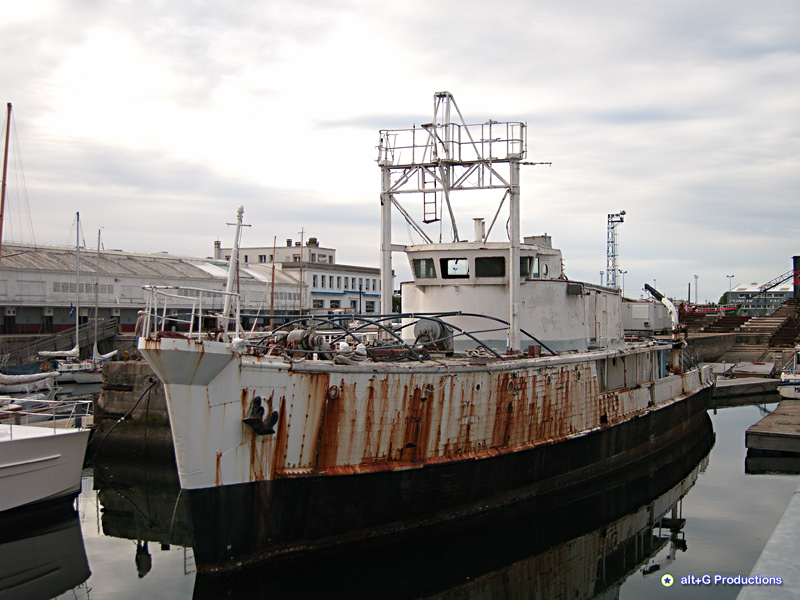
The Calypso.
A legal dispute is preventing the repairs necessary to make the explorer’s floating world seaworthy
THE vessel made famous by Jacques Cousteau, the late French underwater explorer, has decayed beyond repair during a bitter feud between his widow and son over its ownership, according to officials in the port where she is docked.
They say Cousteau’s beloved vessel, the Calypso, is so decrepit that she would need to be rebuilt before going to sea again.
Authorities in La Rochelle on the French Atlantic coast, where the Calypso has languished since 1998, say that salvage plans have been blocked by the dispute between Cousteau’s second wife, Francine, and his son from his first marriage, Jean-Michel.
Calypso, once known to millions of viewers across the world as a pioneering oceanographic research ship, is rusting and rotting as lawyers argue over her fate.
“According to experts, she can’t even be repaired. She has to be rebuilt,” said Marc Parnaudeau, the councillor in charge of the case at La Rochelle. He added: “We just want this legal wrangle to end as quickly as possible.”
But a swift solution appeared unlikely last night as the family quarrel intensified. Mme Cousteau accused her stepson of “irresponsible stubborness” and of manipulating the media.
Both run rival associations which claim to perpetuate the work of the explorer, who died in 1997.
His wife heads L’Equipe Cousteau, and his son Les Campagnes Océanographiques Françaises (COF). Each claims to own the boat and has a different project in mind.
Mme Cousteau says she has signed a deal for the Calypso to be renovated in the Bahamas by the American cruise line, Carnival Corporation, at a cost of $1.3 million (£695,000) and turned into a scientific education centre.
M Cousteau wants to keep the vessel in France, where he has asked naval architects to draw up plans for restoration. “This is an historic vessel that ought to have been classified as part of the French national heritage a long time ago,” he said.
Neither wife nor son can pursue their plans until the court case is settled.
The Calypso is a former Royal Navy minesweeper which was bought by the Guinness brewing dynasty after the Second World War and leased to Cousteau for a nominal one franc a year.
Wearing his trademark red woolly hat, he used the boat to film some of the most celebrated underwater documentaries ever made, such as Le Monde du Silence (The Silent World) which won first prize at the Cannes Film festival in 1955.
But the Calypso was damaged in Singapore harbour in 1996, a year before Cousteau’s death at the age of 87. She was brought back to La Rochelle and has not sailed since.
In November a Paris tribunal approved Mme Cousteau’s ownership claim on the grounds that Leon Guinness, the Anglo-Irish multimillionaire, had sold the ship to her association for €1.
But the COF has appealed against the judgment, arguing that a 1974 customs document makes it the proprietor.
Mme Cousteau’s association responded: “This shows the COF is ready to do anything to prevent the ship being salvaged and to paralyse the work of L’Equipe Cousteau.”
French commentators say that personal jealousies are fuelling the row. Cousteau’s first wife, Simone, who shared the Calypso with him, died in 1990, apparently unaware that he had had two children with Francine, an air hostess he had met on Concorde.
Six months later, when Cousteau married Francine, who was 40 years his junior, his son reacted angrily. M Cousteau’s hostility towards his step- mother increased when she claimed to represent her late husband’s memory.
____
www.dofundodomar.blogspot.com
Times Online
By Adam Sage
December 27, 2005
The Calypso.
A legal dispute is preventing the repairs necessary to make the explorer’s floating world seaworthy
THE vessel made famous by Jacques Cousteau, the late French underwater explorer, has decayed beyond repair during a bitter feud between his widow and son over its ownership, according to officials in the port where she is docked.
They say Cousteau’s beloved vessel, the Calypso, is so decrepit that she would need to be rebuilt before going to sea again.
Authorities in La Rochelle on the French Atlantic coast, where the Calypso has languished since 1998, say that salvage plans have been blocked by the dispute between Cousteau’s second wife, Francine, and his son from his first marriage, Jean-Michel.
Calypso, once known to millions of viewers across the world as a pioneering oceanographic research ship, is rusting and rotting as lawyers argue over her fate.
“According to experts, she can’t even be repaired. She has to be rebuilt,” said Marc Parnaudeau, the councillor in charge of the case at La Rochelle. He added: “We just want this legal wrangle to end as quickly as possible.”
But a swift solution appeared unlikely last night as the family quarrel intensified. Mme Cousteau accused her stepson of “irresponsible stubborness” and of manipulating the media.
Both run rival associations which claim to perpetuate the work of the explorer, who died in 1997.
His wife heads L’Equipe Cousteau, and his son Les Campagnes Océanographiques Françaises (COF). Each claims to own the boat and has a different project in mind.
Mme Cousteau says she has signed a deal for the Calypso to be renovated in the Bahamas by the American cruise line, Carnival Corporation, at a cost of $1.3 million (£695,000) and turned into a scientific education centre.
M Cousteau wants to keep the vessel in France, where he has asked naval architects to draw up plans for restoration. “This is an historic vessel that ought to have been classified as part of the French national heritage a long time ago,” he said.
Neither wife nor son can pursue their plans until the court case is settled.
The Calypso is a former Royal Navy minesweeper which was bought by the Guinness brewing dynasty after the Second World War and leased to Cousteau for a nominal one franc a year.
Wearing his trademark red woolly hat, he used the boat to film some of the most celebrated underwater documentaries ever made, such as Le Monde du Silence (The Silent World) which won first prize at the Cannes Film festival in 1955.
But the Calypso was damaged in Singapore harbour in 1996, a year before Cousteau’s death at the age of 87. She was brought back to La Rochelle and has not sailed since.
In November a Paris tribunal approved Mme Cousteau’s ownership claim on the grounds that Leon Guinness, the Anglo-Irish multimillionaire, had sold the ship to her association for €1.
But the COF has appealed against the judgment, arguing that a 1974 customs document makes it the proprietor.
Mme Cousteau’s association responded: “This shows the COF is ready to do anything to prevent the ship being salvaged and to paralyse the work of L’Equipe Cousteau.”
French commentators say that personal jealousies are fuelling the row. Cousteau’s first wife, Simone, who shared the Calypso with him, died in 1990, apparently unaware that he had had two children with Francine, an air hostess he had met on Concorde.
Six months later, when Cousteau married Francine, who was 40 years his junior, his son reacted angrily. M Cousteau’s hostility towards his step- mother increased when she claimed to represent her late husband’s memory.
____
www.dofundodomar.blogspot.com
Tuesday, December 27, 2005
More treasure off Elba, divers say
_________________________________________________________________
Ansa.it
December 23, 2005

Retrieved gold coins to go on display in January
A group of diving enthusiasts who found sunken treasure in the sea off the island of Elba this year are convinced there is more and are preparing for a new expedition in 2006 .
In the meantime, what they found in the wreck of the steamship Polluce, which sank in 1841, will go on display in an exhibition opening in January in Portoferraio, one of Elba's two ports .
The haul includes 12,000 gold and silver coins, an array of gold jewelry and piles of personal objects belonging to the rich passengers who were travelling on the Polluce .
But Enrico Cappelletti, a writer and diving enthusiast who spearheaded the initiative after extensive research, said he was convinced that under the mud around the wreck there is much more gold and silver .
"We've done tests that showed there are more coins and jewels about a metre and a half under the seabed. According to the records, there should be at least 50,000 coins still to be found."
Capelletti said it had been impossible to retrieve all the treasure during the two-week mission in October because divers had spent much of their time clearing up the mess left by a gang of English plunderers five years ago .
This year's expedition was mounted by a private association, the Polluce Foundation, which won the sponsorship of regional and national authorities. It will also organise the second mission .
As was the case before, whatever is found will remain the property of the Italian state and so cannot be sold. Instead the Foundation, which stumped up over 500,000 euros for the operation, intends to set up a travelling exhibition and recover its investment from ticket sales .
The coins, along with an unknown quantity of precious jewels, were being carried secretly by the Genoese ship when it was attacked by a Neapolitan vessel for reasons which remain unclear .
The Polluce sank and all its precious cargo was lost. But its wreck was recently located at a depth of 103 metres, about five miles out from Elba's main port .
There were several attempts to find the legendary treasure, but for many years expeditions never knew exactly where to look .
But in the late 1990s a French historian managed to pinpoint the location from old library records and documents in state archives. He then promptly sold the information to a group of English adventurers .
Forging the necessary authorisations, the group hired the necessary equipment, found the wreck and tried secretly in 2000 to recover its treasure .
But, despite having practically destroyed the wreck in the course of their search, they only managed to find 2,000 coins and a few jewels .
The art squad of the Italian Carabinieri police got wind of the operation and, when the English treasure hunters tried to sell their coins at a London auction house, British detectives stepped in and seized their haul .
Scotland Yard handed the coins over to their Italian colleagues the following year .
Cappelletti investigated the illegal bid made by the English adventurers, and even spoke to some of them. In the process of his enquiries, the precise position of the Polluce eventually emerged .
____
www.dofundodomar.blogspot.com
Ansa.it
December 23, 2005
Retrieved gold coins to go on display in January
A group of diving enthusiasts who found sunken treasure in the sea off the island of Elba this year are convinced there is more and are preparing for a new expedition in 2006 .
In the meantime, what they found in the wreck of the steamship Polluce, which sank in 1841, will go on display in an exhibition opening in January in Portoferraio, one of Elba's two ports .
The haul includes 12,000 gold and silver coins, an array of gold jewelry and piles of personal objects belonging to the rich passengers who were travelling on the Polluce .
But Enrico Cappelletti, a writer and diving enthusiast who spearheaded the initiative after extensive research, said he was convinced that under the mud around the wreck there is much more gold and silver .
"We've done tests that showed there are more coins and jewels about a metre and a half under the seabed. According to the records, there should be at least 50,000 coins still to be found."
Capelletti said it had been impossible to retrieve all the treasure during the two-week mission in October because divers had spent much of their time clearing up the mess left by a gang of English plunderers five years ago .
This year's expedition was mounted by a private association, the Polluce Foundation, which won the sponsorship of regional and national authorities. It will also organise the second mission .
As was the case before, whatever is found will remain the property of the Italian state and so cannot be sold. Instead the Foundation, which stumped up over 500,000 euros for the operation, intends to set up a travelling exhibition and recover its investment from ticket sales .
The coins, along with an unknown quantity of precious jewels, were being carried secretly by the Genoese ship when it was attacked by a Neapolitan vessel for reasons which remain unclear .
The Polluce sank and all its precious cargo was lost. But its wreck was recently located at a depth of 103 metres, about five miles out from Elba's main port .
There were several attempts to find the legendary treasure, but for many years expeditions never knew exactly where to look .
But in the late 1990s a French historian managed to pinpoint the location from old library records and documents in state archives. He then promptly sold the information to a group of English adventurers .
Forging the necessary authorisations, the group hired the necessary equipment, found the wreck and tried secretly in 2000 to recover its treasure .
But, despite having practically destroyed the wreck in the course of their search, they only managed to find 2,000 coins and a few jewels .
The art squad of the Italian Carabinieri police got wind of the operation and, when the English treasure hunters tried to sell their coins at a London auction house, British detectives stepped in and seized their haul .
Scotland Yard handed the coins over to their Italian colleagues the following year .
Cappelletti investigated the illegal bid made by the English adventurers, and even spoke to some of them. In the process of his enquiries, the precise position of the Polluce eventually emerged .
____
www.dofundodomar.blogspot.com
Remembering The U.S. Submarine S-4
_________________________________________________________________
Cape Cod Chronicle
By Alan Pollock
December 22, 2005
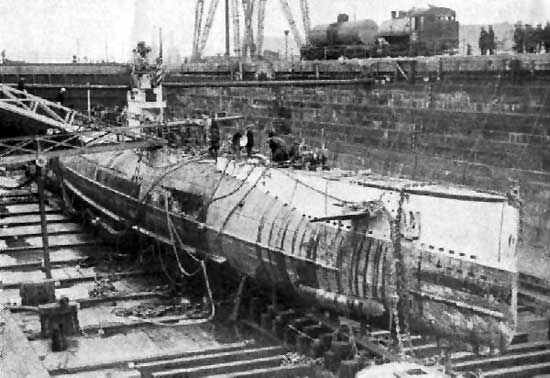
S-4 after sinking and recovery.
The story of the U.S. submarine S-4 is a tale of bravery and suffering made no less heartrending by the passage of 78 years. Even as it threatens to fade from memory, the story is the topic of a book being written by David Zeni of Harwich, a maritime historian and former U.S. Navy submarine officer.
On Dec. 17, 1927 , the S-4 was conducting routine drills just off Long Point, Provincetown , when it came to the surface and was inadvertently rammed by the U.S. Coast Guard destroyer Paulding. The ship punched a two-and-a-half-foot long hole in the starboard side of the submarine, which quickly sank in 110 feet of water.
In the frantic moments after the collision, the crew of the S-4 tried briefly to stop the flooding, but were ultimately forced to retreat behind watertight doors. Most of the crew ran aft, and quickly succumbed. But six men ran forward to the torpedo room, where they faced a less compassionate end.
On the surface, a massive effort was launched to try and save the sailors. Through newspaper and radio accounts, the nation’s eyes and ears were on Provincetown, as Navy and Coast Guard experts tried several times to raise the stricken submarine.
“This put Provincetown on the map,” Zeni said. “This became an international story.” Divers descended to the wreck and used a hammer to tap messages on the hull in Morse code, and received replies from the trapped crewmen.
Battling frigid water and a mass of tangled wreckage, divers determined there was no hope of rescuing the six men. Struggling to breathe in the ever-thinning oxygen, the sailors tapped out the question, “Is there no hope?” There was none, the divers replied.
“We understand,” came the reply.
Even after the rapping on the hull ceased, crews on the surface frantically searched for ways to raise the submarine, but a gusty storm forced them to abandon the effort on Christmas Eve. The painful decision was made to put off salvaging the ship until March, when it was towed to the Charlestown Naval Yard.
The tragedy is a timeless and poignant one, Zeni said.
“I think there’s something about the entrapment of the men in the sub, that they were still alive for three days, that draws people to this story,” he said. When it was clear that the sailors had perished, condolences came from as far away as Italy. The tale has special appeal for Zeni, who served aboard the USS Tecumseh during the Cold War, and knows the dangers inherent in submarine work.
“One of the things we say in the submarine service is that you’re half sunk already,” Zeni said. He recalls one instance when the Tecumseh lost all hydraulic power—rendering its rudder and planes temporarily useless—and started to sink uncontrollably. The crew went through a sequence of emergency steps which they had rehearsed many times before, much as the crew of the S-4 likely did during their emergency, Zeni said.
Zeni hasn’t said when his book will be published, but it may prove to be an important record of a maritime disaster. As in years past, a memorial service was held this Dec. 4 in Provincetown , though the number of eyewitnesses to the event has dwindled to a few. Among those who spoke was former Chatham selectman Parker Wiseman, whose grandfather was the physician who signed the death certificates of the S-4 crewmen. Zeni said in a few years, the yearly memorial service may cease to happen.
Though the tragedy ended the lives of 40 young sailors, the S-4 underwent a strange reincarnation. The submarine was repaired and returned to active duty in October, when it was used as a submarine rescue and salvage test ship. The devices and techniques developed using the old S-4 led to the rescue of 33 men from another stricken sub a dozen years later.
____
www.dofundodomar.blogspot.com
www.schnorkel.blogspot.com
Cape Cod Chronicle
By Alan Pollock
December 22, 2005
S-4 after sinking and recovery.
The story of the U.S. submarine S-4 is a tale of bravery and suffering made no less heartrending by the passage of 78 years. Even as it threatens to fade from memory, the story is the topic of a book being written by David Zeni of Harwich, a maritime historian and former U.S. Navy submarine officer.
On Dec. 17, 1927 , the S-4 was conducting routine drills just off Long Point, Provincetown , when it came to the surface and was inadvertently rammed by the U.S. Coast Guard destroyer Paulding. The ship punched a two-and-a-half-foot long hole in the starboard side of the submarine, which quickly sank in 110 feet of water.
In the frantic moments after the collision, the crew of the S-4 tried briefly to stop the flooding, but were ultimately forced to retreat behind watertight doors. Most of the crew ran aft, and quickly succumbed. But six men ran forward to the torpedo room, where they faced a less compassionate end.
On the surface, a massive effort was launched to try and save the sailors. Through newspaper and radio accounts, the nation’s eyes and ears were on Provincetown, as Navy and Coast Guard experts tried several times to raise the stricken submarine.
“This put Provincetown on the map,” Zeni said. “This became an international story.” Divers descended to the wreck and used a hammer to tap messages on the hull in Morse code, and received replies from the trapped crewmen.
Battling frigid water and a mass of tangled wreckage, divers determined there was no hope of rescuing the six men. Struggling to breathe in the ever-thinning oxygen, the sailors tapped out the question, “Is there no hope?” There was none, the divers replied.
“We understand,” came the reply.
Even after the rapping on the hull ceased, crews on the surface frantically searched for ways to raise the submarine, but a gusty storm forced them to abandon the effort on Christmas Eve. The painful decision was made to put off salvaging the ship until March, when it was towed to the Charlestown Naval Yard.
The tragedy is a timeless and poignant one, Zeni said.
“I think there’s something about the entrapment of the men in the sub, that they were still alive for three days, that draws people to this story,” he said. When it was clear that the sailors had perished, condolences came from as far away as Italy. The tale has special appeal for Zeni, who served aboard the USS Tecumseh during the Cold War, and knows the dangers inherent in submarine work.
“One of the things we say in the submarine service is that you’re half sunk already,” Zeni said. He recalls one instance when the Tecumseh lost all hydraulic power—rendering its rudder and planes temporarily useless—and started to sink uncontrollably. The crew went through a sequence of emergency steps which they had rehearsed many times before, much as the crew of the S-4 likely did during their emergency, Zeni said.
Zeni hasn’t said when his book will be published, but it may prove to be an important record of a maritime disaster. As in years past, a memorial service was held this Dec. 4 in Provincetown , though the number of eyewitnesses to the event has dwindled to a few. Among those who spoke was former Chatham selectman Parker Wiseman, whose grandfather was the physician who signed the death certificates of the S-4 crewmen. Zeni said in a few years, the yearly memorial service may cease to happen.
Though the tragedy ended the lives of 40 young sailors, the S-4 underwent a strange reincarnation. The submarine was repaired and returned to active duty in October, when it was used as a submarine rescue and salvage test ship. The devices and techniques developed using the old S-4 led to the rescue of 33 men from another stricken sub a dozen years later.
____
www.dofundodomar.blogspot.com
www.schnorkel.blogspot.com
Saturday, December 24, 2005
Navy's Last 2 Battleships to Be Decommissioned
_________________________________________________________________
Washington Post
December 21, 2005

The USS Wisconsin is an Iowa-class
battleship with 16-inch guns.
(By Buddy Norris -- Daily
The last two U.S. battleships -- the USS Iowa and the USS Wisconsin -- have been decommissioned and reactivated several times in their 60-year history.
Now they are facing their final deactivation and could be turned into museums.
They were last deactivated in 1991, but Congress ordered them back into reserve status five years later after determining that the Navy would have a gap in its ability to support Marine Corps land operations until early in the 21st century.
From World War II until the 1991 Persian Gulf War, support for the Marines was provided mostly by the Iowa-class battleships' 16-inch guns, which can hurl a 2,000-pound projectile 24 nautical miles.
The last ship to fire its guns in support of U.S. troops ashore was the USS Wisconsin in 1991.
Congress will decide whether to decommission the two battleships for good as lawmakers try to complete the defense authorization and spending bills. A GAO report said the Iowa and Wisconsin together cost about $1.4 million a year to maintain.
The Iowa and the Wisconsin are each nearly three football fields long. The Iowa would become a floating museum in Stockton, Calif., and the Wisconsin would become a museum in Norfolk.
Critics warn that the move could leave Marines vulnerable.
The Navy expects that most future battles will be in or near coastal waters, and that it will need ships that can deliver huge amounts of gunfire to support land operations. Cruisers and destroyers serve that purpose now, and the Navy expects the new DD(X) destroyer to take over the job when it goes into service in 2014.
"The issue here is the need to press forward with a new ship and new technology to meet 21st-century threats," said Landon Hutchens, a Naval Sea Systems Command spokesman. "The battleships performed marvelously in the 20th century, with 20th-century technology. DD(X) incorporates stealth technology, precision-guided long-range naval fire support, the capability to shoot down enemy aircraft before they can fire anti-ship missiles and high-tech command and control communications capabilities."
The critics doubt the DD(X)'s capabilities and say the Navy cannot afford to wait until the next decade.
"At present the Navy's active fleet has no effective NSFS [naval surface fire support] capability," says a statement by the U.S. Naval Fire Support Association, a group that supports reactivating the two battleships. "The Navy's attempt to rectify this serious deficiency by developing long-range 5-inch and 6.1-inch 155 mm gun systems and medium-range missiles is not adequate."
Currently, the Navy uses 5-inch guns on its destroyers and cruisers to support land operations.
The battleship supporters say that only battleships can provide accurate and high-volume fire in all conditions.
____
www.dofundodomar.blogspot.com
Washington Post
December 21, 2005
The USS Wisconsin is an Iowa-class
battleship with 16-inch guns.
(By Buddy Norris -- Daily
The last two U.S. battleships -- the USS Iowa and the USS Wisconsin -- have been decommissioned and reactivated several times in their 60-year history.
Now they are facing their final deactivation and could be turned into museums.
They were last deactivated in 1991, but Congress ordered them back into reserve status five years later after determining that the Navy would have a gap in its ability to support Marine Corps land operations until early in the 21st century.
From World War II until the 1991 Persian Gulf War, support for the Marines was provided mostly by the Iowa-class battleships' 16-inch guns, which can hurl a 2,000-pound projectile 24 nautical miles.
The last ship to fire its guns in support of U.S. troops ashore was the USS Wisconsin in 1991.
Congress will decide whether to decommission the two battleships for good as lawmakers try to complete the defense authorization and spending bills. A GAO report said the Iowa and Wisconsin together cost about $1.4 million a year to maintain.
The Iowa and the Wisconsin are each nearly three football fields long. The Iowa would become a floating museum in Stockton, Calif., and the Wisconsin would become a museum in Norfolk.
Critics warn that the move could leave Marines vulnerable.
The Navy expects that most future battles will be in or near coastal waters, and that it will need ships that can deliver huge amounts of gunfire to support land operations. Cruisers and destroyers serve that purpose now, and the Navy expects the new DD(X) destroyer to take over the job when it goes into service in 2014.
"The issue here is the need to press forward with a new ship and new technology to meet 21st-century threats," said Landon Hutchens, a Naval Sea Systems Command spokesman. "The battleships performed marvelously in the 20th century, with 20th-century technology. DD(X) incorporates stealth technology, precision-guided long-range naval fire support, the capability to shoot down enemy aircraft before they can fire anti-ship missiles and high-tech command and control communications capabilities."
The critics doubt the DD(X)'s capabilities and say the Navy cannot afford to wait until the next decade.
"At present the Navy's active fleet has no effective NSFS [naval surface fire support] capability," says a statement by the U.S. Naval Fire Support Association, a group that supports reactivating the two battleships. "The Navy's attempt to rectify this serious deficiency by developing long-range 5-inch and 6.1-inch 155 mm gun systems and medium-range missiles is not adequate."
Currently, the Navy uses 5-inch guns on its destroyers and cruisers to support land operations.
The battleship supporters say that only battleships can provide accurate and high-volume fire in all conditions.
____
www.dofundodomar.blogspot.com
Friday, December 23, 2005
Diver finds warplane wreck
_________________________________________________________________
News.com.au
By Jade Bilowol
December 21, 2005
A MYSTERY warplane wreck has been found in a watery grave off the tip of far north Queensland.
Diver and underwater filmmaker Ben Cropp today said he discovered the wreck under 6m of water "about half a mile" off the tip of Cape York last month.
The wreck, that took up to 10 passengers to their deaths during World War II, was either an B24 Liberator bomber, a B17 Fortress or even a Japanese Emily flying boat, Mr Cropp said.
Mr Cropp said he was determined return to the site, near Albany Passage, next year to unravel the mystery.
"It's intriguing – there were no survivors, unless it was a Japanese plane and they would want to sneak away," Mr Cropp said.
"I'll identify it by counting the pistons, and they should still be intact, or by finding the name of the engine on the cowling."
He found the wing tip and three engines of the war plane, as well as its coral-covered fuselage, while filming the documentary The Silent Warriors.
"It is a huge, huge bomber – it has a wing span of more than 30m," he said.
"I would say it is the largest plane to crash in Australia. There would be others of the same size but there hasn't been a larger one to crash on land or in the sea here."
However, he doubted any human remains would be recovered from the wreck.
"The sea just eats up everything," Mr Cropp said.
He said the discovery was one of 231 warplane wrecks that crashed in the far north Queensland region during World War II.
Mr Cropp believed the plane crashed because it ran out of fuel.
____
www.dofundodomar.blogspot.com
News.com.au
By Jade Bilowol
December 21, 2005
A MYSTERY warplane wreck has been found in a watery grave off the tip of far north Queensland.
Diver and underwater filmmaker Ben Cropp today said he discovered the wreck under 6m of water "about half a mile" off the tip of Cape York last month.
The wreck, that took up to 10 passengers to their deaths during World War II, was either an B24 Liberator bomber, a B17 Fortress or even a Japanese Emily flying boat, Mr Cropp said.
Mr Cropp said he was determined return to the site, near Albany Passage, next year to unravel the mystery.
"It's intriguing – there were no survivors, unless it was a Japanese plane and they would want to sneak away," Mr Cropp said.
"I'll identify it by counting the pistons, and they should still be intact, or by finding the name of the engine on the cowling."
He found the wing tip and three engines of the war plane, as well as its coral-covered fuselage, while filming the documentary The Silent Warriors.
"It is a huge, huge bomber – it has a wing span of more than 30m," he said.
"I would say it is the largest plane to crash in Australia. There would be others of the same size but there hasn't been a larger one to crash on land or in the sea here."
However, he doubted any human remains would be recovered from the wreck.
"The sea just eats up everything," Mr Cropp said.
He said the discovery was one of 231 warplane wrecks that crashed in the far north Queensland region during World War II.
Mr Cropp believed the plane crashed because it ran out of fuel.
____
www.dofundodomar.blogspot.com
Scientists find sand on seafloor
_________________________________________________________________
News.com.au
By D.D. McNicoll
December 20, 2005
A MONTH after a live television documentary "found" the missing Japanese midget submarine from the 1942 raid on Sydney Harbour, the 24m-long, 46 tonne sub is lost again.
NSW Planning Minister Frank Sartor yesterday announced that NSW Heritage Office investigations found the sub-shaped lump of sand on the ocean floor off Lion Island, in Broken Bay just north of Sydney, was just that - a lump of sand.
But the doco maker remains unconvinced.
"There is no submarine," Mr Sartor said, "Just a pile of sand. We are 99.9 per cent positive there is nothing there."
Standing at the National Maritime Museum with a real submarine - the decommissioned HMAS Onslow - in the background, Mr Sartor said a final check, using a magnetometer, would be made at the site but that a sidescan sonar survey and a sub-bottom profiling survey had found no sign of the submarine.
The three surveys of the site will only cost NSW taxpayers $5000 because much of the work was done for free by the NSW Water Police and scientists interested in discovering if the submarine was really there.
"Filmmakers Damien Lay and Chris Berry are to be congratulated for reigniting interest in Australia's maritime heritage with their detailed investigation into this theory," Mr Sartor said.
"I directed the Heritage Office to immediate evaluate these claims and finally get to the bottom of the mystery - but initial findings show the sea is yet to yield this long-held secret."
The missing Japanese midget submarine, known as M24, disappeared after a raid by three submarines on Sydney Harbour on the night of May 31, 1942.
Lay yesterday said he believed there needed to be further exploration of the site identified in his documentary.
"I still firmly believe it is there," he said.
"We are pleased that the NSW Heritage Office has undertaken initial surveys. However, we believe that further exploration of the site needs to be done to determine whether this is the location of the missing M24 Japanese midget submarine."
Lay said he didn't believe the submarine was intact after more than 60 years on the seabed.
"The Heritage Office seem to think that the conning tower should be sticking up out of the sand," he said. "I believe the submarine would be extremely deteriorated. There is probably very little still in existence."
Lay said legislation covering war wrecks had prevented him from exploring the site.
"But we know there is more than sand in this location," he said. "The only way to solve the mystery is to do a dig and see what is there."
Two of the submarines which attacked Sydney Harbour were sunk during the raid and later recovered from the harbour floor, but no sign of M24 and its two-man crew has been found.
A torpedo from one of the submarines sank the depot ship HMAS Kuttabul, which was being used as a floating dormitory, and 21 sailors were killed.
Investigations by the Heritage Office found that previously located Japanese midget submarines in Madagascar, Papua New Guinea and Hawaii were found upright on the sea floor and largely uncovered by sand.
The office also found that the natural depth of sand in Broken Bay was only 2m-3m, insufficient to totally bury a midget submarine with a hull circumference alone of almost 2m.
____
www.dofundodomar.blogspot.com
www.schnorkel.blogspot.com
News.com.au
By D.D. McNicoll
December 20, 2005
A MONTH after a live television documentary "found" the missing Japanese midget submarine from the 1942 raid on Sydney Harbour, the 24m-long, 46 tonne sub is lost again.
NSW Planning Minister Frank Sartor yesterday announced that NSW Heritage Office investigations found the sub-shaped lump of sand on the ocean floor off Lion Island, in Broken Bay just north of Sydney, was just that - a lump of sand.
But the doco maker remains unconvinced.
"There is no submarine," Mr Sartor said, "Just a pile of sand. We are 99.9 per cent positive there is nothing there."
Standing at the National Maritime Museum with a real submarine - the decommissioned HMAS Onslow - in the background, Mr Sartor said a final check, using a magnetometer, would be made at the site but that a sidescan sonar survey and a sub-bottom profiling survey had found no sign of the submarine.
The three surveys of the site will only cost NSW taxpayers $5000 because much of the work was done for free by the NSW Water Police and scientists interested in discovering if the submarine was really there.
"Filmmakers Damien Lay and Chris Berry are to be congratulated for reigniting interest in Australia's maritime heritage with their detailed investigation into this theory," Mr Sartor said.
"I directed the Heritage Office to immediate evaluate these claims and finally get to the bottom of the mystery - but initial findings show the sea is yet to yield this long-held secret."
The missing Japanese midget submarine, known as M24, disappeared after a raid by three submarines on Sydney Harbour on the night of May 31, 1942.
Lay yesterday said he believed there needed to be further exploration of the site identified in his documentary.
"I still firmly believe it is there," he said.
"We are pleased that the NSW Heritage Office has undertaken initial surveys. However, we believe that further exploration of the site needs to be done to determine whether this is the location of the missing M24 Japanese midget submarine."
Lay said he didn't believe the submarine was intact after more than 60 years on the seabed.
"The Heritage Office seem to think that the conning tower should be sticking up out of the sand," he said. "I believe the submarine would be extremely deteriorated. There is probably very little still in existence."
Lay said legislation covering war wrecks had prevented him from exploring the site.
"But we know there is more than sand in this location," he said. "The only way to solve the mystery is to do a dig and see what is there."
Two of the submarines which attacked Sydney Harbour were sunk during the raid and later recovered from the harbour floor, but no sign of M24 and its two-man crew has been found.
A torpedo from one of the submarines sank the depot ship HMAS Kuttabul, which was being used as a floating dormitory, and 21 sailors were killed.
Investigations by the Heritage Office found that previously located Japanese midget submarines in Madagascar, Papua New Guinea and Hawaii were found upright on the sea floor and largely uncovered by sand.
The office also found that the natural depth of sand in Broken Bay was only 2m-3m, insufficient to totally bury a midget submarine with a hull circumference alone of almost 2m.
____
www.dofundodomar.blogspot.com
www.schnorkel.blogspot.com
Beneath The Seven Seas Launched
_________________________________________________________________
Radio Cayman
December 22, 2005
As of this week, Cayman residents will be able to enjoy the new Beneath the Seven Seas book, which is billed as the most exciting book ever published on marine exploration and seafaring history. It will be unveiled during a book-signing at Hobbies and Books, Grand Harbour this evening, 22 December, between 6:00 and 8:00pm.
The new publication, highlighting underwater archaeological adventures with the Institute of Nautical Archaeology (INA), has been released by Thames and Hudson. The general editor is INA founder Dr. George Bass, considered the father of underwater archaeology. The most significant local contributor is Dr. Peggy Leshikar-Denton, an INA Research Associate, who has been based in the Cayman Islands for many years, affiliated with the Maritime Heritage Trail Partners and the National Museum. She has participated in INA marine research projects around the world. A former student of Dr. Bass, she will be signing the books on Thursday evening. Other local contributors are photographers Lennon Christian, Courtney Platt, and Dennis Leshikar-Denton, who will also be available to sign the books.
The most prominently-placed local photograph appears on the title page, and features the anchor of the Cayman Islands shipwreck Glamis, which was built in Scotland in 1876, and was lost in East End in 1913. This photo was taken by marine biologist Dr. Alexander Mustard, who is a regular visitor to the Cayman Islands.
Reflecting on her adventures, Dr. Leshikar-Denton said that actual research work and discoveries of historical moments and stories are the greatest rewards. For instance, she relates that she was privileged to work on one of the world's oldest known shipwrecks.
Beneath the Seven Seas takes the reader on an across-the-globe adventure, with first-hand exploration reports and accounts of sunken cities, as well as some of the greatest shipwrecks in the world, including in the waters around the Cayman Islands and neighbouring countries.
The content includes accounts of Jamaica's infamous city of Port Royal, which was sunk by an earthquake and is today regarded as the best example of submerged archaeology. East End's Wreck of the Ten Sails, with information and photographs from the local contributors, is featured and the book also describes a royal ship which sank over 3,300 years ago. Articles by Robert Ballard, who discovered the wreckage of the Titanic are also included.
The human side of shipwrecks is also depicted, an aspect all too familiar to many residents in light of local lives lost during Cayman's seafaring era. Two examples drawn from across the globe describe the loss of a returning ship within sight of relatives and friends on the shores of Portugal in 1606, as well as the dark fate of a ship's crew lost off Kenya some years later.
With featured sections covering the Caribbean Sea to the Pacific Ocean and the Mediterranean to the Red Sea, as well as the Indian Ocean, the marine archaeologists vividly describe shipwrecks that reveal details of ancient battles, priceless items of royalty and the more humdrum implements of normal life such as cutlery and wine bottles.
The new first-edition hardcover book is available at both Hobbies and Books locations, as well as both Book Nook stores, the Cayman Islands National Museum, and Ocean Frontiers. It costs CI$40.
____
www.dofundomar.blogspot.com
Radio Cayman
December 22, 2005
As of this week, Cayman residents will be able to enjoy the new Beneath the Seven Seas book, which is billed as the most exciting book ever published on marine exploration and seafaring history. It will be unveiled during a book-signing at Hobbies and Books, Grand Harbour this evening, 22 December, between 6:00 and 8:00pm.
The new publication, highlighting underwater archaeological adventures with the Institute of Nautical Archaeology (INA), has been released by Thames and Hudson. The general editor is INA founder Dr. George Bass, considered the father of underwater archaeology. The most significant local contributor is Dr. Peggy Leshikar-Denton, an INA Research Associate, who has been based in the Cayman Islands for many years, affiliated with the Maritime Heritage Trail Partners and the National Museum. She has participated in INA marine research projects around the world. A former student of Dr. Bass, she will be signing the books on Thursday evening. Other local contributors are photographers Lennon Christian, Courtney Platt, and Dennis Leshikar-Denton, who will also be available to sign the books.
The most prominently-placed local photograph appears on the title page, and features the anchor of the Cayman Islands shipwreck Glamis, which was built in Scotland in 1876, and was lost in East End in 1913. This photo was taken by marine biologist Dr. Alexander Mustard, who is a regular visitor to the Cayman Islands.
Reflecting on her adventures, Dr. Leshikar-Denton said that actual research work and discoveries of historical moments and stories are the greatest rewards. For instance, she relates that she was privileged to work on one of the world's oldest known shipwrecks.
Beneath the Seven Seas takes the reader on an across-the-globe adventure, with first-hand exploration reports and accounts of sunken cities, as well as some of the greatest shipwrecks in the world, including in the waters around the Cayman Islands and neighbouring countries.
The content includes accounts of Jamaica's infamous city of Port Royal, which was sunk by an earthquake and is today regarded as the best example of submerged archaeology. East End's Wreck of the Ten Sails, with information and photographs from the local contributors, is featured and the book also describes a royal ship which sank over 3,300 years ago. Articles by Robert Ballard, who discovered the wreckage of the Titanic are also included.
The human side of shipwrecks is also depicted, an aspect all too familiar to many residents in light of local lives lost during Cayman's seafaring era. Two examples drawn from across the globe describe the loss of a returning ship within sight of relatives and friends on the shores of Portugal in 1606, as well as the dark fate of a ship's crew lost off Kenya some years later.
With featured sections covering the Caribbean Sea to the Pacific Ocean and the Mediterranean to the Red Sea, as well as the Indian Ocean, the marine archaeologists vividly describe shipwrecks that reveal details of ancient battles, priceless items of royalty and the more humdrum implements of normal life such as cutlery and wine bottles.
The new first-edition hardcover book is available at both Hobbies and Books locations, as well as both Book Nook stores, the Cayman Islands National Museum, and Ocean Frontiers. It costs CI$40.
____
www.dofundomar.blogspot.com
Thursday, December 22, 2005
"Carthaginian II" Lahaina icon sinks into deep sleep
_________________________________________________________________
Honolulu Advertiser
By Christie Wilson
December 14, 2005

ALOHA, OLD GIRL: The Carthaginian II, once used as a whaling museum,
is prepared to be towed from Lahaina Harbor to its final resting place off
Puamana. It received a bittersweet send-off yesterday.
LAHAINA, Maui -- The Carthaginian II was given a bittersweet send-off yesterday as it was towed from its longtime berth at Lahaina Harbor and ceremoniously scuttled to the accompaniment of cannon fire.
The 97-foot, steel-hulled vessel, rigged to resemble a 19th-century brig and once used as a whaling museum, sank in 95 feet of water off Puamana, where it will serve as an artificial reef. The operation was undertaken by Atlantis Adventures, a submarine tour company that created similar marine habitats off Waikiki.
Although it had no true historical value, the Carthaginian II was one of Lahaina's most recognizable attractions, featured in thousands of artworks and visitor photographs over the past 32 years. The ship belonged to the nonprofit Lahaina Restoration Foundation, which was spending $50,000 a year to maintain the rusting hulk. When marine engineers advised against further repairs because of the increasing costs, Atlantis was approached two years ago to claim the vessel, which will enhance its underwater tours.

HEADING OUT: Following a Hawaiian blessing, crewmem-bers
prepare to remove the patches over two sets of holes that had
been cut in the steel hull about 18 inches above the water line.
Foundation executive director George "Keoki" Freeland said he was relieved the Carthaginian II had reached its final resting place.
"I was worried the buggah might sink where it was," Freeland said.
The first Carthaginian was a replica of a whaling supply vessel used for the 1966 movie "Hawaii," based on the James Michener novel. The Lahaina Restoration Foundation purchased the wooden boat, but it sank in 1972 on its way to O'ahu for dry dock. A second vessel was acquired, a cement carrier built in Germany in 1920. Rechristened the Carthaginian II, it sailed to Lahaina in 1973. It took seven years for the historically accurate rigging to be assembled dockside.
"It was a focal point for downtown Lahaina. It's like taking a painting off the wall and all of a sudden the wall looks empty," said artist Peg Robertson. "It's sad. I'm going to miss it."
Atlantis spent approximately $350,000 on the Carthaginian project, including preparation of environmental studies. American Marine Services was hired to handle yesterday's operation. Jim Walsh, general manager of Atlantis Submarines Maui, said the sunken ship will not affect swimmers, surfers or other ocean users.
The tour company established its first artificial reef in Hawai'i in 1989 off Waikiki, eventually creating four underwater habitats using a Navy tanker, an old fishing vessel, large sections of two airplanes and a pyramid structure.

GOING DOWN: The Carthaginian II begins its 95-foot descent off
Puamana, where it will serve as an artificial reef.
Walsh said Atlantis staff and Maui Community College students will be monitoring the Puamana site to determine how quickly marine life moves into the shipwreck and what kind of species take up residence there.
Before the Carthaginian II was towed from Lahaina Harbor yesterday, entertainers from the Old Lahaina Lu'au performed "Aloha 'Oe" and members of the Lahaina Restoration Foundation placed lei on the vessel and held signs bidding it aloha.
To prepare for the sinking, 10 tons of concrete had been loaded on board, adding to the 35 tons of material the boat already was carrying. Atlantis' small tugboat Roxie pulled the Carthaginian II out of the harbor before transferring the operation to the larger American Islander tugboat.
A flotilla of about 20 boats was waiting when the Carthaginian II arrived at Puamana, and spectators lined the shore or pulled over on Honoapi'ilani Highway to watch the spectacle. Kahu Charles Kaupu offered a Hawaiian blessing, and after a 3-ton anchor was secured to the bow and the boat was in position, patches were removed from two sets of holes that had been cut into the hull about 18 inches above the water line. Seawater was pumped into the hull, and 27 minutes later the Carthaginian was headed to the sandy bottom.
Observers let loose with applause and whoops of appreciation as the ship quietly slipped beneath the surface. Aboard the Atlantis shuttle boat, Freeland fired three air-shattering blasts from a miniature brass cannon.
Back on shore, Robertson was critical of the Lahaina Restoration Foundation for not having a replacement for the Carthaginian II that would continue to provide residents and visitors with a picturesque view and a historical link to the town's colorful past.
Freeland said because it was impossible to predict when Atlantis would receive state and federal approvals, the organization was not able to arrange for a new attraction to immediately occupy the berth at Lahaina Harbor.

The space is reserved for cultural or historical purposes, and with the Carthaginian now gone, Freeland said the foundation has 120 days to find a new vessel for the berth, or risk losing it to commercial operations.
Freeland has been in discussions with Hui O Wa'a Kaulua about placing one of the group's Hawaiian sailing canoes there. He said that would be ideal because it would be an operational vessel that could be used for educational programs.
Lahaina Harbor expansion plans by the state Department of Land and Natural Resources also will affect future use of the site. Freeland said he has urged DLNR officials to reserve space for the foundation.
DLNR officials were not available yesterday to comment.
____
www.dofundodomar.blogspot.com
Honolulu Advertiser
By Christie Wilson
December 14, 2005
ALOHA, OLD GIRL: The Carthaginian II, once used as a whaling museum,
is prepared to be towed from Lahaina Harbor to its final resting place off
Puamana. It received a bittersweet send-off yesterday.
LAHAINA, Maui -- The Carthaginian II was given a bittersweet send-off yesterday as it was towed from its longtime berth at Lahaina Harbor and ceremoniously scuttled to the accompaniment of cannon fire.
The 97-foot, steel-hulled vessel, rigged to resemble a 19th-century brig and once used as a whaling museum, sank in 95 feet of water off Puamana, where it will serve as an artificial reef. The operation was undertaken by Atlantis Adventures, a submarine tour company that created similar marine habitats off Waikiki.
Although it had no true historical value, the Carthaginian II was one of Lahaina's most recognizable attractions, featured in thousands of artworks and visitor photographs over the past 32 years. The ship belonged to the nonprofit Lahaina Restoration Foundation, which was spending $50,000 a year to maintain the rusting hulk. When marine engineers advised against further repairs because of the increasing costs, Atlantis was approached two years ago to claim the vessel, which will enhance its underwater tours.
HEADING OUT: Following a Hawaiian blessing, crewmem-bers
prepare to remove the patches over two sets of holes that had
been cut in the steel hull about 18 inches above the water line.
Foundation executive director George "Keoki" Freeland said he was relieved the Carthaginian II had reached its final resting place.
"I was worried the buggah might sink where it was," Freeland said.
The first Carthaginian was a replica of a whaling supply vessel used for the 1966 movie "Hawaii," based on the James Michener novel. The Lahaina Restoration Foundation purchased the wooden boat, but it sank in 1972 on its way to O'ahu for dry dock. A second vessel was acquired, a cement carrier built in Germany in 1920. Rechristened the Carthaginian II, it sailed to Lahaina in 1973. It took seven years for the historically accurate rigging to be assembled dockside.
"It was a focal point for downtown Lahaina. It's like taking a painting off the wall and all of a sudden the wall looks empty," said artist Peg Robertson. "It's sad. I'm going to miss it."
Atlantis spent approximately $350,000 on the Carthaginian project, including preparation of environmental studies. American Marine Services was hired to handle yesterday's operation. Jim Walsh, general manager of Atlantis Submarines Maui, said the sunken ship will not affect swimmers, surfers or other ocean users.
The tour company established its first artificial reef in Hawai'i in 1989 off Waikiki, eventually creating four underwater habitats using a Navy tanker, an old fishing vessel, large sections of two airplanes and a pyramid structure.
GOING DOWN: The Carthaginian II begins its 95-foot descent off
Puamana, where it will serve as an artificial reef.
Walsh said Atlantis staff and Maui Community College students will be monitoring the Puamana site to determine how quickly marine life moves into the shipwreck and what kind of species take up residence there.
Before the Carthaginian II was towed from Lahaina Harbor yesterday, entertainers from the Old Lahaina Lu'au performed "Aloha 'Oe" and members of the Lahaina Restoration Foundation placed lei on the vessel and held signs bidding it aloha.
To prepare for the sinking, 10 tons of concrete had been loaded on board, adding to the 35 tons of material the boat already was carrying. Atlantis' small tugboat Roxie pulled the Carthaginian II out of the harbor before transferring the operation to the larger American Islander tugboat.
A flotilla of about 20 boats was waiting when the Carthaginian II arrived at Puamana, and spectators lined the shore or pulled over on Honoapi'ilani Highway to watch the spectacle. Kahu Charles Kaupu offered a Hawaiian blessing, and after a 3-ton anchor was secured to the bow and the boat was in position, patches were removed from two sets of holes that had been cut into the hull about 18 inches above the water line. Seawater was pumped into the hull, and 27 minutes later the Carthaginian was headed to the sandy bottom.
Observers let loose with applause and whoops of appreciation as the ship quietly slipped beneath the surface. Aboard the Atlantis shuttle boat, Freeland fired three air-shattering blasts from a miniature brass cannon.
Back on shore, Robertson was critical of the Lahaina Restoration Foundation for not having a replacement for the Carthaginian II that would continue to provide residents and visitors with a picturesque view and a historical link to the town's colorful past.
Freeland said because it was impossible to predict when Atlantis would receive state and federal approvals, the organization was not able to arrange for a new attraction to immediately occupy the berth at Lahaina Harbor.
The space is reserved for cultural or historical purposes, and with the Carthaginian now gone, Freeland said the foundation has 120 days to find a new vessel for the berth, or risk losing it to commercial operations.
Freeland has been in discussions with Hui O Wa'a Kaulua about placing one of the group's Hawaiian sailing canoes there. He said that would be ideal because it would be an operational vessel that could be used for educational programs.
Lahaina Harbor expansion plans by the state Department of Land and Natural Resources also will affect future use of the site. Freeland said he has urged DLNR officials to reserve space for the foundation.
DLNR officials were not available yesterday to comment.
____
www.dofundodomar.blogspot.com
1900 shipwreck was a close call
_________________________________________________________________
Ocean County Observer
December 19, 2005
It may have been the season to be jolly, but Ocean County was still a dangerous place as Christmas approached in 1900.
Over on the beach, in Lavallette, lifesaving crews braved a winter storm and a surf filled with lumber to haul a crew of six off the three-masted schooner Oliver Schofield.
At least it was a three-masted schooner when it first ran aground about 3 p.m. on Dec. 4.A severe gale demasted the schooner and she was waterlogged.
Gone were the main and mizzen masts when the crew of the Chadwick Lifesaving Station arrived. They left their station three minutes after the ship went aground, hauling their rescue gear over the beach to reach the ship.
The schooner was filled with lumber, bound from Norfolk, Va., to New York.J. W. Petit, keeper of the Chadwick Station, said a line was fired to the ship, which was 200 yards offshore.
The crew of the schooner tried to make the line fast to the foremast just as it too was washed overboard.
Instead they tied the line to lumber and two men were taken off before the line operating the breeches buoy broke the first time.It was mended and the fourth man was taken off just as it broke again.
The captain and mate were left aboard.
Unable to reassemble the gear, and with darkness approaching, the two seamen worked their way from the ship toward the beach hand-over-hand on the hawser, dropping into the sea filled with lumber when they were close enough for members of the lifesaving crew to reach them.
"It was hard and dangerous work," Petit said. His crew was aided by the one from Mantoloking and fishermen from Lavallette.
"Each man staid at his post and there was no shirking," Petit said of the Lifesavers. "We saw from the start that we must take our lives in our hands if we hoped to save our fellow man," he added.
The crew was rescued, the ship left a hopeless wreck on the beach, its cargo in piles nearby.
The ship was built in 1867, was 136-feet long, 31-feet wide, and weighed 376 tons. Her homeport was New London, Conn.
If Ocean County surfmen had saved passing seamen in Lavallette, two from Tuckerton were just as glad for the work of those at Rocky Point, Long Island, N.Y.George W. Jones and Walter C. Stiles were part of the crew of the yacht Rosina, owned by Harry T. Malpass of Philadelphia, when it went to pieces at Rocky Point. They were among the crew members rescued by the Lifesaving crew there, and were back in Tuckerton in time to celebrate their good fortune and Christmas.
____
www.dofundodomar.blogspot.com
Ocean County Observer
December 19, 2005
It may have been the season to be jolly, but Ocean County was still a dangerous place as Christmas approached in 1900.
Over on the beach, in Lavallette, lifesaving crews braved a winter storm and a surf filled with lumber to haul a crew of six off the three-masted schooner Oliver Schofield.
At least it was a three-masted schooner when it first ran aground about 3 p.m. on Dec. 4.A severe gale demasted the schooner and she was waterlogged.
Gone were the main and mizzen masts when the crew of the Chadwick Lifesaving Station arrived. They left their station three minutes after the ship went aground, hauling their rescue gear over the beach to reach the ship.
The schooner was filled with lumber, bound from Norfolk, Va., to New York.J. W. Petit, keeper of the Chadwick Station, said a line was fired to the ship, which was 200 yards offshore.
The crew of the schooner tried to make the line fast to the foremast just as it too was washed overboard.
Instead they tied the line to lumber and two men were taken off before the line operating the breeches buoy broke the first time.It was mended and the fourth man was taken off just as it broke again.
The captain and mate were left aboard.
Unable to reassemble the gear, and with darkness approaching, the two seamen worked their way from the ship toward the beach hand-over-hand on the hawser, dropping into the sea filled with lumber when they were close enough for members of the lifesaving crew to reach them.
"It was hard and dangerous work," Petit said. His crew was aided by the one from Mantoloking and fishermen from Lavallette.
"Each man staid at his post and there was no shirking," Petit said of the Lifesavers. "We saw from the start that we must take our lives in our hands if we hoped to save our fellow man," he added.
The crew was rescued, the ship left a hopeless wreck on the beach, its cargo in piles nearby.
The ship was built in 1867, was 136-feet long, 31-feet wide, and weighed 376 tons. Her homeport was New London, Conn.
If Ocean County surfmen had saved passing seamen in Lavallette, two from Tuckerton were just as glad for the work of those at Rocky Point, Long Island, N.Y.George W. Jones and Walter C. Stiles were part of the crew of the yacht Rosina, owned by Harry T. Malpass of Philadelphia, when it went to pieces at Rocky Point. They were among the crew members rescued by the Lifesaving crew there, and were back in Tuckerton in time to celebrate their good fortune and Christmas.
____
www.dofundodomar.blogspot.com
Wednesday, December 21, 2005
3D Images Give New Life to Old Shipwrecks
_________________________________________________________________
Live Science
By Heather Whipps
December 19, 2005

Wreck of the Currajong in Sydney Harbour, Australia,
using 3D imaging. Credit: GeoAcoustics.
It's no nightingale, but a new seismic technology nicknamed Chirp is making music for the ears of archaeologists interested in the wrecks of sunken ships.
Named for the bird-like blips it makes in action, GeoChirp 3-D is able to generate three-dimensional images of just about anything lying beneath the seafloor, including shipwrecks hidden under years of muck and sand build-up.
Chirp is "a seismic system that works by firing sound waves at the seafloor and measuring the reflections as they bounce back from objects and different rock layers in the seabed," writes the UK's Engineering and Physical Sciences Research Council (EPSRC) in a recent edition of their quarterly publication Newsline.
Unlike the traditional two-dimensional method of slicing the seabed vertically from the top down, Chirp produces a cube of information.
"The processed output from this system is a true 3-D 'volume,' as though when looking at the seabed you had switched on your 'X-ray vision' and were able to see buried objects," explained Peter Hogarth, technical director with GeoAcoustics Ltd, the manufacturer of Chirp.
The oil industry has used a similar 3-D seismic system for several decades to detect untapped pockets of hydrocarbon. In that industry, a less detailed resolution over a wider area works just fine, said Justin Dix, professor of marine geophysics and geoarchaeology at Southampton University.
For studying shipwrecks, the resolution needed to be much more focused.
"Archaeology is precise," Dix said in a recent telephone interview. "Unlike the oil surveyors, we wanted to know what was happening between the lines down to a few centimeters accuracy."
Currently, Dix and other researchers from the university's School of Ocean and Earth Sciences (SOES) are using the equipment to explore The Invincible, a mid-18th century English naval vessel. The wreck, which sits partially buried off the south coast of England, has been the focus of study since 1980.
Shipwrecks are ideal candidates for systems like Chirp because wooden material sends off very strong seismic reflections, Dix said. Chirp's non-invasive nature also makes it a perfect fit for the field of maritime archaeology in general.
"The primary role of this new technology is to protect heritage," he said. "We can't bring ships up to display in museums, so the focus with a wreck becomes what we can find out without actually touching it."
With the Invincible, 3-D models will be given to dive teams so they know exactly where to look, thus minimizing damage their presence might do to the ship.
The technology wouldn't be good for discovering new wrecks, according to Dix.
"Chirp can cover a small footprint of couple of hundred meters squared, which is great if you have an idea of where to look," he said. "It can't survey large areas."Dix expects the new system will take him to Norway next, where he plans to explore Viking ships nearly a thousand years old.
The 3-D Chirp sub-bottom profiler was developed by the National Oceanography Centre, Southampton (NOCS) in collaboration with GeoAcoustics Ltd. and the Institute of Sound of Vibration Research (ISVR) at Southampton University. The project was funded by the EPSRC, GeoAcoustics Ltd and English Heritage.
____
www.dofundodomar.blogspot.com
Live Science
By Heather Whipps
December 19, 2005
Wreck of the Currajong in Sydney Harbour, Australia,
using 3D imaging. Credit: GeoAcoustics.
It's no nightingale, but a new seismic technology nicknamed Chirp is making music for the ears of archaeologists interested in the wrecks of sunken ships.
Named for the bird-like blips it makes in action, GeoChirp 3-D is able to generate three-dimensional images of just about anything lying beneath the seafloor, including shipwrecks hidden under years of muck and sand build-up.
Chirp is "a seismic system that works by firing sound waves at the seafloor and measuring the reflections as they bounce back from objects and different rock layers in the seabed," writes the UK's Engineering and Physical Sciences Research Council (EPSRC) in a recent edition of their quarterly publication Newsline.
Unlike the traditional two-dimensional method of slicing the seabed vertically from the top down, Chirp produces a cube of information.
"The processed output from this system is a true 3-D 'volume,' as though when looking at the seabed you had switched on your 'X-ray vision' and were able to see buried objects," explained Peter Hogarth, technical director with GeoAcoustics Ltd, the manufacturer of Chirp.
The oil industry has used a similar 3-D seismic system for several decades to detect untapped pockets of hydrocarbon. In that industry, a less detailed resolution over a wider area works just fine, said Justin Dix, professor of marine geophysics and geoarchaeology at Southampton University.
For studying shipwrecks, the resolution needed to be much more focused.
"Archaeology is precise," Dix said in a recent telephone interview. "Unlike the oil surveyors, we wanted to know what was happening between the lines down to a few centimeters accuracy."
Currently, Dix and other researchers from the university's School of Ocean and Earth Sciences (SOES) are using the equipment to explore The Invincible, a mid-18th century English naval vessel. The wreck, which sits partially buried off the south coast of England, has been the focus of study since 1980.
Shipwrecks are ideal candidates for systems like Chirp because wooden material sends off very strong seismic reflections, Dix said. Chirp's non-invasive nature also makes it a perfect fit for the field of maritime archaeology in general.
"The primary role of this new technology is to protect heritage," he said. "We can't bring ships up to display in museums, so the focus with a wreck becomes what we can find out without actually touching it."
With the Invincible, 3-D models will be given to dive teams so they know exactly where to look, thus minimizing damage their presence might do to the ship.
The technology wouldn't be good for discovering new wrecks, according to Dix.
"Chirp can cover a small footprint of couple of hundred meters squared, which is great if you have an idea of where to look," he said. "It can't survey large areas."Dix expects the new system will take him to Norway next, where he plans to explore Viking ships nearly a thousand years old.
The 3-D Chirp sub-bottom profiler was developed by the National Oceanography Centre, Southampton (NOCS) in collaboration with GeoAcoustics Ltd. and the Institute of Sound of Vibration Research (ISVR) at Southampton University. The project was funded by the EPSRC, GeoAcoustics Ltd and English Heritage.
____
www.dofundodomar.blogspot.com
Probe fails to back midget sub claim
_________________________________________________________________
The Sidney Morning Herald
December 19, 2005

Part of one of the Japanese midget submarines found in Neutral Bay.
The NSW Heritage Office has almost certainly discredited claims by a TV documentary team to have found the resting place of a Japanese midget submarine that raided Sydney Harbour during World War II.
The sub, known as M24, was one of three Japanese midget submarines that entered the harbour on May 31, 1942.
Its two crewmen killed 21 Australian sailors when one of its torpedoes hit the converted Manly ferry HMAS Kuttabul.
The other two subs were both recovered from the bottom of Sydney Harbour, but mystery has surrounded the whereabouts of M24 after it was tracked leaving the harbour but failed to reach the mother sub.
Last month Australian filmmaker Damien Lay, a co-producer of the Foxtel TV documentary that attempted to trace the M24's last hours, claimed he had discovered the location of the sub near Broken Bay, north of Sydney.
Mr Lay said the results of a number of technical surveys, including sub-bottom profiling, magnometer readings and side scan sonar tests, showed an object with the same dimensions as M24 lying 20 metres underwater east of Lion Island.
He handed over his evidence to the NSW Heritage Office, which is responsible for the management of the state's underwater heritage, including historic shipwrecks.
But Planning Minister Frank Sartor reported today that a Heritage Office investigation had failed to unearth any evidence of a buried sub.
Mr Sartor said a remote sensing archaeological survey, carried out east of Lion Island, had no success.
"Unfortunately, one of Australia's great maritime mysteries will remain a puzzle, for now, with the sonar survey failing to unearth any evidence of a buried sub," Mr Sartor said.
"This will undoubtedly be a disappointment to the families of the Japanese crew, along with Australia's veteran community, history buffs and locals."
Leading remote sensing sonar specialists conducted a side scan sonar survey to remotely image the seabed, as well as a sub-bottom profiling survey, the Heritage Office report said.
The sand column imaging technology found the site only had two to three metres of sand - not enough to conceal a midget submarine which has a hull circumference alone of almost two metres.
Mr Sartor said the Heritage Office would also carry out a magnetometer survey at the target site to confirm the findings, but there was little hope of finding the sub.
"The chances already are about 99 per cent that there is no buried midget submarine near Broken Bay," Mr Sartor said.
____
www.dofundodomar.blogspot.com
The Sidney Morning Herald
December 19, 2005
Part of one of the Japanese midget submarines found in Neutral Bay.
The NSW Heritage Office has almost certainly discredited claims by a TV documentary team to have found the resting place of a Japanese midget submarine that raided Sydney Harbour during World War II.
The sub, known as M24, was one of three Japanese midget submarines that entered the harbour on May 31, 1942.
Its two crewmen killed 21 Australian sailors when one of its torpedoes hit the converted Manly ferry HMAS Kuttabul.
The other two subs were both recovered from the bottom of Sydney Harbour, but mystery has surrounded the whereabouts of M24 after it was tracked leaving the harbour but failed to reach the mother sub.
Last month Australian filmmaker Damien Lay, a co-producer of the Foxtel TV documentary that attempted to trace the M24's last hours, claimed he had discovered the location of the sub near Broken Bay, north of Sydney.
Mr Lay said the results of a number of technical surveys, including sub-bottom profiling, magnometer readings and side scan sonar tests, showed an object with the same dimensions as M24 lying 20 metres underwater east of Lion Island.
He handed over his evidence to the NSW Heritage Office, which is responsible for the management of the state's underwater heritage, including historic shipwrecks.
But Planning Minister Frank Sartor reported today that a Heritage Office investigation had failed to unearth any evidence of a buried sub.
Mr Sartor said a remote sensing archaeological survey, carried out east of Lion Island, had no success.
"Unfortunately, one of Australia's great maritime mysteries will remain a puzzle, for now, with the sonar survey failing to unearth any evidence of a buried sub," Mr Sartor said.
"This will undoubtedly be a disappointment to the families of the Japanese crew, along with Australia's veteran community, history buffs and locals."
Leading remote sensing sonar specialists conducted a side scan sonar survey to remotely image the seabed, as well as a sub-bottom profiling survey, the Heritage Office report said.
The sand column imaging technology found the site only had two to three metres of sand - not enough to conceal a midget submarine which has a hull circumference alone of almost two metres.
Mr Sartor said the Heritage Office would also carry out a magnetometer survey at the target site to confirm the findings, but there was little hope of finding the sub.
"The chances already are about 99 per cent that there is no buried midget submarine near Broken Bay," Mr Sartor said.
____
www.dofundodomar.blogspot.com
Museum supports Booya wreckage conservation
_________________________________________________________________
Optusnet
December 19, 2005
The Northern Territory museum and art gallery says the wreckage of a ship in Darwin Harbour will become a wonderful tourist site.
Divers in Darwin have located the Booya, 29 years after it sank during Cyclone Tracy.
The Territory Government has imposed a 90-day conservation order to protect the wreckage.
The museum's curator of maritime archaeology, Paul Clark, says a long-term management plan is needed to preserve the site while granting some public access.
"We don't want people taking things off the site because if you take things away there's nothing else for someone else to look at in the future," he said.
"It's a non-renewable resource, you can't replace it, it's unique.
"And so I'm sure in the future it will become a wonderful tourist site for people to visit."
____
www.dofundodomar.blogspot.com
Optusnet
December 19, 2005
The Northern Territory museum and art gallery says the wreckage of a ship in Darwin Harbour will become a wonderful tourist site.
Divers in Darwin have located the Booya, 29 years after it sank during Cyclone Tracy.
The Territory Government has imposed a 90-day conservation order to protect the wreckage.
The museum's curator of maritime archaeology, Paul Clark, says a long-term management plan is needed to preserve the site while granting some public access.
"We don't want people taking things off the site because if you take things away there's nothing else for someone else to look at in the future," he said.
"It's a non-renewable resource, you can't replace it, it's unique.
"And so I'm sure in the future it will become a wonderful tourist site for people to visit."
____
www.dofundodomar.blogspot.com
Tuesday, December 20, 2005
Brit Divers Recover Ancient Pottery Shard with G-string-Clad Gladiator and Whip
_________________________________________________________________
Underwater Times
December 15, 2005
Researchers think the shard shows a
gladiator in his prime, wowing the ladies,
and possibly the men.
Piercebridge, England - Divers exploring a river near a former Roman Empire fort and settlement in Britain have found a piece of pottery that depicts the backside of a rather buff gladiator wielding a whip and wearing nothing but a G-string, according to British researchers.
The image represents the first known depiction of a gladiator in such revealing attire. It adds to the evidence that ancient Romans viewed gladiators not only as fearless warriors, but also as sex symbols.
Philippa Walton, who analyzed the object and is a finds liaison officer for the Cambridgeshire County Council, described the artifact to Discovery News. "The find is a small shard of pottery possibly from a drinking beaker made in Britain in the 3rd century A.D.," Walton said. "It depicts a man wearing a G-string and possibly holding a whip and is likely therefore to represent a gladiator."
She added, "There are parallels for depictions of gladiators on drinking beakers — some quite pornographic! — but I cannot think of any depictions where the gladiator in question wears nothing but a G-string."
The shard was located in the River Tees in the town of Piercebridge, County Durham, England. Its discovery was announced by the Portable Antiquities Scheme, which is a British project that encourages members of the public to report archaeological finds.
Gladiators were trained warriors who fought to entertain the ancient Romans. Whips represent only one type of weapon that they used. Gladiators also wielded short, curved swords, nets, two-foot-long "stabbing swords," three-pronged spears and other weapons.
Most of the warriors were war prisoners, slaves and criminals, but some were freemen desiring fortune and fame. At a time without movie stars and pay-per-view, gladiators filled the public's desire for action, adventure and sex.
"A lot of film stars and celebrities like to show a bit of bum, so the Romans were no doubt the same or worse," Rolfe Hutchinson told Discovery News. He discovered the object with diving partner Bob Middlemass. "After all, they were the celebrities of the day."
On a wall in Pompeii, the phrase "the girls' delight" described one gladiator.
Although gladiator games were under state control, the entertainment format often gave popular warriors the chance to display not only their physiques, but also their power that could, at least in isolated moments in the arena, rival that of emperors and other state leaders.
At least one emperor, Commodus, decided in 192 A.D. to step into a gladiator-like role. Dressed in skimpy Hercules attire, the emperor scared away most of the viewing public, who thought he would re-enact the myth of the Stymphalian birds by shooting arrows into the crowd. The historian Cassius Dio (164-235 A.D.) documented what happened next.
"Having killed an ostrich & cut off its head, he came up to where we (senators) were sitting, holding the head in its left hand & in his right hand waving aloft his bloody sword; and though he spoke not a word, yet he wagged his head with a grin, indicating that he would treat us in the same way."
The ancient Romans may have relished such dramatic displays of beefcake and power, but they also could be quite practical.
Near the site of the pottery shard, Hutchinson and Middlemass also found a copper razor handle, dating to approximately the same period. The handle was modeled into the shape of a Roman soldier leg and foot, the two-inch-high foot wearing a heavy wool sock stuffed into a sandal.
____
www.dofundodomar.blogspot.com
Underwater Times
December 15, 2005
Researchers think the shard shows a
gladiator in his prime, wowing the ladies,
and possibly the men.
Piercebridge, England - Divers exploring a river near a former Roman Empire fort and settlement in Britain have found a piece of pottery that depicts the backside of a rather buff gladiator wielding a whip and wearing nothing but a G-string, according to British researchers.
The image represents the first known depiction of a gladiator in such revealing attire. It adds to the evidence that ancient Romans viewed gladiators not only as fearless warriors, but also as sex symbols.
Philippa Walton, who analyzed the object and is a finds liaison officer for the Cambridgeshire County Council, described the artifact to Discovery News. "The find is a small shard of pottery possibly from a drinking beaker made in Britain in the 3rd century A.D.," Walton said. "It depicts a man wearing a G-string and possibly holding a whip and is likely therefore to represent a gladiator."
She added, "There are parallels for depictions of gladiators on drinking beakers — some quite pornographic! — but I cannot think of any depictions where the gladiator in question wears nothing but a G-string."
The shard was located in the River Tees in the town of Piercebridge, County Durham, England. Its discovery was announced by the Portable Antiquities Scheme, which is a British project that encourages members of the public to report archaeological finds.
Gladiators were trained warriors who fought to entertain the ancient Romans. Whips represent only one type of weapon that they used. Gladiators also wielded short, curved swords, nets, two-foot-long "stabbing swords," three-pronged spears and other weapons.
Most of the warriors were war prisoners, slaves and criminals, but some were freemen desiring fortune and fame. At a time without movie stars and pay-per-view, gladiators filled the public's desire for action, adventure and sex.
"A lot of film stars and celebrities like to show a bit of bum, so the Romans were no doubt the same or worse," Rolfe Hutchinson told Discovery News. He discovered the object with diving partner Bob Middlemass. "After all, they were the celebrities of the day."
On a wall in Pompeii, the phrase "the girls' delight" described one gladiator.
Although gladiator games were under state control, the entertainment format often gave popular warriors the chance to display not only their physiques, but also their power that could, at least in isolated moments in the arena, rival that of emperors and other state leaders.
At least one emperor, Commodus, decided in 192 A.D. to step into a gladiator-like role. Dressed in skimpy Hercules attire, the emperor scared away most of the viewing public, who thought he would re-enact the myth of the Stymphalian birds by shooting arrows into the crowd. The historian Cassius Dio (164-235 A.D.) documented what happened next.
"Having killed an ostrich & cut off its head, he came up to where we (senators) were sitting, holding the head in its left hand & in his right hand waving aloft his bloody sword; and though he spoke not a word, yet he wagged his head with a grin, indicating that he would treat us in the same way."
The ancient Romans may have relished such dramatic displays of beefcake and power, but they also could be quite practical.
Near the site of the pottery shard, Hutchinson and Middlemass also found a copper razor handle, dating to approximately the same period. The handle was modeled into the shape of a Roman soldier leg and foot, the two-inch-high foot wearing a heavy wool sock stuffed into a sandal.
____
www.dofundodomar.blogspot.com
Dead Sea anchors were carefully designed
_________________________________________________________________
The Jerusalem Post
By Meir Ronnen
December 15, 205
Two remarkably well-preserved wooden anchors more than two millennia old, discovered recently on the shores of the Dead Sea, are now on view opposite the book shop at the Israel Museum, on loan from the Israel Antiquities Authority.
Over the last few decades, Israel's diversion of water from Lake Kinneret into the national water carrier has caused the progressive drop in the level of the Dead Sea, reducing its size by nearly half. The receding waters uncovered the two wooden anchors, which were spotted by archaeologist Dr. Gideon Hadas during a stroll along the shore.
The first anchor, approximately 2,500 years old, was found where the Ein Gedi harbor was once located, and may have been used by the Jews of biblical Ein Gedi. The later anchor, some 2,000 years old, was constructed according to the best Roman technology and probably belonged to a large craft used by one of the rulers of Judea. As the sea recedes further, we may yet get to see the ship to which this anchor belonged.
The 2000-year-old anchor, which originally weighed a massive 130 kg., is made from a Jujube tree and was reinforced with lead, iron and bronze. While the wooden parts are very well-preserved, its metal parts have disappeared almost entirely. Their traces have survived only in the crystals encasing the anchor. The design of the anchor is surprisingly modern: there are two flukes which were reinforced with a hook joint and a wooden plate fixed with wooden pegs, and a lead collar. The anchor also had a tripline, which was used to haul it out of the water.
The ingenious earlier anchor, with some of its ropes still attached to it, is in an astonishing state of preservation. The oldest Dead Sea anchor known, it was made from the trunk of an acacia tree, with one of its branches sharpened to a point and originally reinforced with metal, to engage the seabed. Amazingly enough, most of the trunk is still covered in bark. The 12.5 meter-long ropes were made from date-palm fibers, each fashioned from three strands and lashed into grooves in the wood. Both anchors were weighted with a heavy stone lashed laterally.
So it appears that the Dead Sea was once very much alive, a bustling trade route in ancient times. Ships carried salt, asphalt and agricultural goods, says David Mevorah, Curator of Hellenistic, Roman and Byzantine Periods and curator of the special exhibit, who avers that it was the lack of oxygen in the Dead Sea water that preserved the wood of the anchors. In contrast, all that remains of ancient anchors found in the Mediterranean is their metal parts; the wooden elements rotted away.
On display with the anchors are some local natural resources like a huge lump of pitch/asphalt and some salt - both expensive materials of the ancient world; in the days before refrigeration, salt was a necessity for preserving food. Also on view are 1,400 tiny Hellenist bronze coins from 80 BCE, probably dropped from a Hasmonean ship near the edge of the Dead Sea; and a copy of a mosaic map depicting ships sailing the Dead Sea. The original mosaic, with its clear plan of the Cardo in Jerusalem, decorated the floor of a 6th-century Byzantine church at Madaba in Jordan.
The tiny coins on view are a reminder that the trade routes also had to be defended. The coins were found near the naval complex of towers and slipways constructed near the northern end of the sea during the reign of Alexander Yannai. They are just part of a hoard of tens of thousands that may have been intended to be payment for mercenaries defending the area against the Nabateans, who were menacing the eastern and southern shores of the Dead Sea. Each coin sports a two-armed anchor and the Greek inscription Of King Alexander. The reverse side has an eight-rayed star and the words Jonathan the King (the king's Hebrew name was Yonatan).
____
www.dofundodomar.blogspot.com
The Jerusalem Post
By Meir Ronnen
December 15, 205
Two remarkably well-preserved wooden anchors more than two millennia old, discovered recently on the shores of the Dead Sea, are now on view opposite the book shop at the Israel Museum, on loan from the Israel Antiquities Authority.
Over the last few decades, Israel's diversion of water from Lake Kinneret into the national water carrier has caused the progressive drop in the level of the Dead Sea, reducing its size by nearly half. The receding waters uncovered the two wooden anchors, which were spotted by archaeologist Dr. Gideon Hadas during a stroll along the shore.
The first anchor, approximately 2,500 years old, was found where the Ein Gedi harbor was once located, and may have been used by the Jews of biblical Ein Gedi. The later anchor, some 2,000 years old, was constructed according to the best Roman technology and probably belonged to a large craft used by one of the rulers of Judea. As the sea recedes further, we may yet get to see the ship to which this anchor belonged.
The 2000-year-old anchor, which originally weighed a massive 130 kg., is made from a Jujube tree and was reinforced with lead, iron and bronze. While the wooden parts are very well-preserved, its metal parts have disappeared almost entirely. Their traces have survived only in the crystals encasing the anchor. The design of the anchor is surprisingly modern: there are two flukes which were reinforced with a hook joint and a wooden plate fixed with wooden pegs, and a lead collar. The anchor also had a tripline, which was used to haul it out of the water.
The ingenious earlier anchor, with some of its ropes still attached to it, is in an astonishing state of preservation. The oldest Dead Sea anchor known, it was made from the trunk of an acacia tree, with one of its branches sharpened to a point and originally reinforced with metal, to engage the seabed. Amazingly enough, most of the trunk is still covered in bark. The 12.5 meter-long ropes were made from date-palm fibers, each fashioned from three strands and lashed into grooves in the wood. Both anchors were weighted with a heavy stone lashed laterally.
So it appears that the Dead Sea was once very much alive, a bustling trade route in ancient times. Ships carried salt, asphalt and agricultural goods, says David Mevorah, Curator of Hellenistic, Roman and Byzantine Periods and curator of the special exhibit, who avers that it was the lack of oxygen in the Dead Sea water that preserved the wood of the anchors. In contrast, all that remains of ancient anchors found in the Mediterranean is their metal parts; the wooden elements rotted away.
On display with the anchors are some local natural resources like a huge lump of pitch/asphalt and some salt - both expensive materials of the ancient world; in the days before refrigeration, salt was a necessity for preserving food. Also on view are 1,400 tiny Hellenist bronze coins from 80 BCE, probably dropped from a Hasmonean ship near the edge of the Dead Sea; and a copy of a mosaic map depicting ships sailing the Dead Sea. The original mosaic, with its clear plan of the Cardo in Jerusalem, decorated the floor of a 6th-century Byzantine church at Madaba in Jordan.
The tiny coins on view are a reminder that the trade routes also had to be defended. The coins were found near the naval complex of towers and slipways constructed near the northern end of the sea during the reign of Alexander Yannai. They are just part of a hoard of tens of thousands that may have been intended to be payment for mercenaries defending the area against the Nabateans, who were menacing the eastern and southern shores of the Dead Sea. Each coin sports a two-armed anchor and the Greek inscription Of King Alexander. The reverse side has an eight-rayed star and the words Jonathan the King (the king's Hebrew name was Yonatan).
____
www.dofundodomar.blogspot.com
Sailor's diary reveals horrors of war
_________________________________________________________________
Pekin Times
By Gaye Maxson
December 16, 2005

Helen Tomlin reads husband George TomlinÕs
journals of his duty aboard the U.S.S. Crevalle
during World War II. She did not know that the
journals existed until after his death. Photo by
Gaye Maxson / Times correspondent
MASON CITY - While going through her husband's personal effects after his death two years ago, Helen Tomlin came across two pocket-sized black leather notebooks.
She picked up one of the books and read the first yellowed pages.“George Lawrence Tomlin, aboard the U.S.S. Crevalle,” it said in faded ink.
“I looked at it and saw it was a diary, and I had never known it existed,” Helen Tomlin said. “He never said anything about it at all. I never went through his things.”
George Tomlin watched the Crevalle, a submarine, being built and commissioned in Portsmouth Naval Yard June 24, 1943. The books were journals of his ship's engagements with the Japanese fleet, with entries from Nov. 9, 1943 through June 26, 1945.
Tomlin was an electrician's mate first class and slept and worked in the aft battery - the torpedo room. He omitted the mundane, but gave emotional descriptions of many battles.
In one of the first entries, the Crevalle came upon 10 ships and three destroyer escorts near Balabak Strait in the South China Sea. The water was only 150 feet deep.
A 20,000-ton tanker was “staring them in the face,” wrote George.
They knew an attack in shallow water would be rough. The Crevalle torpedo crew fired four “fish” and heard two explosions. The tanker sank fast, and the three destroyers zoomed toward them.
“Down we went to the bottom, rigged for a depth charge attack,” Tomlin wrote. “At 0716, Hell really broke lose. The charges came fast and furious. By 0733, 55 charges had hit within a few yards. Oh, but it was awful. Everyone in the boat was scared to death.
“My heart pounded so hard and fast I couldn't keep up with counting. Sweat was rolling and pouring on the deck. I laid down and thought of home. The control room deck had an inch of human sweat covering the deck."
“We laid on the bottom for an hour. They'd come over the top of us and stop. Would they drop the final charge? No one knew!”
With each charge, the submarine would shake, fly off the bottom, and then settle down to await the next. The final charge never came and the Crevalle crept away, scraping the bottom at one-third speed.
“That morning, a Saturday morning, I lay in my bunk and drawed my pay of $174 a month. I'd have gladly traded anyone at home. I've never heard such loud explosions in my life. Oh what a terrible experience. I hope never to go through with another such horrible experience,” the young sailor wrote.
But more harrowing experiences were to follow.Sept. 11, 1944, “was almost the fatal day,” he wrote. “No boat ever came closer and survived.”
After a trim dive, the bow went under and water rushed through the hatch into the conning tower, flooding the pump and control room. The 312-foot ship was at a perilous 42-degree angle, with the bow 200 feet down and the stern on the surface. One of two men washed away was never recovered, though they searched for 12 hours just 60 miles from a Japanese naval base. They couldn't dive, and were at one-third speed all day.
The submarine had no compass, radar, radio, meters or indicators on the entire ship.
“Our air banks were low and we had no air compressor - no periscope, no hydraulics system. In fact, all we had was main power,” George wrote.
It took four days and nights to get back to “the barn” at Perth, Australia, clearing barriers and being guided by the stars.
After repairs, the crew was sent on more runs.“Please, oh Lord, let's not have any more (Japanese) ships come near us so that we won't have anything to fight,” he wrote in April 1945.
The Crevalle established one of the best records in the fleet and emerged from a dangerous mission with “Hydeman's Hellcats” in the Sea of Japan where other ships were lost.
Mere miles from the Japanese coast, his handwriting grew more scrawled as he told of oxygen shortages and anxiety over the continued depth charges the submarine endured.
Tomlin's last entry June 26, 1945, left little indication it would be his last. The Crevalle left Japanese waters on three main engines, sailing through thick fog. One ship, the U.S.S. Bonefish, was unaccounted for.
“It was a real rough sea,” George wrote.
____
www.dofundodomar.blogspot.com
Pekin Times
By Gaye Maxson
December 16, 2005
Helen Tomlin reads husband George TomlinÕs
journals of his duty aboard the U.S.S. Crevalle
during World War II. She did not know that the
journals existed until after his death. Photo by
Gaye Maxson / Times correspondent
MASON CITY - While going through her husband's personal effects after his death two years ago, Helen Tomlin came across two pocket-sized black leather notebooks.
She picked up one of the books and read the first yellowed pages.“George Lawrence Tomlin, aboard the U.S.S. Crevalle,” it said in faded ink.
“I looked at it and saw it was a diary, and I had never known it existed,” Helen Tomlin said. “He never said anything about it at all. I never went through his things.”
George Tomlin watched the Crevalle, a submarine, being built and commissioned in Portsmouth Naval Yard June 24, 1943. The books were journals of his ship's engagements with the Japanese fleet, with entries from Nov. 9, 1943 through June 26, 1945.
Tomlin was an electrician's mate first class and slept and worked in the aft battery - the torpedo room. He omitted the mundane, but gave emotional descriptions of many battles.
In one of the first entries, the Crevalle came upon 10 ships and three destroyer escorts near Balabak Strait in the South China Sea. The water was only 150 feet deep.
A 20,000-ton tanker was “staring them in the face,” wrote George.
They knew an attack in shallow water would be rough. The Crevalle torpedo crew fired four “fish” and heard two explosions. The tanker sank fast, and the three destroyers zoomed toward them.
“Down we went to the bottom, rigged for a depth charge attack,” Tomlin wrote. “At 0716, Hell really broke lose. The charges came fast and furious. By 0733, 55 charges had hit within a few yards. Oh, but it was awful. Everyone in the boat was scared to death.
“My heart pounded so hard and fast I couldn't keep up with counting. Sweat was rolling and pouring on the deck. I laid down and thought of home. The control room deck had an inch of human sweat covering the deck."
“We laid on the bottom for an hour. They'd come over the top of us and stop. Would they drop the final charge? No one knew!”
With each charge, the submarine would shake, fly off the bottom, and then settle down to await the next. The final charge never came and the Crevalle crept away, scraping the bottom at one-third speed.
“That morning, a Saturday morning, I lay in my bunk and drawed my pay of $174 a month. I'd have gladly traded anyone at home. I've never heard such loud explosions in my life. Oh what a terrible experience. I hope never to go through with another such horrible experience,” the young sailor wrote.
But more harrowing experiences were to follow.Sept. 11, 1944, “was almost the fatal day,” he wrote. “No boat ever came closer and survived.”
After a trim dive, the bow went under and water rushed through the hatch into the conning tower, flooding the pump and control room. The 312-foot ship was at a perilous 42-degree angle, with the bow 200 feet down and the stern on the surface. One of two men washed away was never recovered, though they searched for 12 hours just 60 miles from a Japanese naval base. They couldn't dive, and were at one-third speed all day.
The submarine had no compass, radar, radio, meters or indicators on the entire ship.
“Our air banks were low and we had no air compressor - no periscope, no hydraulics system. In fact, all we had was main power,” George wrote.
It took four days and nights to get back to “the barn” at Perth, Australia, clearing barriers and being guided by the stars.
After repairs, the crew was sent on more runs.“Please, oh Lord, let's not have any more (Japanese) ships come near us so that we won't have anything to fight,” he wrote in April 1945.
The Crevalle established one of the best records in the fleet and emerged from a dangerous mission with “Hydeman's Hellcats” in the Sea of Japan where other ships were lost.
Mere miles from the Japanese coast, his handwriting grew more scrawled as he told of oxygen shortages and anxiety over the continued depth charges the submarine endured.
Tomlin's last entry June 26, 1945, left little indication it would be his last. The Crevalle left Japanese waters on three main engines, sailing through thick fog. One ship, the U.S.S. Bonefish, was unaccounted for.
“It was a real rough sea,” George wrote.
____
www.dofundodomar.blogspot.com


